Sunday, 12 March 2017

48 hours in Ottawa: hotels, restaurants and places to visit

Why go now?

Canada’s capital was chosen in 1857 as “the least objectionable place” to locate the seat of government. Today, few cities are blessed with the superb location and sheer good looks that Ottawa enjoys. Autumn is the ideal time to visit: the summer heat is cooling, and tinges of red and gold are starting to colour the great outdoors in which the city is set.

The nation’s parliament returns on Monday 19 September, and as Ottawa gets back to work, the cultural pulse of the city quickens – with the One World Film Festival (oneworldfilmfestival.ca) running 29 September to 2 October.

Get your bearings

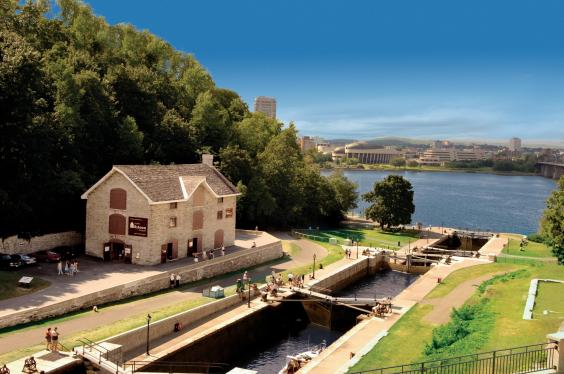
The capital is defined by two waterways. The broad Ottawa River marks the north-western edge of the city, with national institutions on the high bluff above the water. Just below Parliament Hill, the Rideau Canal meets the river at the Ottawa Locks (1). The canal cuts south-east through the city. The commercial hub is clear from the huddle of skyscrapers that populates the area south and west of the canal.
bytown-museum-and-rideau-canal-locks-credit-ottawa-tourism.jpg
Bytown Museum and the Ottawa Locks (Ottawa Tourism)

The Capital Information Kiosk (2) at 90 Wellington Street opens 9am-5pm daily (001 844 878 8333; ottawatourism.ca). It is more grand than the name suggests: it formerly a branch of Molson’s Bank, as the ornate mosaic on the floor testifies.

Congestion in and around the city centre can be intense, due to the construction work expanding the light-rail system, the O-Train. The network should be complete in 2018.

Currently C$1 = £0.57 or US$0.76.

Day one

Take a view

Nepean Point (3), overlooking the Ottawa River,  provides an excellent overview of the city and its verdant surroundings. It also looks back to the early days of European occupation, in the shape of an equestrian statue of Samuel de Champlain, who founded New France in 1608.

Take a hike

An enlightening two-mile hike begins from just below Nepean Point (3). The Trans-Canada Trail, which runs through the capital, leads you along the south bank of the Ottawa River, beneath the main structures of government on Parliament Hill. Leave the trail and aim for the steps that take you up to the Library and Archives (4) at 395 Wellington Street. The ground floor level is open 10am-6pm at weekends (6am-11pm on weekdays). It contains emblems of nationhood – including a statue, donated by Iceland, representing the first Europeans in Canada – as well as a new exhibition, Icons of Knowledge, which opens on Thursday 22 September.

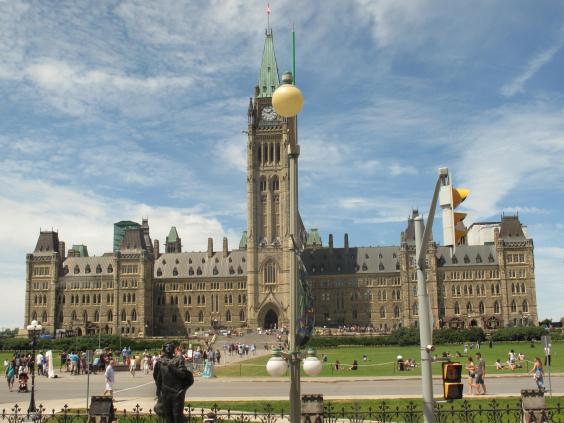
Wellington Street leads you past the Supreme Court (5), the Confederation Building (6) and Parliament (7). To visit the Parliament, call in at the Capital Information Kiosk (2) for a free ticket. With summer over, you may be able to get a space on an imminent guided tour, lasting 40 minutes, of the interior. Or just pick up a ticket for the Peace Tower, Ottawa’s answer to Big Ben (which is also open to visitors on guided tours).
canada-parliament-ottawa.jpg
The Parliament building (Simon Calder)

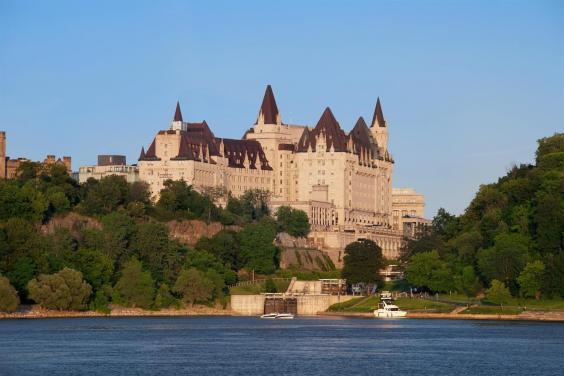
One more impressive monument remains: the French gothic Chateau Laurier (8), a grand hotel built to host passengers arriving on the Canadian Pacific Railway (the station used to be in the city centre, but the trains have since moved several miles out). It is named for Sir Wilfred Laurier, the nation’s first French-Canadian, bilingual Prime Minister, who helped secure permission to build it on a patch of parkland. There's a gallery on the ground floor depicting the hotel’s colourful history.

Read more

  • Travel guide to fly-drive Canada: how to plan a road trip to North America's wildest corners
  • Do I need a visa for Canada now?
  • 48 Hours in Toronto: hotels, restaurants and places to visit in Canada's largest city

Lunch on the run

The hike ends on the edge of ByWard Market, the entertainment and dining district. Lt-Col John By, who laid out the area in 1826, specified that George Street and York Street should be extra wide to allow for market stalls – which sell fresh produce daily except in the depths of winter. 

You could pick up the ingredients for a picnic, or choose one of the many competing lunch options. If you’re happy to splash out, the small plates at Play (9) at 1 York Street (001 613 667 9207; playfood.ca) are always tempting; you can order two for C$22 (£12.57) at lunchtime. 

Take a ride 

Take southbound bus 1 or 7 (fare C$3.65, cash only), and you get an excellent tour of the city thrown in. From the top deck, you get a fresh perspective on Wellington Street – note the banners showing flowers from each of the Canadian provinces. Then the bus turns south, and cuts through the layers of commerce and culture along Bank Street. Once you get beyond Highway 417 (the motorway to Montreal), you reach The Glebe – with the highest concentration of independent (and sometimes weird) stores in Ottawa. 

Window shopping

Start at the junction with First Street. The Great Glebe Emporium (10) at 724 Bank Street has an eclectic selection of arty gifts, while at the junction of Third Street, at No 791, Delilah in the Glebe (11) turns local designs into retro fashion. In the next block on the other side of the road, The Flag Shop (12) at No 838 (ottawa.flagshop.com) offers possibly the widest range of national banners you have ever seen.

The area is interspersed with places to pause, such as Wild Oat Bakery (13), at No 817, where you can sip a mango lassi. Where Bank Street broadens on its way south, a bunch of newer stores bring more recognised brands – but for Ottawa’s best selection of “respectable retail”, the Rideau Centre (14), at 50 Rideau Street, re-opened in the heart of the city last month after some dramatic remodelling. 

An aperitif

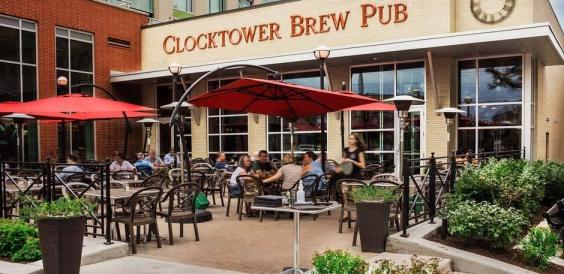
Late September in Ottawa often features warm evenings, and several locations on Bank Street in The Glebe offer outdoor tables on terraces: try the Clocktower Brew Pub (15) close to the freeway (001 613 724 4561​; clocktower.ca), or the FarmTeam Cookhouse (16) at 683 Bank Street (001 613 680 3324; farmteamcookhouse.ca). Both offer local beers such as Beau’s Lug Tread and St Ambroise Apricot Wheat Ale.
12651198-1116350605091236-1516151055613024216-n.jpg
Indulge in an al-fresco beer ( The Clocktower Brew Pub/Facebook)

For a view of the water rather than the traffic, return to the city centre and visit the Mill Street Brew Pub (17) at 555 Wellington Street (001 613 567 2337; millstreetbrewery.com) overlooking one of the veins of the Gatineau River just across from Portage Bridge.

Dine with the locals

Still in The Glebe? Try the “gourmet burger bistro” known as The Works (18) at 580 Bank Street (001 613 247 0406; worksburger.com), which spawned sister restaurants in other Canadian cities.

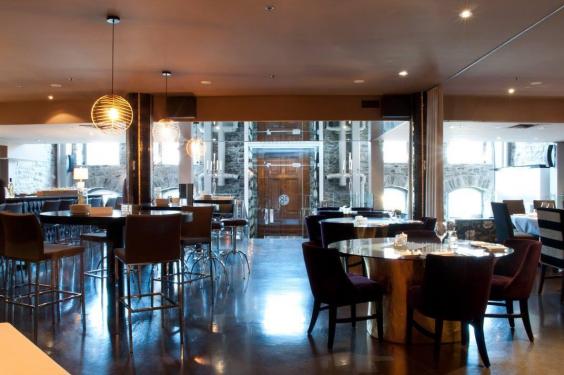
For something significantly more sophisticated, return to ByWard Market. E18hteen (19) at 18 York Street (001 613 244 1188; restaurant18.com) has a five-course Tasting Menu for C$95 (£54.30), offering the best of its meat and seafood options.
12916769-10153923707465465-5137532544007724469-o.jpg
E18hteen serves sophisticated meat and seafood dishes ( E18hteen/Facebook)

Day two

Sunday morning: out to brunch

If jet-lag has woken you early, Zak’s Diner (20) at 14 Byward Market Square (001 613 241 2401; zaksdiner.com) is the answer; it’s open 24 hours a day, serving a massive Lumberjack’s Breakfast (egg, bacon, cheese, homefries, toast…) for $15.49 (£9).

A walk by the canal

The Rideau Canal is an extraordinary waterway created as a British military supply route, following an ancient Indian canoe route to connect the Navy Yards at Kingston on Lake Ontario with the Ottawa River. It rises from the river in a magnificent flight of eight locks. The stone cottage halfway up houses the Bytown Museum (21), which tells the story of settlement from the early 19th century; the ground floor (with free access) offers an overview of the history of the waterway (001 613 234 2570; bytownmuseum.ca; 9am-4pm daily except Monday).

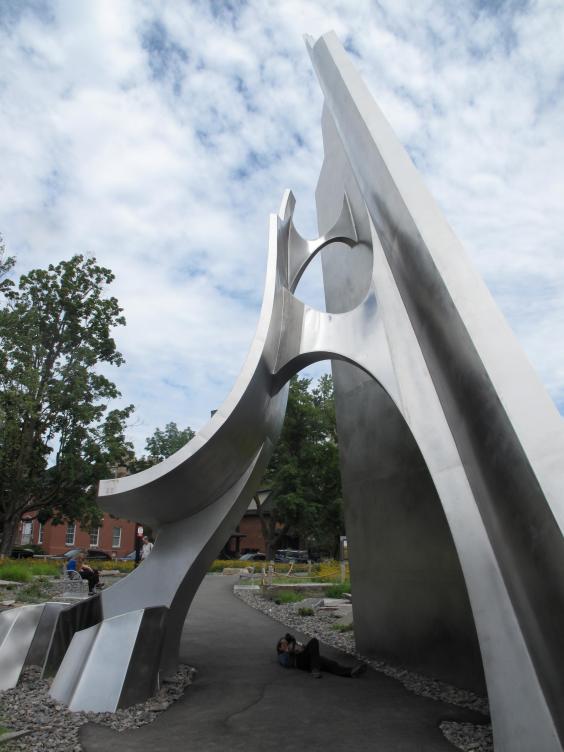
Heading south, the canal's tree-lined banks provide a verdant antidote to the city streets. Just before it reaches the freeway, bear right along Argyle Avenue to the Canadian Museum of Nature (22) – which has a brand new shard of steel this autumn, in the shape of Bill Lishman’s study of an iceberg. It soars skyward from terrain intended to represent the Arctic tundra in the north of Canada.

The museum, formerly the Victoria Memorial Museum, served as Canada’s parliament following a ferocious fire a century ago; 9am-5pm daily except Monday, with late opening to 8pm on Thursdays; admission C$13.50 (£11.15) (nature.ca).
icebergsculpture3.jpg
Bill Lishman’s iceberg sculpture (Simon Calder)

Cultural afternoon

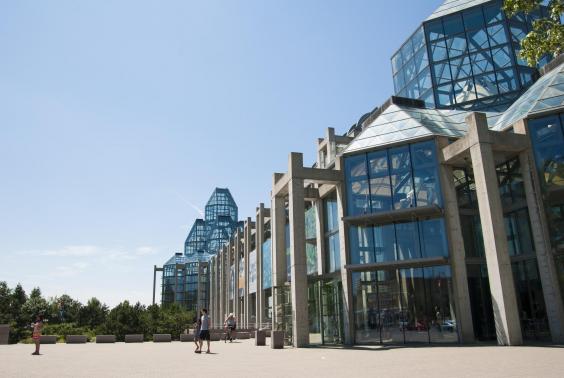
Ottawa is extremely rich in culture. The shiny National Gallery of Canada (23) at 380 Sussex Drive (001 613 990 1985; www.national.gallery.ca) is prefaced by a giant spider, Maman. Once inside you can discover some remarkable Inuit art on the ground floor, which has the nation’s best collection of carvings from the Arctic world. You can also inspect a reasonable collection of European Old Masters, but the architecture is equally impressive – especially the Keorner Family Atrium. The Gallery also contains the Rideau Chapel, which was rescued from destruction and is now buried in the heart of the building. It opens 10am-5pm daily except Monday (to 8pm on Thursdays), admission C$12 (£6.85). 
national-gallery-of-canada-ngc-exterior-people-summer-credit-ottawa-tourism.jpg
National Gallery of Canada (Ottawa Tourism)

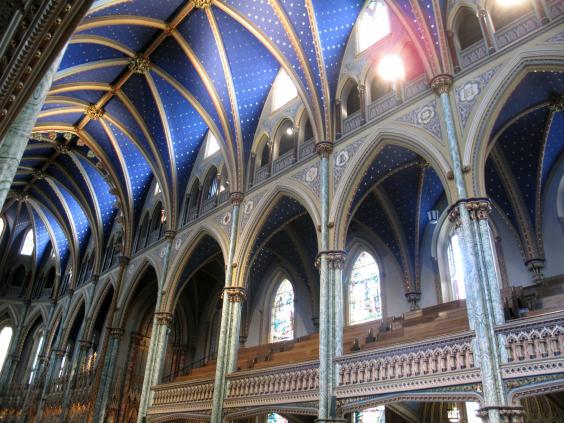
Almost next door to the Gallery stands the Notre Dame Cathedral Basilica (24) at 375 Sussex Drive. Inside, the cathedral is spacious and ornate, its blue ceiling covered with gold stars. It opens 8am-8.15pm on Sunday, 11.30am-6pm on Monday, 7.30am-6pm Tuesday-Saturday.
ottawa-cathedral1.jpg
Notre Dame Cathedral Basilica (Simon Calder)

The crowning cultural attraction is across the river in Gatineau: the Canadian Museum of History (25), whose entrance is close to the north end of Alexandra Bridge (001 819 776 7000; historymuseum.ca; 9.30am-5pm daily; Thursdays to 8pm; $15/£9). The country’s story, from First Nations people through early European exploration to the modern Canada, is told with some spectacular exhibits, such as the totem poles on the ground floor. 

Icing on the cake

“Indulgent moments since 1978” is the boast of the BeaverTails kiosk (26) at 69 George Street, in ByWard Market (beavertails.com), where deep-fried spears of dough are available with a variety of toppings including cinnamon, sugar and lemon (C$4.75/£2.70), chocolate and hazelnut (C$5.75/£3.30) and cheesecake (C$6.25/£3/60).

Travel essentials

Getting there

Air Canada (0871 220 1111; aircanada.com) flies from Heathrow to Ottawa with a stop in Halifax, while WestJet (00800 5381 5696; westjet.com) flies from Gatwick to Ottawa with a stop in St John’s. 

The airport (27) is nine miles south of the city centre. Bus 97 departs from outside the level 1 arrivals area (pillar 14) for central Ottawa. The journey of 30-40 minutes costs C$3.65. A taxi costs around C$40 (£22.86) and takes 20 minutes.

Montreal’s Trudeau airport has many more flights from the UK, including services on Air Transat and British Airways as well as Air Canada and WestJet. Frequent buses run direct from Montreal airport in around two hours to Ottawa’s modest bus station (28).

Staying there

Now part of the Fairmont brand, the Chateau Laurier (8) at 1 Rideau Street (001 613 241 1414; fairmont.com) is the grande dame of Ottawa hotels. The typical rate for a double room is C$429 (£245), though cheaper deals are available at weekends. Join the President’s Club loyalty programme (no fee) to qualify for free wi-fi and use of the bikes that are kept by the concierge.
clh-v-100-478164-med.jpg
Fairmont Chateau Laurier

The Swiss Hotel (29) at 89 Daly Avenue (001 613 237 0335; swisshotel.ca) is a small, family-run property just away from the hub of the city. It might not be quite the boutique hotel it claims, but the two-night-minimum stay rate of C$173 (£99), without breakfast, is good value. The adjacent Barefoot Hostel (30), which has the same owners, has just become an all-female hostel, with beds from C$34 (£19.50).

The Ottawa Jail Hostel (31) at 75 Nicholas Street (001 613 235 2595; hihostels.ca/ottawa) was established in 1862 as the Carleton County Gaol prison, and offers the chance to stay in an unreconstructed small cell. “A truly once-in-a-lifetime experience not available anywhere else in the world without actually breaking the law” is promised The rate is C$45 (£25.75), including breakfast; standard dorm beds and private rooms are also available.

48 hours in Buenos Aires: hotels, restaurants and places to visit

Why go now

Until 25 September Buenos Aires food week is shining a light on the city’s passionate food culture, with gauchos (cowboys) barbecuing armadillos in streets overlooked by kitchens where chefs pore over molecular gastronomy. Whether or not you’re in time to catch the markets and special tasting menus (a full list of participating restaurants is available at bafoodweek.com), Argentina’s capital has started to warm up as spring takes hold, and has plenty to offer those keen to escape the rainy English autumn with a night or two of tango dancing or, in November, the renowned Open Polo Tournament (aapolo.com).

Read more

  • Argentina: From Buenos Aires to the wilds of the pampas
  • Wine-themed holidays: From Spain to South America
  • Villa Epecuén, Argentina's ghost town

Get your bearings

Buenos Aires sits on the south-west bank of the River Plate, close to the estuary. The districts of Monserrat and San Nicolas sit at its heart, the gentrified docklands of Puerto Madero to the east, historic San Telmo, and the traditionally working-class La Boca, south of the centre. North of San Nicolas are the green, affluent barrios of Retiro, Recoleta and Palermo.

From the airport take a Tienda Leon shuttle bus to central Puerto Madero, near the Sheraton Hotel (1) at 1299 Av Eduardo Madero (every 30 minutes; tiendaleon.com; single AR$190). Taxis charge AR$630 (£32). Both take 40 minutes to an hour, depending on traffic.

San Nicolas has a tourist office (2) at Calle Florida 100 (00 54 11 4313 0187; bue.gov.ar) – while Puerto Madero (3) has another at Avenida Alicia Moreau de Justo 200 (00 54 11 4315 4265). Both are open daily 9am-6pm.

Day one

Take a hike

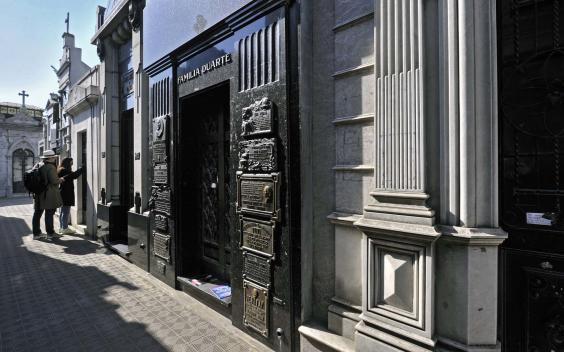
Encounter the city’s European history with a walk through Recoleta, where neo-classical mansions jostle with bustling street markets. From Las Heras metro station (4) turn right on to Av Gral Las Heras, then left onto Junin to stop at the haunting Recoleta cemetery (5), open daily from 7am-5.40pm. Eva Peron, the Argentine first lady whose story is told in Evita, is buried among its gothic mausoleums.

gettyimages-160413185.jpg
Recoleta cemetery (Juan Mabromata/AFP/Getty Images)

Then pass the gilded church of Nuestra Senora Del Pilar (6) and continue through the park to Av del Libertador and the Museum of Fine Art (7) at No 1473 (00 54 11 5288 9900; bellasartes.gob.ar; free entry; open 11am-8.30pm on weekdays and from 10am on weekends; closed Mondays). Seek out the classic Argentinian art hidden among its Van Goghs and the Rothkos, then compare and contrast down the road at the Museum of Latin American Art (Malba) (8) at 3415 Av Pres Figueroa Alcorta, where Yoko Ono’s exhibition Dream Come True runs until 31 October (00 54 11 4808 6500; malba.org.ar; entry AR$100; open 12pm-8pm Thursday through Monday and Wednesday till 9pm. Closed Tuesdays).

Lunch on the run

Bosques de Palermo lies on the edge of Palermo, a barrio so trendy it has subdivided itself into smaller neighbourhoods known locally as Palermo Soho and Palermo Hollywood. Nana’s (9) at 499 Pres Hipólito Yrigoyen (00 54 11 4837 9220; nana.com.ar), all exposed wood, brickwork and bare lightbulbs, serves up zingy, colourful salads – but also does a fine line in the Argentine staple, steak.

Window shopping

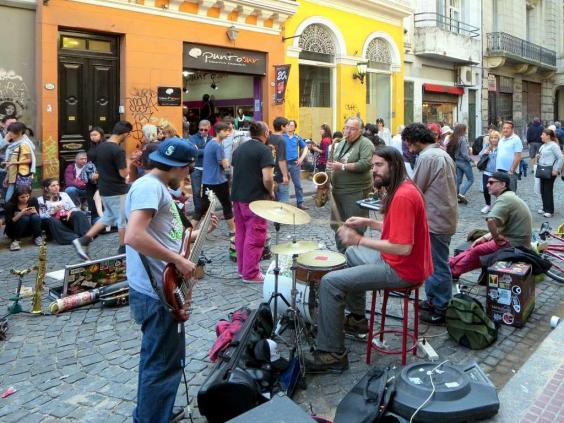
Pick through beaten up leatherwork and worn books in the antiques markets of cobbled San Telmo, one of Buenos Aires’ oldest neighbourhoods. On Sunday, Calle Defensa (10) turns into an enormous, bustling street market.

16307931231-dfce28ecaf-o.jpg
Calle Defensa on a Sunday ( David Stanley/Flickr)

An aperitif

Is it a florist? Is it a record shop? No, it’s a speakeasy: hiding behind the door at the back of Floreria Atlantico (11) at 872 Arroyo (00 54 11 4313 6093; floreriaatlantico.com.ar) lies one of Buenos Aires’ best bars, serving up classic cocktails with an Argentine twist – like a dash of the herb yerba mate, for example.

Dine with the locals

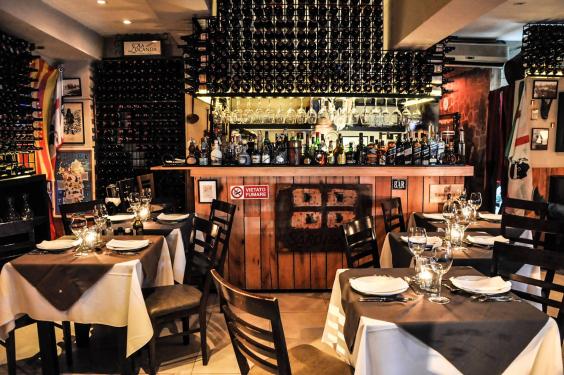
Argentinian food draws heavily on the influence of its Italian immigrant community, with pizza restaurants on every street corner. One of the best is La Locanda (12) at 2697 José León Pagano (00 54 11 4806 6343; lalocandabuenosaires.com; closed Mondays); stepping into the cosy restaurant is like stepping into a Sicilian taverna. Try the local cheeses, the octopus or the juicy lasagna.

an106496548la-locanda-12697.jpg
La Locanda

For a real local’s night out, elbow your way to a table at Cerveceria Nacional (13) at 1588 Arévalo (00 54 11 4771 3383; facebook.com/cervecerianacionalbar), a busy craft beer bar that serves excellent, fresh empanadas – a sort of Latin American twist on the Cornish pasty. Hours spent over drinks and small plates is the standard in Buenos Aires – with the added benefit that you won’t feel too full for tango dancing later.

Day two

Sunday morning: out to brunch

Puerto Madero waterfront has undergone a glistening refurbishment, and has become a hub for the new rich. Luckily, you don’t need to flash too much cash to enjoy brunch at Le Grill (14), a smart riverside spot at 876 Alicia Moreau de Justo (00 54 11 4331 0454; legrill.com.ar) that specialises – like most of Argentina – in grilled meat. Try the steak tasting plate for AR$550/£27.

A walk in the park

Walk off your steak in the nearby nature reserve, Reserva Ecológica Costanera Sur (15), which stretches across the old marshlands on the other side of the Rio Darsena Sur. Unbelievably peaceful, considering its central location, the park sits against an imposing backdrop of the city’s skyscrapers, but looks out across the Rio De La Plata to Uruguay on its eastern side.

Take a ride

Head out to Buenos Aires’s outlying districts – like Flores, where Pope Francis was born and grew up – aboard the clean, efficient and mostly air-conditioned underground system, Subte. Two of its six lines run north to south; the others run east to west. You can buy and charge SUBE cards from the ticket office; a ride costs a flat AR$7.50, no matter how many connections you make.

The bus system, with some 180 lines, is not for the faint hearted, but it is cheap – around AR$6 a ride – and does run throughout the night; you can only pay with a SUBE card. The tourist board’s interactive map (comollego.ba.gob.ar), is the easiest way to plan your route.

Cultural afternoon

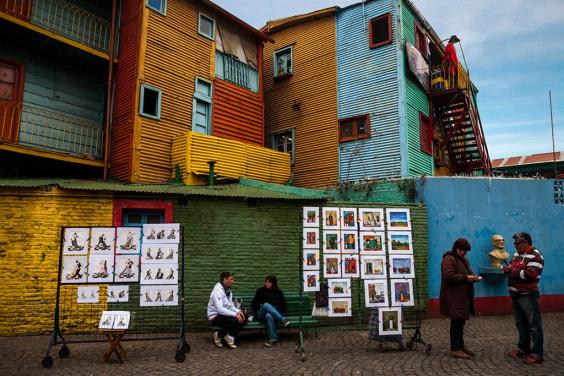
For a peek into Buenos Aires’ maritime past head south-east to the amazing, technicoloured streets of portside La Boca. The neighbourhood’s painted houses once hosted entire families in a single room; now, the floors of its restored homes belong to artists and sculptors who run open studios and galleries.

25079233230-c5c45a4ded-o.jpg
The colourful houses of La Boca ( sandeepachetan.com/Flickr)

The Buenos Aires tourist board offers free guided walks around the barrio, which take in more than just the main tourist drag, the Caminito (16) (turismo.buenosaires.gob.ar/en/guidedtours). 

The icing on the cake

Buenos Aires is the tango capital of the world; for an authentic experience, head to a milonga (a tango club) rather than a tourist show. A good place to start is Oliverio Girondo (17) at Vera 574 (facebook.com/OliverioGirondoEspacioCultural), which mixes a relaxed vibe with an exciting, messy vibrancy.

For all milongas, it’s worth booking ahead if you want a table, and bear in mind that the clubs only really get busy around 1-2am. Entry costs AR$100-150. Casual milongas like Girondo don’t mind learners having a go – but if you end up somewhere more conservative, it’s best just to watch and learn.

Travel essentials

Getting there

British Airways (ba.com) offers the only direct to flights from the UK to Buenos Aires’ Ministro Pistarini International Airport (18), operating once a day from Heathrow. Indirect options include Iberia (iberia.com) via Madrid and LATAM (latam.com) via Sao Paulo.

Staying there

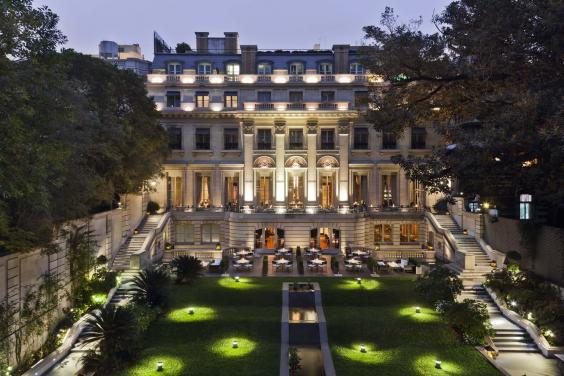
One of the grandest hotels in town, the Palacio Duhau (19) at (00 54 11 5171 1234; buenosaires.park.hyatt.com) offers plush rooms in both its refurbished mansion and the annexe building developed when it came under the Park Hyatt brand. Doubles from £413, not including breakfast.

an106496206palacio-duhau-.jpg
Palacio Duhau

The Panamerican Hotel (20) at 551 Carlos Pellegrini (00 54 11 4348 5000; panamericano.us) is minutes away from the Teatro Colon (21) and has a spectacular view of Buenos Aires’ main thoroughfare, the bustling 9 de Julio, from the 23rd floor. Rooms start at about £130 a night including breakfast.

For budget stays, head to San Telmo. Posada de la Luna (22) at Peru 565 (00 54 11 4343 0911; posadaluna.com) has rooms from AR$400 (£20) including breakfast.

48 hours in Buenos Aires: hotels, restaurants and places to visit

Why go now

Until 25 September Buenos Aires food week is shining a light on the city’s passionate food culture, with gauchos (cowboys) barbecuing armadillos in streets overlooked by kitchens where chefs pore over molecular gastronomy. Whether or not you’re in time to catch the markets and special tasting menus (a full list of participating restaurants is available at bafoodweek.com), Argentina’s capital has started to warm up as spring takes hold, and has plenty to offer those keen to escape the rainy English autumn with a night or two of tango dancing or, in November, the renowned Open Polo Tournament (aapolo.com).

Read more

  • Argentina: From Buenos Aires to the wilds of the pampas
  • Wine-themed holidays: From Spain to South America
  • Villa Epecuén, Argentina's ghost town

Get your bearings

Buenos Aires sits on the south-west bank of the River Plate, close to the estuary. The districts of Monserrat and San Nicolas sit at its heart, the gentrified docklands of Puerto Madero to the east, historic San Telmo, and the traditionally working-class La Boca, south of the centre. North of San Nicolas are the green, affluent barrios of Retiro, Recoleta and Palermo.

From the airport take a Tienda Leon shuttle bus to central Puerto Madero, near the Sheraton Hotel (1) at 1299 Av Eduardo Madero (every 30 minutes; tiendaleon.com; single AR$190). Taxis charge AR$630 (£32). Both take 40 minutes to an hour, depending on traffic.

San Nicolas has a tourist office (2) at Calle Florida 100 (00 54 11 4313 0187; bue.gov.ar) – while Puerto Madero (3) has another at Avenida Alicia Moreau de Justo 200 (00 54 11 4315 4265). Both are open daily 9am-6pm.

Day one

Take a hike

Encounter the city’s European history with a walk through Recoleta, where neo-classical mansions jostle with bustling street markets. From Las Heras metro station (4) turn right on to Av Gral Las Heras, then left onto Junin to stop at the haunting Recoleta cemetery (5), open daily from 7am-5.40pm. Eva Peron, the Argentine first lady whose story is told in Evita, is buried among its gothic mausoleums.

gettyimages-160413185.jpg
Recoleta cemetery (Juan Mabromata/AFP/Getty Images)

Then pass the gilded church of Nuestra Senora Del Pilar (6) and continue through the park to Av del Libertador and the Museum of Fine Art (7) at No 1473 (00 54 11 5288 9900; bellasartes.gob.ar; free entry; open 11am-8.30pm on weekdays and from 10am on weekends; closed Mondays). Seek out the classic Argentinian art hidden among its Van Goghs and the Rothkos, then compare and contrast down the road at the Museum of Latin American Art (Malba) (8) at 3415 Av Pres Figueroa Alcorta, where Yoko Ono’s exhibition Dream Come True runs until 31 October (00 54 11 4808 6500; malba.org.ar; entry AR$100; open 12pm-8pm Thursday through Monday and Wednesday till 9pm. Closed Tuesdays).

Lunch on the run

Bosques de Palermo lies on the edge of Palermo, a barrio so trendy it has subdivided itself into smaller neighbourhoods known locally as Palermo Soho and Palermo Hollywood. Nana’s (9) at 499 Pres Hipólito Yrigoyen (00 54 11 4837 9220; nana.com.ar), all exposed wood, brickwork and bare lightbulbs, serves up zingy, colourful salads – but also does a fine line in the Argentine staple, steak.

Window shopping

Pick through beaten up leatherwork and worn books in the antiques markets of cobbled San Telmo, one of Buenos Aires’ oldest neighbourhoods. On Sunday, Calle Defensa (10) turns into an enormous, bustling street market.

16307931231-dfce28ecaf-o.jpg
Calle Defensa on a Sunday ( David Stanley/Flickr)

An aperitif

Is it a florist? Is it a record shop? No, it’s a speakeasy: hiding behind the door at the back of Floreria Atlantico (11) at 872 Arroyo (00 54 11 4313 6093; floreriaatlantico.com.ar) lies one of Buenos Aires’ best bars, serving up classic cocktails with an Argentine twist – like a dash of the herb yerba mate, for example.

Dine with the locals

Argentinian food draws heavily on the influence of its Italian immigrant community, with pizza restaurants on every street corner. One of the best is La Locanda (12) at 2697 José León Pagano (00 54 11 4806 6343; lalocandabuenosaires.com; closed Mondays); stepping into the cosy restaurant is like stepping into a Sicilian taverna. Try the local cheeses, the octopus or the juicy lasagna.

an106496548la-locanda-12697.jpg
La Locanda

For a real local’s night out, elbow your way to a table at Cerveceria Nacional (13) at 1588 Arévalo (00 54 11 4771 3383; facebook.com/cervecerianacionalbar), a busy craft beer bar that serves excellent, fresh empanadas – a sort of Latin American twist on the Cornish pasty. Hours spent over drinks and small plates is the standard in Buenos Aires – with the added benefit that you won’t feel too full for tango dancing later.

Day two

Sunday morning: out to brunch

Puerto Madero waterfront has undergone a glistening refurbishment, and has become a hub for the new rich. Luckily, you don’t need to flash too much cash to enjoy brunch at Le Grill (14), a smart riverside spot at 876 Alicia Moreau de Justo (00 54 11 4331 0454; legrill.com.ar) that specialises – like most of Argentina – in grilled meat. Try the steak tasting plate for AR$550/£27.

A walk in the park

Walk off your steak in the nearby nature reserve, Reserva Ecológica Costanera Sur (15), which stretches across the old marshlands on the other side of the Rio Darsena Sur. Unbelievably peaceful, considering its central location, the park sits against an imposing backdrop of the city’s skyscrapers, but looks out across the Rio De La Plata to Uruguay on its eastern side.

Take a ride

Head out to Buenos Aires’s outlying districts – like Flores, where Pope Francis was born and grew up – aboard the clean, efficient and mostly air-conditioned underground system, Subte. Two of its six lines run north to south; the others run east to west. You can buy and charge SUBE cards from the ticket office; a ride costs a flat AR$7.50, no matter how many connections you make.

The bus system, with some 180 lines, is not for the faint hearted, but it is cheap – around AR$6 a ride – and does run throughout the night; you can only pay with a SUBE card. The tourist board’s interactive map (comollego.ba.gob.ar), is the easiest way to plan your route.

Cultural afternoon

For a peek into Buenos Aires’ maritime past head south-east to the amazing, technicoloured streets of portside La Boca. The neighbourhood’s painted houses once hosted entire families in a single room; now, the floors of its restored homes belong to artists and sculptors who run open studios and galleries.

25079233230-c5c45a4ded-o.jpg
The colourful houses of La Boca ( sandeepachetan.com/Flickr)

The Buenos Aires tourist board offers free guided walks around the barrio, which take in more than just the main tourist drag, the Caminito (16) (turismo.buenosaires.gob.ar/en/guidedtours). 

The icing on the cake

Buenos Aires is the tango capital of the world; for an authentic experience, head to a milonga (a tango club) rather than a tourist show. A good place to start is Oliverio Girondo (17) at Vera 574 (facebook.com/OliverioGirondoEspacioCultural), which mixes a relaxed vibe with an exciting, messy vibrancy.

For all milongas, it’s worth booking ahead if you want a table, and bear in mind that the clubs only really get busy around 1-2am. Entry costs AR$100-150. Casual milongas like Girondo don’t mind learners having a go – but if you end up somewhere more conservative, it’s best just to watch and learn.

Travel essentials

Getting there

British Airways (ba.com) offers the only direct to flights from the UK to Buenos Aires’ Ministro Pistarini International Airport (18), operating once a day from Heathrow. Indirect options include Iberia (iberia.com) via Madrid and LATAM (latam.com) via Sao Paulo.

Staying there

One of the grandest hotels in town, the Palacio Duhau (19) at (00 54 11 5171 1234; buenosaires.park.hyatt.com) offers plush rooms in both its refurbished mansion and the annexe building developed when it came under the Park Hyatt brand. Doubles from £413, not including breakfast.

an106496206palacio-duhau-.jpg
Palacio Duhau

The Panamerican Hotel (20) at 551 Carlos Pellegrini (00 54 11 4348 5000; panamericano.us) is minutes away from the Teatro Colon (21) and has a spectacular view of Buenos Aires’ main thoroughfare, the bustling 9 de Julio, from the 23rd floor. Rooms start at about £130 a night including breakfast.

For budget stays, head to San Telmo. Posada de la Luna (22) at Peru 565 (00 54 11 4343 0911; posadaluna.com) has rooms from AR$400 (£20) including breakfast.

Saturday, 11 March 2017

48 hours in Bratislava: Hotels, restaurants and places to visit

Why go now?

Slovakia currently holds the rotating Presidency of the EU, pushing its capital, the “little big city” of Bratislava, into the spotlight this month as host of the Special EU Summit. But there’s far more to explore here than politics. For one night on 8 October, the White Night Festival (bielanoc.sk) shows contemporary art in unusual settings, from banks to palace gardens, all over town. Visitors get a special map guiding them around installations, concerts, films, dance and live performances.

The grape harvest also gets going in September and cellars along the 40km Small Carpathian Wine Route open their doors for free tastings, singing and dancing until mid-October. Start in the village of Raca (1), in Bratislava’s outskirts and meander by bus, train or bicycle to Pezinok (2) (pezinok.sk) and Modra (3) (modra.sk), where you can also pick up folk ceramics and fine chinaware, made here since the 16th century. 

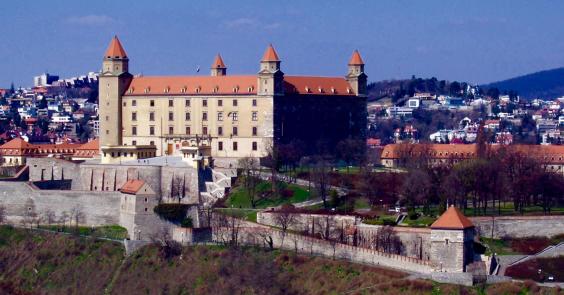
brat-castle-from-ufo.jpg
Bratislava Castle, as seen from the UFO observation deck (Lucy Mallows)

Get your bearings 

Bratislava lies astride the Danube, bordering the Austrian and Hungarian frontiers. The main draw is the Old Town, a largely pedestrianised area. The tourist office (31) is at Klobucnicka 2  (00 421 2 16 186; visitbratislava.com). Opening hours vary depending on whether it is on-season or off-season and on the day of the week, but arrive any time between 10am and 3pm and you should catch them. 

The airport is approximately 9km north-east of the city centre. From the airport, bus number 61 goes to the train station every 20 minutes (a one-way ticket costs €0.90). From here, tram 1 or bus 93 take you to the Old Town within 10 minutes. Taxis cost €25-30 one-way, and the journey should take around 15 minutes.

Day one

Take a view

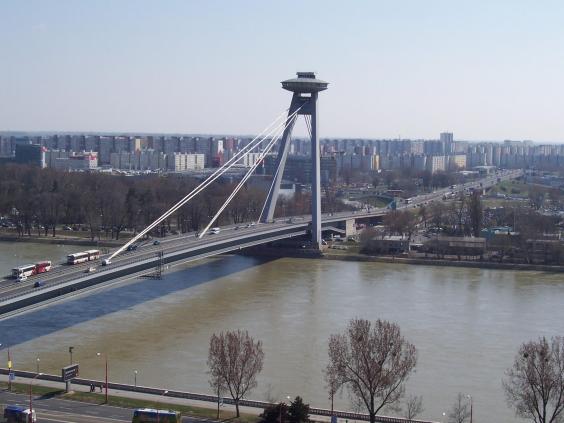
Get an overview of the city by whizzing up in the lift to the open-air observation deck at UFO (4), entry €6.50, the flying saucer-shaped cupola sticking up 87 metres above Most SNP bridge. The UFO offers spectacular views along the Danube and across the Old Town rooftops to the surrounding hills. From here you can also admire Petržalka’s crowded Seventies housing estate, which stretches almost to Austria. To check out the ‘loo with a view’, treat yourself to a coffee or a cocktail in the bar of the stratospherically-priced UFO restaurant (00 421 2 6252 0300; u-f-o.sk).

brat-ufocafe-novy-most.jpg
The UFO sticks out from Most SNP bridge (Lucy Mallows)

Take a hike

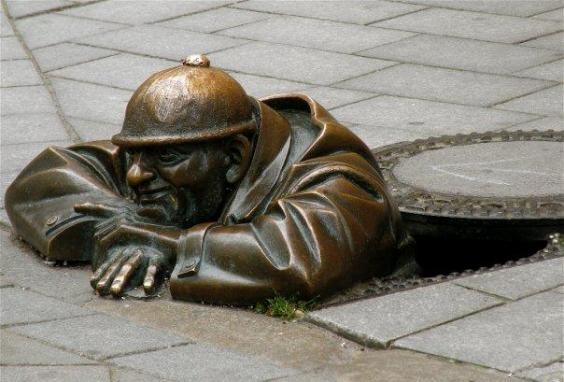
Start in the Old Town’s main square, Hlavné námestie (5), where in December you’ll find traditional Christmas markets. Admire Napoleon’s cannonball, still embedded in the wall of the Old Town Hall’s tower, then walk through the Old Town Hall’s elegant courtyard to emerge into another historic square, this time adorned by the pink, 18th-century Primate’s Palace (6). Turn right and walk along Laurinská street (7), where you can admire the humorous statues of Schöne Náci (tipping his top hat) and Čumil (peering out from his manhole cover). This leads to St Martin’s Cathedral (8), a dinky three-nave Gothic church and the site of the coronation of 19 Hungarian kings and queens. Daily services and concerts are held 9am-11.30am and 1pm-4pm every Monday to Saturday, and at 1.30pm-4.30pm on Sunday (00 421 2/3054 4334; dom.fara.sk; free entry). 

brat.cumil-.statue.jpg
The Čumil statue on Laurinská street (Lucy Mallows)

Lunch on the run

A short walk over Most SNP bridge, in Sad Janka Král’a park (9) (one of the oldest municipal parks in Europe), Leberfinger (10) (00 421 917 115 116; leberfinger.sk) is a lovely lunch spot in a historic 18th-century building overlooking the Danube – go for the classic autumnal dish of goose leg with red cabbage, €17.90. Back in the Old Town, the popular Orbis (11), at Laurinská 7 (facebook.com/orbisfood), is open from 11am and offers street food from around the world; Moroccan wraps, masala omelettes and twice-cooked Belgian frites.

Window shopping

Bratislava’s Old Town is filled with indie fashion boutiques and folk craft emporia. Kompot (12) at Laurinská 19 (00 421 948 630 852; kompot.sk) offers hip T-shirts, totes and homeware. Open 10.30am-7pm Monday to Friday, 2pm-7pm Saturday, closed Sundays.

slavica (13) is a local favourite at Laurinska 19 (14) (00 421 917 968 736; slavicadesign.sk), selling clothes, jewellery and ceramics by young local designers. Open 11am-8pm Monday to Friday, and 11am-5pm Saturday and Sunday. 

An aperitif

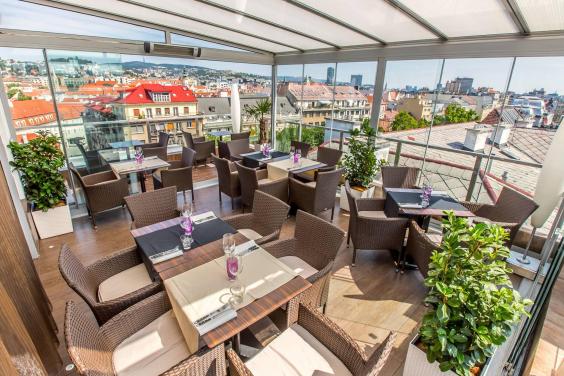
The seventh floor Sky Bar (15) (00 421 948 109 400; skybar.sk) offers a dramatic view across the red rooftops to Bratislava Castle, St Martin’s Cathedral and the hills beyond. Sip a crisp local white wine or try a cocktail made with typically Slovak Borovička juniper brandy.

13482885-1103806626325077-5917997867622629308-o.jpg
The view from the Sky Bar, up on the seventh floor (Sky Bar/Facebook)

Dine with the locals

Up in Bratislava Castle’s grounds, at Námestie A. Dubčeka 1, Restauracia Hrad (16) (00 421 2 5972 4256; facebook.com/restauraciahrad) offers a lighter take on classic Middle Europe dishes (such as local catch zander with potato soufflé, €15.90), quality local wines and a spectacular view from the terrace. Or roll further down the cobbled hill to atmospheric, low-lit Modrá Hviezda (17) (00 421 2 5443 2747; modrahviezda.sk), in an 18th-century, late-Baroque building, for traditional specialities such as roast Mangalica pig with chestnuts and pumpkin purée, €18.90. 

Day two

Sunday morning: out to brunch 

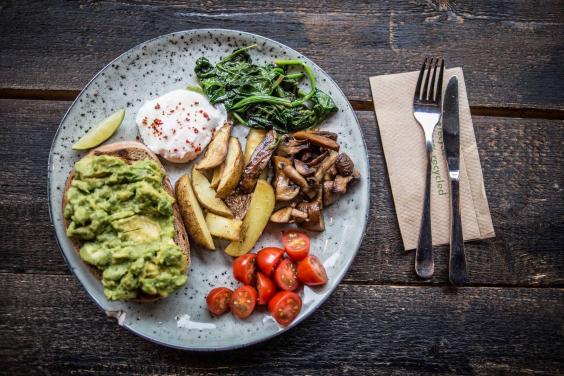
In the early 1900s, the Habsburg-style Kaffe Mayer (18) (00 421 2 5441 1741; kaffeemayer.sk), at Hlavné námestie 4, tempted Viennese ladies to __travel 60km by tram for top-notch kaffee und kuchen – the latter here meaning a choice of 37 different cakes. Or for a contemporary brunch, chill out in a hammock and order the halloumi and portobello mushroom burger (€6.90) at the self-consciously oh-so-cool Urban House (19) (00 421 904 001021; urbanhouse.sk) at Laurinská 14. 

13988135-1912192262341131-5231081924182070267-o.jpg
A typical brunch at typically hip Urban House (Urban House/Facebook)

A walk in the park

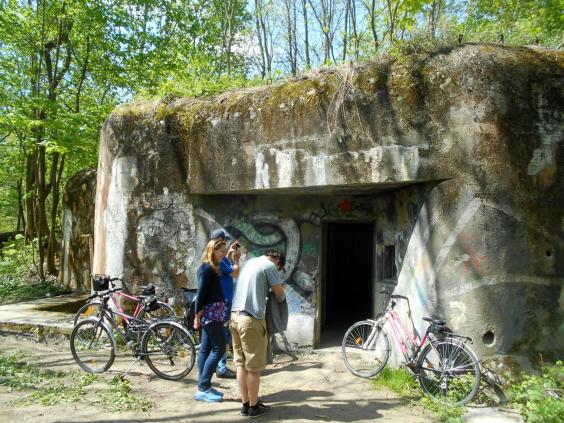
Bratislava is incredibly green. For a truly local view of its prettiest parts – along with a bit of brutal history – forget walking and join brothers Branislav and Peter Chrenka of Authentic Slovakia (00 421 908 308 234; authenticslovakia.com), who take visitors on fascinating bike rides along the Danube to see the Iron Curtain border bunkers and explore hidden gems in verdant Sad Janka Král’a (9). A two-and-a-half-hour tour costs from €22 per person.

Read more

How to spend the perfect weekend in Ljubljana

Take a ride

Bratislava has excellent linked-up public transport operating 5am-11pm daily, with nine tram routes, 14 trolleybus lines, 66 bus routes and many night buses. 

Buy tickets from machines at bus/tram stops and stamp as soon as you board. A 24-hour ticket offering unlimited __travel via tram, bus and trolleybus in all zones of Bratislava costs €6.90 or €3.45 for concessions. 

The Slovak capital is also criss-crossed with cycle paths. Two companies (bikebratislava.sk and bratislavabikepoint.com) rent out bikes; two hours starts from €8. Both banks of the Danube offer lovely, leafy cycle routes. 

For more fresh air, take a 15-minute ride on trolleybus 203 from Hodžovo námestie (20) up to Koliba-Kamzik (21) and explore the cool, well signposted walking trails of the Bratislava Mountain Park (22). A favourite local route is to walk down via a flower-filled meadow to the Železná Studnička (23) (Iron Well), where people like to have picnics and little stalls offer beer and sausages. 

authenticslovakia.ironcurtain.bunker.jpg
Uncovering Bratislava's bunkers on a bike ride with Authentic Slovakia (Lucy Mallows)

Cultural afternoon

The Rococo-style Mirbach Palace (24) (00 421 2 5443 1556; gmb.sk; entry €4) at Františkanske námestie 11 offers two beautifully wood-panelled rooms displaying prints created between 1704-80 that recall scenes of aristocratic life. The Pálffy Palace (25) (00 421 2 5443 3627; gmb.sk; entry €4), also in the Old Town at Panská 19, has a permanent exhibition by Bratislava-born artist Matej Krén, where his captivating “Pasáž” (Passage) installation sees the visitor walk between vertiginous walls of books. Both galleries open 11am-6pm, Tuesday to Sunday.

brat.bluechurch02.jpg
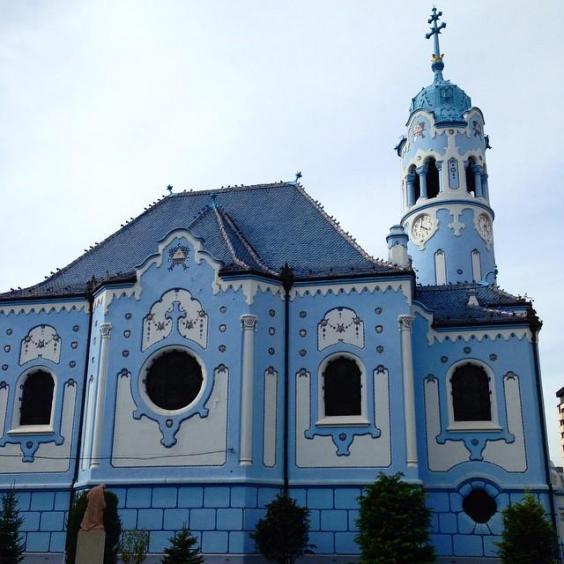
The fairytale exterior of the Blue Church of St Elizabeth (Lucy Mallows)

Bratislava boasts two opera houses under the name of the Slovak National Theatre: the Historic SND (26) (00 421 2 2047 2111; snd.sk) on Hviezdoslavovo námestie, and the New SND (27) (00 421 2 2047 2299; snd.sk) at Pribinova 17, opposite the Eurovea mall. Both have Sunday performances at 5pm of operas such as Cosi fan Tutte, Fidelio and Simon Boccanegra, with tickets costing from €6 in the cheap seats, up to €65 for a prime perch.

The icing on the cake

The outrageously charming Blue Church of St Elizabeth (28) at Bezručová 2, with its Art Nouveau flourishes and light blue icing sugar details, is like something from a fairytale. Opening hours are awkward (6.30am-8am or 5.30pm-7.30pm Monday to Saturday, 7.30am-noon or 5.30pm-7.30pm Sunday, or during a regular mass; free entry) but it’s worth a walk if only just to see the exterior. 

Afterwards, stick with the arty vibe and enjoy imaginative, seasonal dishes in Cubist-themed U Kubistu (29) around the corner at Grösslingová 26 (00 421 948 077 845; ukubistu.sk). 

Travel essentials

Getting there

Ryanair (0871 246 0000; ryanair.com) flies to M R Stefanik Airport (30), 9km north-east of the centre, from Luton, Stansted, Edinburgh and Birmingham.

37127-114323471960530-6294092-n.jpg
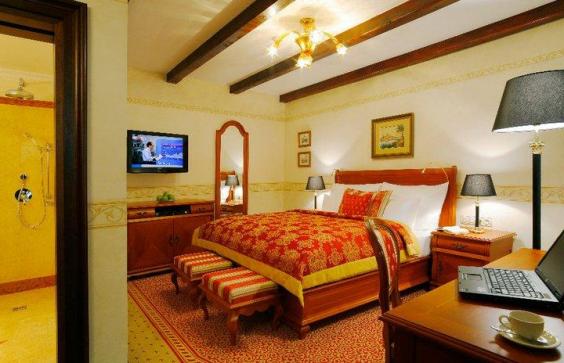
A room at the five-star Arcadia hotel (Arcadia/Facebook)

Staying there

With 21 rooms and nine comfortable split-level maisonettes, the supremely stylish Arcadia (31), at Františkánska 3 (00 421 2 5949 0500; arcadia-hotel.sk) in a listed 13th-century building, offers romantic weekend packages from €209 per night.

Renovated in 2012, yet retaining a traditional ambience, Hotel Devin (32), Riečna 4 (00 421 2 5998 5111; hoteldevin.sk), has a great breakfast buffet and a spa with doubles for €69.

Downtown Backpackers (33), Panenská 31 (00 421 2 2075 6777; backpackers.sk), offers dorms and rooms named after artists. Klimt & Mucha doubles cost €18 a night. Breakfast isn’t included, but there’s a great pub providing bistro lunches.

Friday, 10 March 2017

Why 2017 is the year to visit Kathmandu

Why go now?

There’s a compelling reason for visiting in 2017. Every rupee spent in hotels and restaurants, shops, taxis or temples is helping Kathmandu get back on its feet. Nearly two years after the earthquake that devastated swathes of Nepal and severely damaged the capital, Kathmandu is bouncing back to its alluring self with astonishing verve. Rebuilding and restoration is proceeding apace while tourists are returning to bathe in the Himalayan city’s sensory overload: temples and squares, prayer flags and sputtering scooters, merchants yelling behind marigold-garlanded stalls amid wafts of incense, spices and holy cow dung.

Get your bearings

The old city, known as Durbar Square, lies at the centre of Kathmandu. To its north, frenetic Thamel is a maze of hotels, restaurants, trekking agencies and shops. To the south, the Bagmati River borders peaceful Patan district with its own Durbar Square and expatriate communities. Beyond the former Royal Palace to the east are the smarter shopping centres and embassies.

Local tempos (minibuses) and buses are best avoided – they’re crowded, slow and not the safest. However, taxis are cheap and plentiful and rickshaws can be a useful way of travelling short distances.

Day one

Take a view

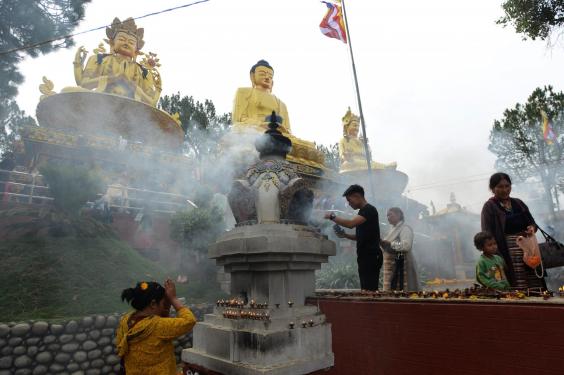
Puff your way up the 400-step stone staircase to the Buddhist stupa of Swayambhunath (1), known as “Monkey Temple” on account of the hundreds of “holy” monkeys who will be your chattering, food-begging companions. If the day is clear, the whole of Kathmandu valley unfurls at your feet. You will see from here how localised the earthquake damage was; isolated pockets have collapsed like cards while large areas remained more or less unscathed. 

kattemple.jpg
Take a view from the Swayambhunath temple, but watch out for the monkeys ( Getty)

Take a hike

Nowhere is the localised nature of the earthquake damage more apparent that in the area known as Durbar Square, a riot of ancient palaces, temples and royal monuments which comprise the UNESCO-listed historic heart of Kathmandu.

Start at the northern Thamel end check post (2) where tourists pay an entrance fee of 1000Rs (about £7.70) for free run of the whole area. Join throngs of pilgrims at Shiva-dedicated Mahendreshwar Mandir (3) with its chiming bells and flickering candles. Follow the flow down to Jagannath Mandir (4), a Hindu temple which attracts gawping fascination on account of its athletic and imaginative erotic carvings which seem to suggest that the earth has always moved in these parts.

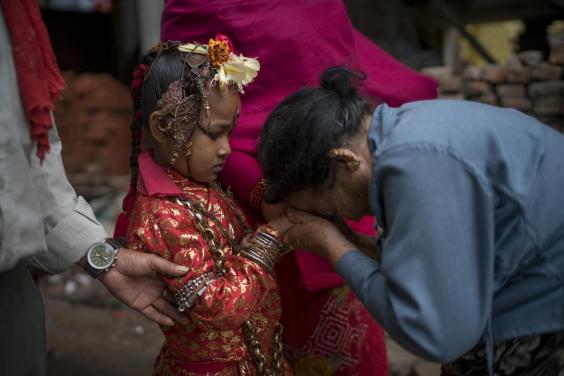
If it’s between 10am and noon, keep an eye out – the Kumari Devi, or living ‘child-goddess’ might put in an appearance at her window above the courtyard of her magnificently carved sacred home, the Kumari Dar (5). However, now that you are down at the south end of the historic region, the heartrending extent of the earthquake damage becomes unavoidable. Cordoned off for safety is the red brick old Royal Palace, (6) whose walls are now cracked, while the adjacent Basantapur Tower (7) somehow remains precariously erect. Exit via “Freak Street” (official name Jochne) (8), the legendary 1960s hippy hangout (though its glory days are now over).
katkumari.jpg
If you're lucky, you may catch a glimpse of the Kumari Devi, or living child goddess ( Getty)

Lunch on the run

Climb six flights of stairs to the rooftop Kasthamandap Café (9) at 23 Maru (00 977 1 6219177, no website) for an open-air coffee, a snack under a sun umbrella and commanding views over Durbar Square.
Window shopping

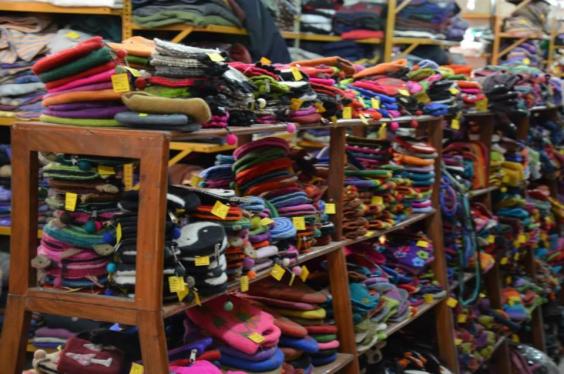
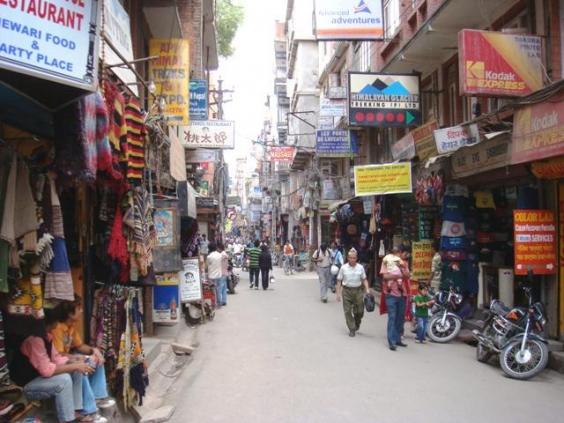
The Thamel district, north of Durbar Square, survived the earthquake more or less intact and remains the backpacker hub (a successor to Freak Street). It’s a carnival of noisy alleys and tiny squares, packed with hundreds of trekking agencies and shops hawking everything from tourist tat to genuine Tibetan antiques. One good bet for quality thanka paintings and woven rugs, is Amrita Craft (10) on Chhetrapait.
katamrita-crafts.jpg
You'll find colourful handicrafts galore at Amrita Craft  (Amrita Craft/Facebook)

An aperitif

Owner Prakash will probably be around to welcome you in person to Zibro (11) on Chaksibari Marg (00 977 984 1059449, no website), his laid-back rooftop bar where young Nepalis shoot the breeze with holidaying Indians and European travellers. The music is one multi-cultural message too, with songs from little known local bands playing Nepali folk-rock fusion in the background. It’s a great place to make new friends over a glass of local craft beer Khumbu Kolsch.

Dine with the locals

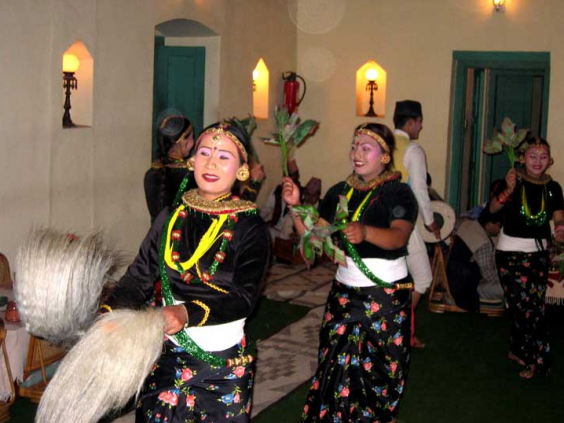
At Bhojan Griha (12), on Dilli Bazaar in the eastern district of Kathmandu, traditional “Newari” dishes are served to guests in a 19th-century mansion, restored with painstaking attention to detail. Dishes include buffalo meat or vegetable-filled momo dumplings, and duck with peanuts and spiced lentils. The restaurant says that all produce is organic and no plastic is used. Mains around £6-8.

screen-shot-2017-03-09-at-11.48.28.png
You'll get entertainment with your food at Bhojan Griha (Bhojan Griha)

Day two

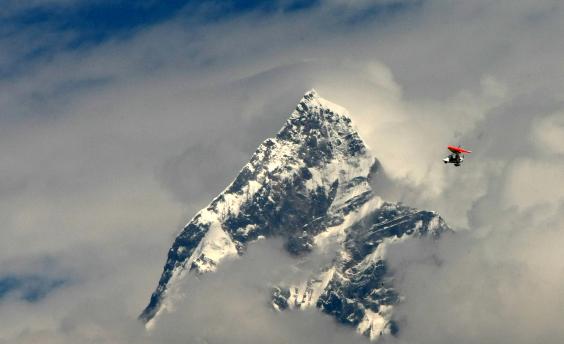
katflight.jpg
Get up early for a dawn flight to see the Himalayas in a prop plane (more robust than this one) (AFP/ Getty Images)

Take a ride

For the ride of your life, board a small propeller plane for a dawn “Mountain Flight” along the crest of the Himalayas. You’ll pass up close and personal many of the world’s highest peaks, including Mount Everest. Flights are in the early mornings when conditions are generally clearest, but good views are weather-dependent and weather-related cancellations are frequent. An hour-long flight with Buddha Air costs US$192 (£158).

Sunday morning: out to brunch

La Dolce Vita (13), at Chaksibhari Marg (00 977 1 4700612, no website), doesn’t have the best coffee in Kathmandu, but what it lacks in a caffeine fix it makes up for with delicious Italian pastries, pasta and gnocchi, sprinkled with grated yak’s cheese. Sit on the sunny terrace watching the street dramas of chaotic Thamel below. Open from 11am, meals around £8-10.

katthamelstreet.jpg
Thamel is the backpacker hub, though it has nothing on 'Freak Street' (Shoestring at wts/ Wikivoyage via Wikimedia Commons)

A walk in the park

It says a lot that Swapna Bagaicha (14) on Kaiser Mahal, Tridevi Marg, is also known as the Garden of Dreams. A botanical park and serene retreat from the frenetic city, it’s just a few minutes’ walk from central Thamel. Sadly, the park took a hard hit in the earthquake, damaging some of the neo-classical pavilions, statues, ponds and fountains. Nevertheless, the plants are still lovingly tended and the 200R (£1.50) entrance fee is being put to good restorative use.

Cultural afternoon

The historic Buddhist city of Patan – effectively a suburb of Kathmandu – is a 20-minute taxi ride across the tea-coloured Bagmati River. Patan is a repository of temples, palaces and stupas strewn around its own Durbar Square. Sadly, several of these took hits in the earthquake. The façade of the Kwa Bahal (15), also known as the Golden Temple, is one almost untouched highlight; the four giant, prayer flag-festooned Ashoka Stupas (16) are another. And then there’s the fact it’s guarded by scores of “holy tortoises”.

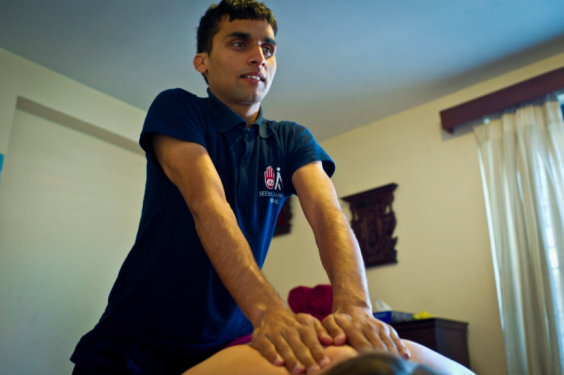
screen-shot-2017-03-09-at-11.55.21.png
A Seeing Hands massage from a blind therapist isn't just great for your body; you're helping a worthy cause, too (Seeing Hands)

The icing on the cake

Treat yourself to a massage by a Seeing Hands blind masseur whose fingers are attuned to muscle and tissue in ways that the sighted will never match. At the same time, support this commendable organisation which provides employment and independence for Nepal’s blind men and women. A range of therapies are offered in a clinical setting, in its premises off Jyatha Road, Thamel (17).

Travel essentials

Getting there

Qatar Airways flies to Kathmandu via Doha from Heathrow, Manchester, Birmingham and Edinburgh, from £685 return. Other options include Etihad via Abu Dhabi and Jet Airways via Delhi or Mumbai.   

Staying there

Hotel Shangri-La (18) is, as the name suggests, as swanky as Kathmandu gets. It’s an inviting, low-rise modern hotel with traditional flourishes in a lush garden with cool pool. Doubles from £105, B&B.

Something of a Thamel institution – everyone from Jeremy Irons to Ricky Martin have stayed here – the Kathmandu Guest House (19) is a bit rough round the edges these days, but still a good mid-range choice – it’s located in a former palace. Doubles from £65, B&B.

On a budget? Hotel Horizon (20) is a gem tucked away in an alley near the north end of Durbar Square. Breakfast on sequinned cushions in the courtyard is a treat. Doubles from £24, B&B.

Thursday, 9 March 2017

Rainbow walkways and streetfood in shipping containers: Forget Copenhagen, Aarhus is Denmark's new capital of cool

Why go now?

Denmark’s second city will officially step out of Copenhagen’s shadow in the new year to become European Capital of Culture 2017 (along with Paphos, Cyprus). A stacked calendar of more than 350 events, festivals and projects kicks off on 21 January under the banner “Let’s Rethink”, reflecting the creative spirit that has long permeated this cool harbour-side sprawl.

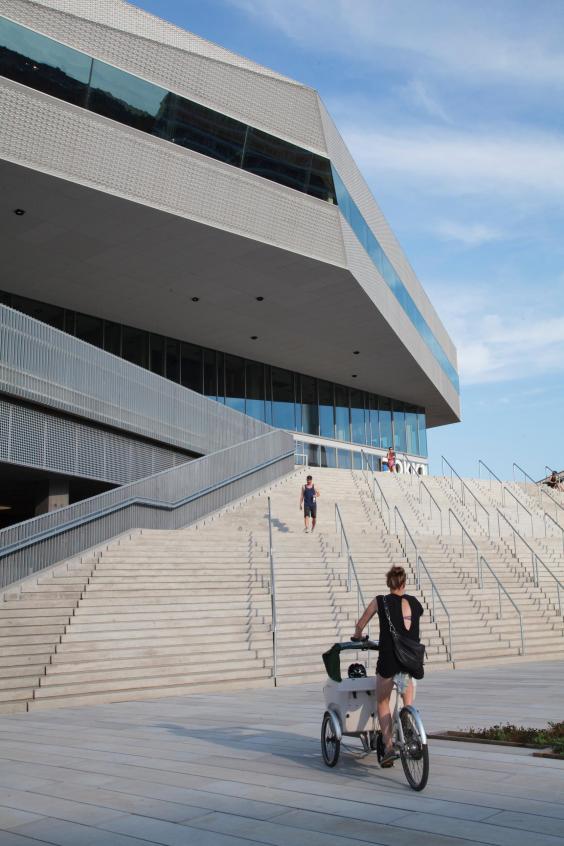
The city’s docks have been transformed by a host of new cultural venues, such as Dokk1 (1), which, together with a thriving gastronomic scene and clutch of world-class museums, means Aarhus should no longer play second fiddle to the capital.

15319-dokk1-aarhus-kim-wyon.jpg
Dokk1 houses a public library and theatre space by the waterfront (Kim Wyon/ VisitDenmark)

Get your bearings

Aarhus sits on the eastern coast of Denmark’s Jutland peninsula and feels more like a laidback town than a city, with cobbled streets, picturesque canals and charming docks. And with most points of interest accessible on foot or by bike from the compact centre, getting around couldn’t be easier.

Read more

  • Where to stay in Denmark: An old smugglers' inn, Scandi-chic hotels
  • How Bornholm was reinvented as Denmark's 'green island'
  • Copenhagen's best music venues

For longer journeys, a fleet of yellow city buses operate throughout central Aarhus. An AarhusCard gives unlimited travel, plus free or discounted entry to many of the city’s headline attractions, and costs Dkr 129 (£14.80) for 24 hours. Cards can be purchased at the bus station and most attractions.  

The main tourist centre can be found at Dokk1 (1), where you can use free online touch screens for information and ideas. Open Monday-Saturday 10am-4pm; Sunday 11am-2pm.

Day One

Take a view

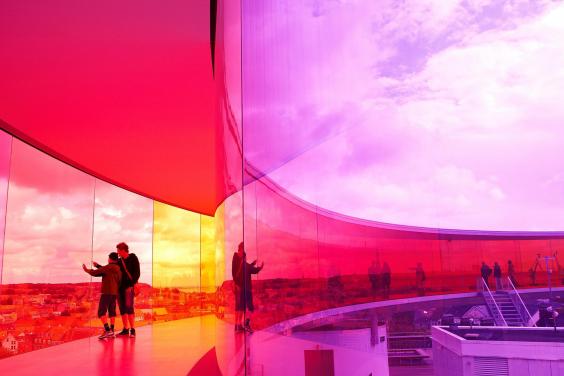
Get a colourful overview of Aarhus from Your Rainbow Panorama, a kaleidoscopic circular walkway on the roof of Aros art museum (2). The brainchild of Olafur Eliasson, a Danish-Icelandic artist famed for his bold, conceptual pieces, this 360-degree skywalk offers brilliant technicolour views of Aarhus through rainbow-hued glass panels. 

Aros takes its main theme from Dante’s “The Divine Comedy” and is designed as a journey from hell to heaven. Hell is The 9 Spaces, a black-walled basement of eerie installations, while heaven is Eliasson’s multi-coloured halo hovering high above the streets.

9256-aros-aarhus-kunstmuseum-your-rainbow-panorama-claes-bech-poulsen.jpg
Glass act: experience 360 degree hues at Inside Your Panorama ( Bech Poulsen/ VisitDenmark)

Take a hike

Start in Aarhus’ centre point, Domkirkepladsen, where the city’s 12th century cathedral (3) looms large. Across the square, under the Nordea Bank, is where the Vikings founded Aarhus in the ninth century (its name comes from “Aros”, meaning “place at the river’s mouth”); the Viking Museum (4) marks the exact spot.

mollestien-photo-ditte-isager.jpg
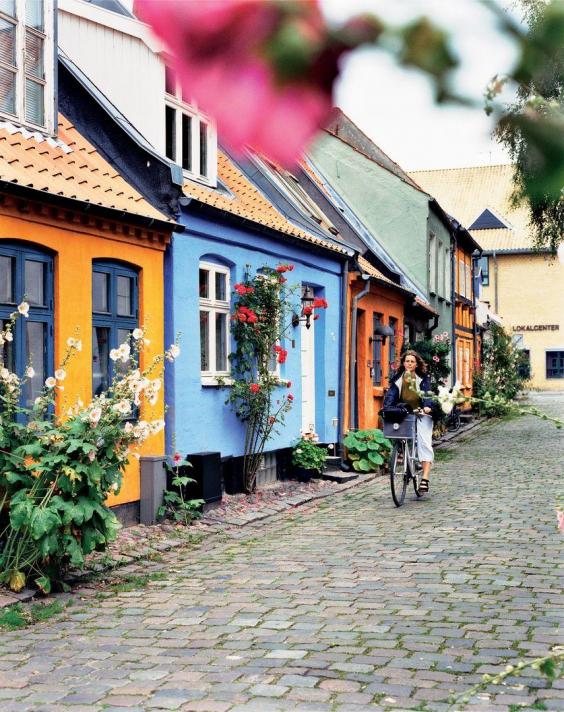
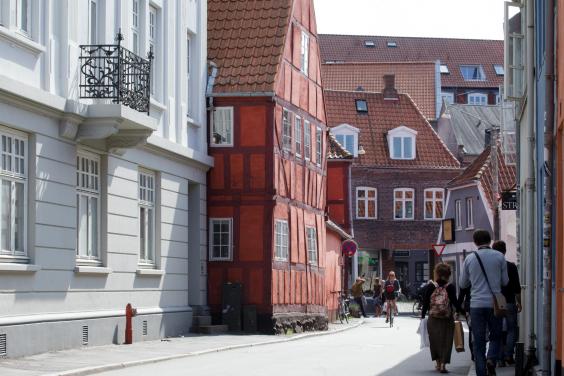
Selfie conscious: head down to Mollestien to marvel at the city’s most Instagrammed street ( Ditte Isager)

From here, wander through cobbled lanes, past churches and half-timbered houses in the Latin Quarter, the city’s oldest neighbourhood, towards Mollestien (5). It’s by far Aarhus’ prettiest (and most Instagrammed) street with pastel-coloured facades that have looked the same for centuries.

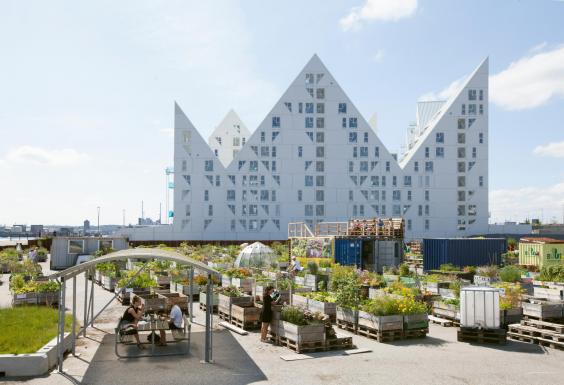
To witness the city’s waterfront regeneration, head east to Dokk1 (1). It’s home to Scandinavia’s largest library and is part of the city’s Urban Mediaspace project, turning former industrial port areas into bright modern spaces. Stroll up the harbour to Aarhus O, the new dockland neighbourhood that’s turning architectural heads with photogenic developments like the iconic Iceberg (6).

15314-isbjerget-aarhus-kim-wyon.jpg
The Iceberg is located in a disused container port (Kim Wyon/ VisitDenmark)

Lunch on the run

Head back down the harbour, or hop on a bus to Banegardspladsen (7) (central station), for the Aarhus Central Food Market (8). Opened in October, this buzzing indoor market is full of specialist shops, delis and breweries, where you can grab everything from Kahler’s seasonal smorrebrod to gourmet porridge at Grod – think oatmeal with organic chicken and peanuts.

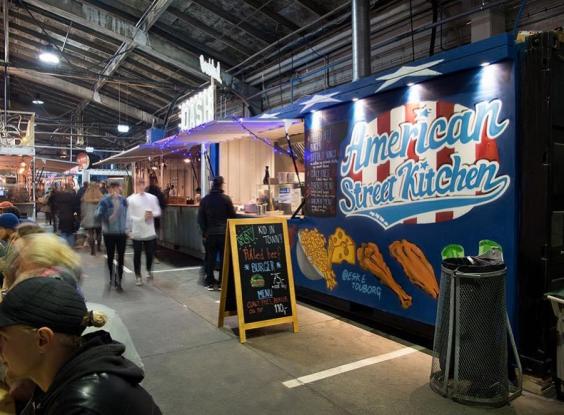
Another mark of the city’s booming food scene is the nearby Aarhus Street Food (9), which opened last summer in a former car park with stalls in repurposed shipping containers. Feast on melt-in-the-mouth pulled-duck burgers at Duck It, or spicy Vietnamese buns at Banh Mi Bandits.

15337515-389230331410039-197788359627927167-n.jpg
Take your pick from food stalls in old shipping containers ( Aarhus Street Food/Facebook)

Window shopping

The Stroget is the backbone of Aarhus’ shopping life with an 850-metre long pedestrianised parade of stores. Highlights include Skagen (10), the iconic Danish watch house; department store Salling (11) with big-name brands such as Royal Copenhagen porcelain; and Georg Jensen (12), featuring exquisite silverware and jewellery from the Danish master.

For more independent retailers, head to the so-called “Side Streets Quarter” between Aboulevarden and Norre Alle, where cheaper rents have allowed new designers and artisans to flourish. Check out 1+1 Textil (13) for hygge-enhancing homeware and nearby St Valentin (14) for stylish Scandi menswear. 

An aperitif

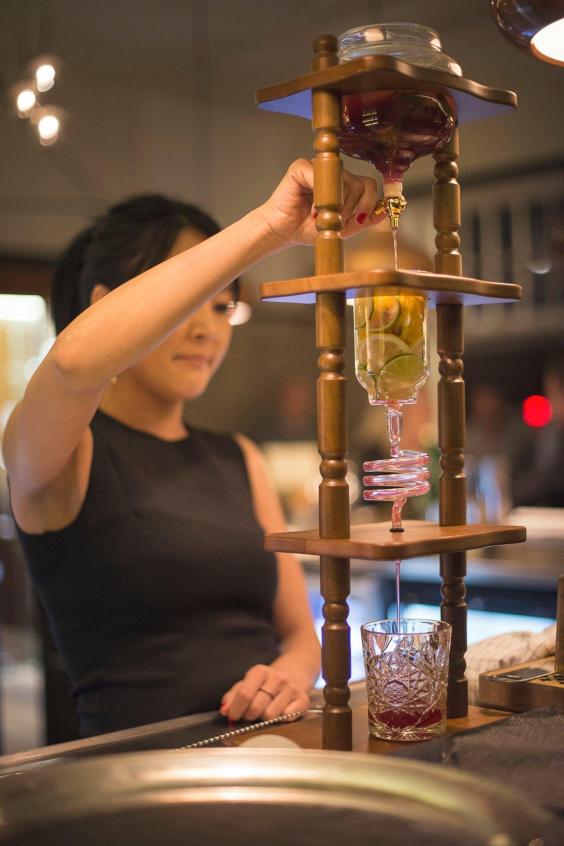
Pharmacy-turned-bar St Pauls Apothek (15) has a vintage, speakeasy charm, with a hip atmosphere and slick mood lighting. The food menu is limited, following a concept of small Nordic dishes and wine pairings, but it’s the killer cocktails that pull in the crowds from pre-dinner into the early hours. It also holds regular rum, whiskey and tequila tastings. Tables fill fast so book ahead or expect a lengthy wait.

10668886-811252028913537-6024176639680582645-o.jpg
Creative cocktails are a speciality at St Pauls Apothek

Dine with the locals

Aarhus’ food revolution has been gathering momentum for some time with Frederikshoj, Gastrome and Substans awarded Denmark’s first Michelin stars outside of Copenhagen in 2015. Much of the recent buzz has centred on newcomer Sart (16), where a band of young chefs adhere to a philosophy of producing everything they can from scratch. Expect casual, Danish-style tapas with sharing plates such as charcuterie meats, venison bolognese and apple compote pizza.

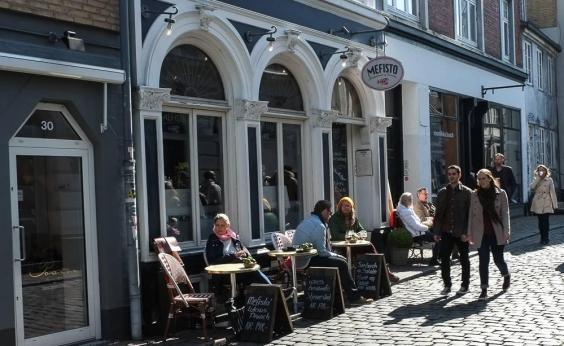
For cosier but equally impressive dining, head to Mefisto (17) in the Latin Quarter. It offers a seasonal four-course menu with pairing wines for Dkr 600; dishes currently include pickled monkfish with apples and horseradish. 

10295026-836085083072560-6713565114744404297-o.jpg
Mefisto offers up a variety of dishes with unexpected combinations ( Mefisto Aarhus)

Day two

Sunday morning: out to brunch

Café Smaglos (18) is reputedly one of Aarhus’ oldest cafes, with a charming outdoor area overlooking Monastery Square. Oddly, smaglos in English means “tasteless” but the food and atmosphere is anything but. There’s kitschy decor, live music and a decent breakfast buffet for only Dkr 45 (daily, 9-11:30am). For bigger appetites, order the café’s cult favourite, the NamNam burger.

Take a ride

Do as the Danes do and get on a bike. With wide cycle lanes, few cars and relatively flat roads, Aarhus is geared for two-wheeled discovery. Cycling Aarhus (19) offers rental bikes for Dkr 110 a day, as well as several themed tours of the city’s highlights.

For a taste of the great outdoors, get on the Ringgaden Circular Road and head south for a brisk ride on the Brabrandstien cycle trail. It’ll take you along the river Aarhus and around beautiful Brabrand Lake (20), a haven for birdlife with watching towers and nature information dotted along the path. 

A walk in the park

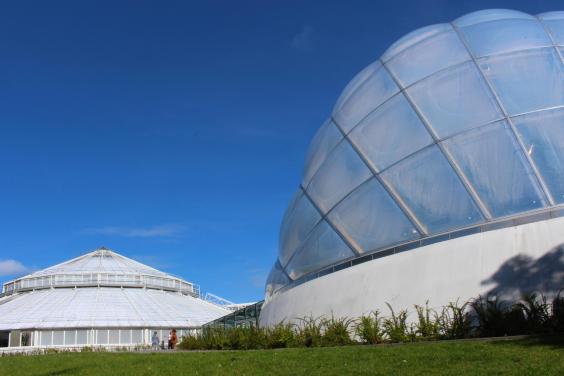
Cycle back up the Ringgaden to the Botanical Gardens (21) for a stroll around its immaculate lawns and striking dome-shaped greenhouses. The glorious gardens make up one of the biggest parks in Aarhus, spread over 53 acres, with lakes, streams and exotic plants gathered from all over the world.

14135-vaeksthusene-i-botanisk-have-science-museerne-.jpg
The Botanical Gardens provide a selection of some of the planet’s most spectacular plants (Science Museerne)

Cultural afternoon

For a unique local insight, take a journey through time at Den Gamle By (22). It’s an incredibly engaging open-air museum of half-timbered houses, painstakingly reconstructed to form a provincial old market town with supporting costumed guides, horse-drawn wagons and interactive exhibits.

15322-den-gamle-by.-aarhus-kim-wyon.jpg

Step back in time at Den Gamle By (Kim Wyon/VisitDenmark)

After exploring Aarhus of old, head over to Den Gamle By’s more recent historical neighbourhoods, recreating local life in 1927 and 1974. In the latter, you can browse an old hi-fi store with authentic Seventies tech or wander around apartments for an intimate peek into real past lives. Open daily 10am-5pm, but hours vary by season.

The icing on the cake

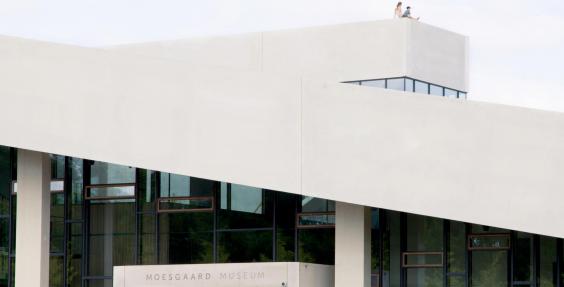
Aarhus isn’t short of fascinating museums or eye-catching architecture, but at Moesgaard Museum (23) you get both. Prehistory exhibits are presented in a spectacular modern space, with the star attraction the 2,000-year-old Grauballe Man – the world’s best-preserved bog body. The part-historical, part-forensic display showcases a remarkably intact body – right down to the fingernails – while more than 50,000 other artefacts document everything from the evolution of man to Viking voyages. Moesgard sits 10km south of the city in Hojbjerg. Bus 18 runs here regularly and takes 25 minutes from central station (7).

15329-moesgaard-museum-aarhus-kim-wyon.jpg

Moesgaard Museum is home to more than 50,000 artefacts (Kim Wyon/VisitDenmark)

Travel essentials

Getting there

Ryanair flies from Stansted to Aarhus airport (24), and to the nearby city of Billund. British Airways flies from Heathrow and London City to Billund, as well as from Manchester through partner Sun-Air.

A shuttle bus (number 925X) leaves from outside the arrivals terminal at Aarhus airport to the city’s central station (7), and takes 50 minutes. Tickets cost Dkr 115 one-way.

From Billund the 912X bus travels direct to Aarhus and takes just under an hour and a half (tickets cost Dkr 146).

Staying there

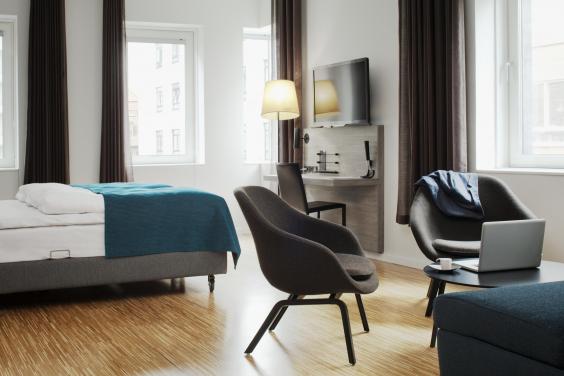
The lively Scandic Aarhus City (25) on Ostergade is a stone’s throw from the main shopping artery, Stroget, and just a five-minute stroll from the train station (7). Bag a room on the top floor for scenic views of the harbour, woods and beaches. Doubles from £95, including breakfast.

12602-scandic-aarhus-city-twin-upgrade-vaerelse-scandic-aarhus-city.jpg

The stylish Scandic Aarhus City is the perfect springboard for accessing the rest of the city

A stylish townhouse in the heart of the Latin Quarter, Aarhus Guldsmeden (26) offers French colonial style rooms with four-poster beds and Persian rugs, plus a charming garden for cocktails. Doubles from €171 (£146) with breakfast.

Cabinn Aarhus (27) has functional but budget-friendly rooms reminiscent of ship cabins that stretch along a vibrant canal front opposite Aarhus Cathedral (3). It offers compact rooms with twin or bunks beds as well as family rooms for four. Rooms from Dkr 495, room only.

Wednesday, 8 March 2017

Crazy cube houses and the country's best cocktail bar: Why Rotterdam beats Amsterdam

Why go now?

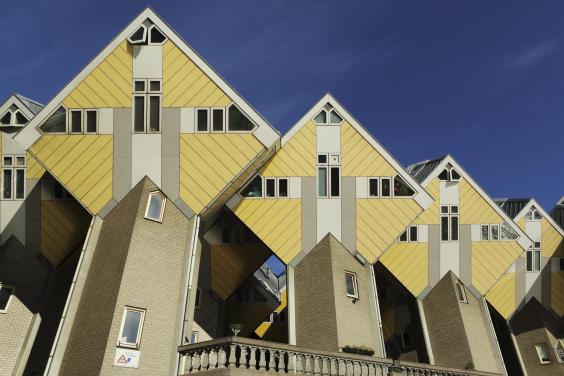
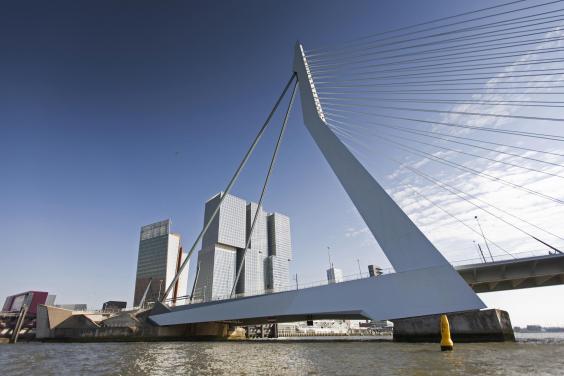
Rotterdam has evolved from a down-at-heel port city into one of Europe’s most exciting urban getaways. The 2014 opening of the Markthal (1) (markthalrotterdam.nl) supplied the city with an iconic visitor attraction and a shot of self-confidence – the arched ceiling of this market hall and residential building bears the country’s largest artwork, a piece by Dutch digital artist Arno Coenen, equivalent to the size of two football pitches. The city has also become known for its unusual architecture, such as surreal bright yellow Cube Houses (2) and the De Rotterdam complex’s (3) stacked glass towers.

In comparison to Amsterdam (42 minutes away by Intercity direct train), where hotels are enjoying record occupancy, Rotterdam offers value for money and a good smattering of museums for chilly days.

Until February 12, slick black-and-white portraits of supermodels and personalities from popular culture will be exhibited at the Kunsthal (4) (00 31 10 4400 300; kunsthal.nl) in Peter Lindbergh: A Different Vision of Fashion Photography.

Get your bearings

The swan-shaped Erasmus Bridge (5) and red Willemsbrug bridge (6) straddle the New Meuse close to Rotterdam’s centre, which lies on the river’s northern side.

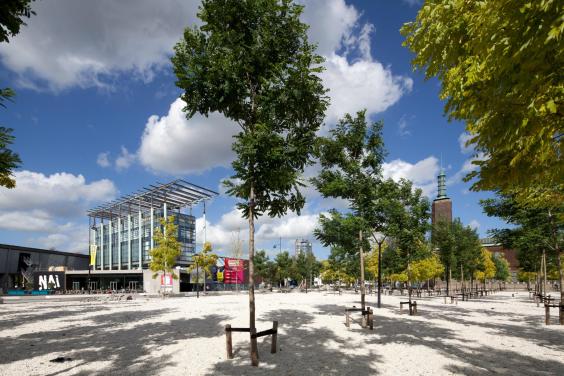
The Museumpark (7), offering six different museums and galleries, is 10 minutes’ walk west of the Erasmus Bridge (5) and 15 minutes’ stroll south of Centraal Station (8). The Markthal (1) is near Rotterdam Blaak station and the Oudehaven (Old Port) (9).

sf-rotterdam-2015-042.jpg
Rotterdam's surreal canary-yellow Cube Houses (Stuart Forster)
2014-erasmusbrug-de-rotterdam-claire-droppert.jpg
The city's landmark Erasmus Bridge, with the stacked glass towers of the De Rotterdam complex behind (Claire Droppert)

The main tourist information office (10) is at Coolsingel 114 (00 31 10 7900 185; rotterdam.info), open 9.30am-6pm daily, in the garden of the Schielandshuis (11), a 17th-century townhouse that opens to the public in 2017.

Day one

Take a hike

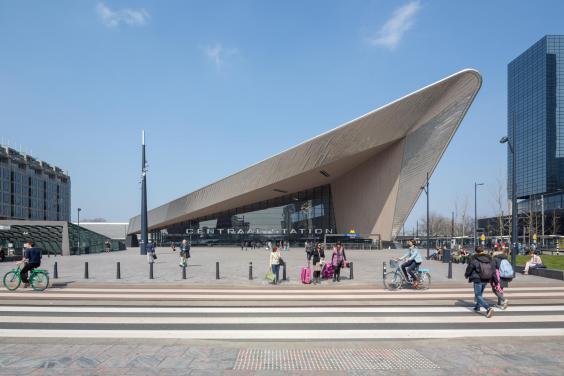
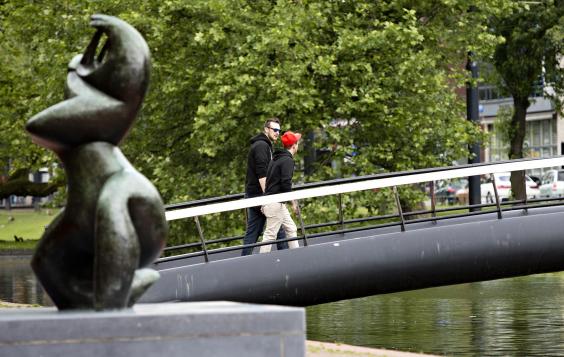
View the distinctive metallic façade of Centraal Station (8), which opened in 2014, from Stationsplein (12), then head towards the nearby Westersingel canal, where you can stroll along the Westersingel Sculpture Route (13) – waterside artworks include August Rodin’s L’Homme qui Marche (“the walking man”) and Henri Laurens’ bronze La Grande Musicienne. Halfway along the canal you’ll see the Functionalist façade of De Unie (14), at Mauritsweg 34-35 (00 31 6 4839 4017; unie010.nl), which originally opened as a café and restaurant in 1925, and reopened in 1986. It was one of the many city centre buildings to fall victim to the bombs dropped by the Luftwaffe on May 14, 1940 – a trail of lights set into pavements marks the boundary of that wartime destruction.

2016-rotterdam-centraal-3-ossipvanduivenbode-redactioneel.jpg
The distinctive Centraal Station
2016-irisvandenbroek-67a2143-redactioneel.jpg
La Grande Musicienne, by Henri Laurens, on the Westersingel Sculpture Route (Iris Van Denbroek)

Lunch on the run

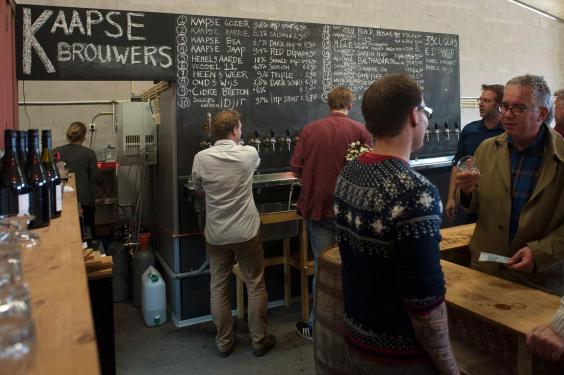
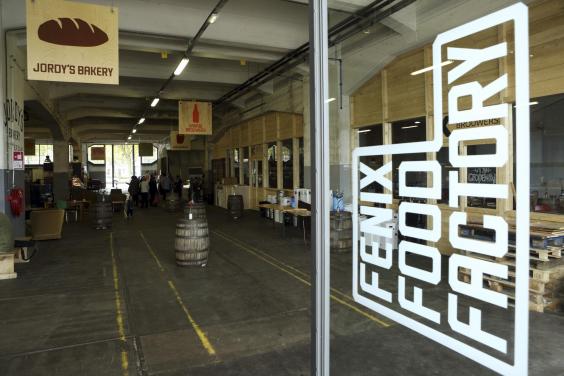
For informal dining, cross the river and take your pick from stalls in the Fenix Food Factory (15) at Veerlaan 19D (fenixfoodfactory.nl). The emphasis is on local, artisanal produce – a bakery, coffee roastery and Moroccan deli number among businesses operating in the former warehouse. Grab your grub and take a seat among the eclectic array of furniture at the building’s centre. The Kaapse Brouwers brewpub (00 31 10 2180 853; kaapsebrouwers.nl) hosts live jazz sessions on Friday evenings and Sunday afternoons. Opening hours vary, closed Monday.

-7414.jpg
Catch live jazz sessions and sample local beers at Kaapse Brouwers brewpub

Window shopping

Browse vintage furniture in Posse (16) at Verlaan 13 (00 31 10 7371 815; posse.nl). Rummage around the back room before sinking into a leather armchair for coffee and a slice of cake. Open Friday to Monday, hours vary.

For photography books and prints of works by Dutch photographers, browse the shop in the Nederlands Fotomuseum (17) at Wilhelminakade 332 (00 31 10 2030 4 05; nederlandsfotomuseum.nl). Open 10am-5pm Tuesday to Friday, 11am-5pm on weekends.

sf-holland-rotterdam-080.jpg
Head to Fenix Food Factory for local produce from independent suppliers (Stuart Forster)

An aperitif

Have a cocktail tailored to your tastes in Stirr (18), at Eendrachtsweg 29b (thestirr.nl). Open from 6pm, Wednesday to Monday. The speakeasy-style bar was named the Netherlands’ best new cocktail bar in Esquire’s 2016 awards. Drinks cost €10.50.

If you prefer gin and tonic peruse the long list round the corner in Ballroom (19) at Witte de Withstraat 88b (00 31 10 3412 029; ballroomrotterdam.nl). Open from 4pm, Tuesday to Sunday. The owners claim to have the biggest collection of gins in Europe, costing from €6 a glass.

Dutch police train eagles to take down drones

Dine with the locals

For well-presented seafood or a tender rib-eye steak, at €39.50, reserve a table in the stylish Restaurant Las Palmas (20), run by Dutch TV chef Herman den Blijker, at Wilhelminakade 330 (00 31 10 2345 122; restaurantlaspalmas.nl). Open Monday to Friday 12pm-3pm, Monday to Saturday from 6pm, Sunday 12pm to 8pm.

Day two

Sunday morning: out to brunch

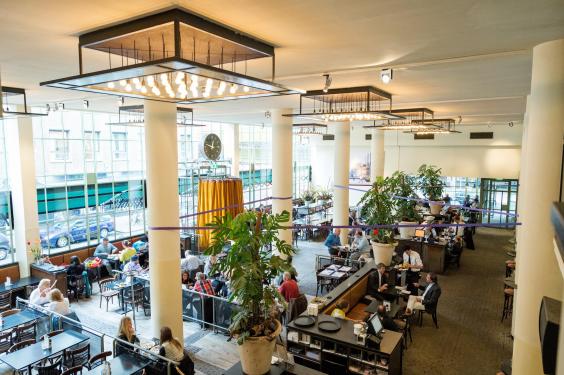
Dudok (21) at Meent 88 (00 31 10 4333 102; dudok.nl) is a buzzy brasserie and popular meeting place serving uitsmijter (an open sandwich with fried eggs, cheese and meat or salmon) for €9.75 and apple pie, from its patisserie, for €3.75. Open daily, from 9am-11pm on Sunday.

2014-dudok-janbijl-0202.jpg
Dudok is a popular spot for brunch

A walk in the park

The Zuiderpark (22), a couple of kilometres south of the river, is the Netherlands’ largest urban park, and offers a world away from the city with hiking and biking trails, wetlands and forests. 

2010-watertaxi-213-mh.jpg
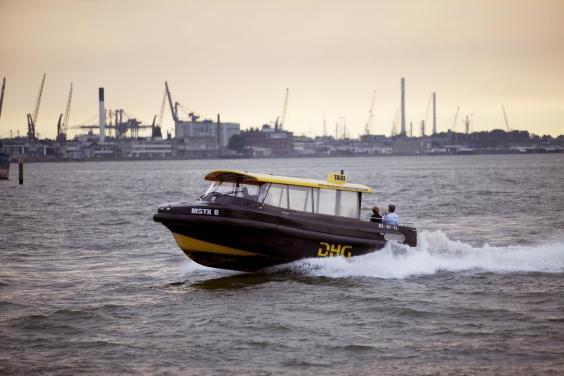
Catch a water taxi for a view of the city from the river

Take a ride

Rotterdam’s network of buses, trams, ferries and metro trains means public transport (ret.nl) is reliable and easy to use. A reloadable OV-Chipcaart (ov-chipkaart.nl) can be acquired for a €7.50 deposit – the tap in, tap out system is comparable to London’s Oyster card and valid across the Netherlands, including on rail journeys.

Day tickets for local transport cost €7.50. Rotterdam Welcome Cards, valid for one day (€11) as well as two (€16) or three (€20) consecutive days of __travel are available from Rotterdam Tourist Information and online – they also bring discounted entry to a number of attractions.

Rides by water taxi (watertaxirotterdam.nl), costing from €4.50, are a thrilling way of seeing the skyline from the river.

2011-museumpark3-ovd.jpg
The Museumpark, an urban park offering six different galleries and museums

Cultural afternoon

If you appreciate art and applied design, spend time exploring the expansive Museum Boijmans Van Beuningen (23) at Museumpark 18-20 (00 31 10 4419 400; boijmans.nl). View paintings by the likes of Rembrandt van Rijn, Vincent van Gogh and Piet Mondriaan, along with furniture designed by the De Stijl movement’s Gerrit Rietveld. From February 11 until May 28 the Mad About Surrealism exhibition will show works by the likes of Salvador Dali, Max Ernst and René Magritte. Open 11am-5pm, Tuesday to Sunday; entry €15.

The icing on the cake

Schiedam, a mere five-minute rail journey from central Rotterdam, is home to the world’s tallest traditional windmill and renowned as the centre of Dutch gin production. The National Jenever Museum (24) (00 31 10 2469 676; jenevermuseum.nl) here tells the story of the spirit’s production and consumption, and houses a working distillery. Open 11.30am-5pm on Saturday and 12.30pm-5pm on Sunday; entry €5.

7741194328-868ec4a603-o.jpg
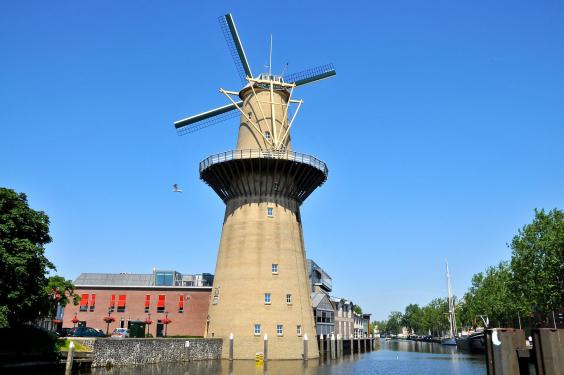
The windmill at Schiedam, considered to be the world's tallest (FaceMePLS/Flickr/CC BY 2.0)

Travel essentials

Getting there

Rotterdam The Hague Airport (25) is 7km north-west of the city centre and can be reached from London City Airport with Air France, British Airways, KLM and City Jet.

Bus 33 takes 25 minutes to the city centre and runs from 6am until shortly after midnight, costing €3. Alternatively, a free shuttle service runs between the airport and Meijersplein metro station. They journey by taxi costs anything between €20 and €30.

Amsterdam Airport Schiphol is 60km north-east of Rotterdam. Trains to Rotterdam Centraal Station (8) run around the clock. The journey takes around 55 minutes, costing €12.20. Intercity direct trains, requiring a €2.40 supplement, cut the journey to 27 minutes. 

Staying there

Booking into Stayokay Rotterdam (26) at Overblaak 85-87 (00 31 10 436 5763; stayokay.com/nl/hostel/rotterdam) means an opportunity to stay within the Cube Houses, designed by Piet Blom, at the Oudehaven. Double rooms from €54.50 per night, including breakfast.

Right on the river, nHow Rotterdam (27) at Wilheminakade 137 (00 31 10 206 7600; nhow-rotterdam.com) is in the vast De Rotterdam building (3), designed by Rem Koolhaas. The 278 designer rooms have floor-to-ceiling windows and those facing the waterfront give impressive views of the Erasmus Bridge. Rooms from €111 per night, excluding breakfast.

On the other side of the river, the Mainport (28) at Leuvehaven 77 (00 31 10 217 5757; mainporthotel.com) is a five-star design hotel with 215 rooms and suites. A spacious eighth-floor spa, featuring a hammam and Finnish sauna, overlooks the riverfront. Rooms from €144 per night, excluding breakfast.

More information

rotterdam.info

Click here to see tours and holidays in The Netherlands, with Independent Holidays.