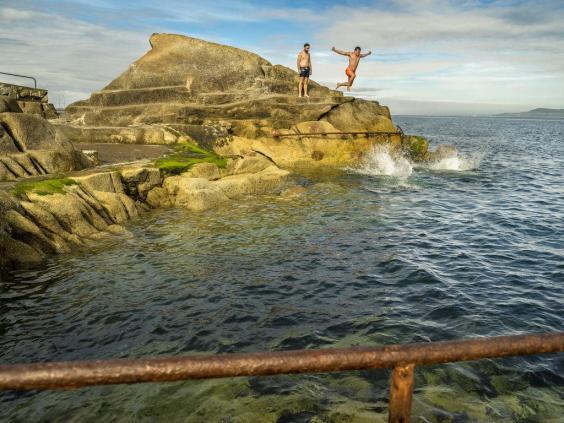
Wednesday, 4 January 2017

48 Hours in Biarritz: restaurants, hotels and places to visit

Travel essentials

Why go now?

With British Airways re-starting flights from Heathrow this summer, the biggest resort in south-west France is easier than ever to reach. Biarritz has its origins as a fishing port, but in the past couple of centuries it has acquired plenty of style while welcoming the rich and glamorous from France and beyond.

Touch down

BA (0344 493 0787; ba.com) flies from Heathrow; easyJet (0330 365 5000; easyjet.com) from Gatwick; Ryanair (0871 246 0000; ryanair.com) from Stansted; and Flybe (0371 700 2000; flybe.com) from Birmingham and Southampton.

Biarritz airport (1) is just two miles east of the city. Turn left out of the terminal and walk for a few minutes to find the stop for bus 14, which runs approximately half-hourly to the town centre for just €1 (or buy a 24-hour pass for only €2). It terminates close to the tourist office (2), which occupies a peach-coloured mansion beside Square d'Ixelles (00 33 5 59 41 59 41; tourisme.biarritz.fr; 9am-7pm daily in July and August).

By rail, Biarritz is nine or 10 hours from London St Pancras on Eurostar (03432 186 186; eurostar.com), requiring a change of stations from Gare du Nord to Montparnasse. Through fares are typically £250 return in summer.
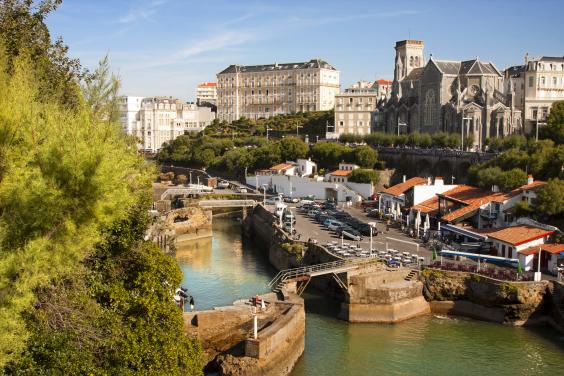
shutterstock_113915401.jpg
(Shutterstock)

Biarritz rail station (3) is inconveniently located two miles south-east of the city centre; bus 8 covers the ground every 20 minutes or so for €1.

Get your bearings

The last big resort in south-west France before the Spanish border, Biarritz decorates a serrated sweep of the Côte des Basques. The main beach is the Grande Plage (formerly Plage de l'Impératrice, until the Second Empire collapsed). Its north-east end is marked by the lighthouse known as the Phare de Biarritz (4). At the south-west end of the beach, a thumb of land sticks out into the Atlantic; this is the oldest part of Biarritz, crowding around the horseshoe-shaped Plage du Port-Vieux (5). Further south, the Plage de la Côte des Basques extends towards the Spanish frontier. 

Inland, Place Georges Clémenceau (6) has the strongest claim to be the hub of the town.

Check in

Wherever you end up staying, you should certainly visit the Hôtel du Palais (7). It occupies a prime tract of seafront real estate at 1 Avenue de l'Impératrice (00 33 5 59 41 64 00; hotel-du-palais.com). It is more than merely one of France's finest hotels; it is also a location with a fascinating history. Napoléon III built a villa on the site for his much-revered wife, Empress Eugénie. It burned down in 1903, and after rebuilding, reopened as a hotel de grand luxe. The price of a double room reflects the four-star quality: around €400-€500 per night double, excluding breakfast.

The small, friendly if slightly cramped three-star Hôtel Palym (8), at 7 Rue du Port-Vieux (00 33 5 59 24 16 56: hotel-palym-biarritz.fr) has double rooms for €93 or less, excluding breakfast.

The two-star Hôtel Le Bellevue (9) at 5 Avenue Edouard VII (00 33 5 59 24 17 07; hotel-bellevue-biarritz.com) has an excellent location by the Grande Plage, which helps explain its fairly high room rates of around €100 double, excluding breakfast.

Day one

Take a view

The best place from which to appreciate the scale and diversity of Biarritz is on the Plateau de L'Atalaye (10), high above the Plage du Port-Vieux. Then walk out across the footbridge to the Rocher de la Vierge (11), an outlying rock that supports a statue of the Virgin Mary and provides an excellent view of the magnificent coastline.

Next, at the art deco Aquarium de Biarritz (12), you can gaze into the world beneath the water (00 33 5 59 22 75 40; aquariumbiarritz.com). The aquarium - formerly the Musée de la Mer - has more than 5,000 creatures and a 40-foot coral reef. Get there at 10.30am (or 5pm) to see the seals being fed. In July and August, it opens 9am-midnight daily, admission €14.50.

Lunch on the run

The main street running inland from the Plage du Port-Vieux (5), Rue du Port-Vieux, is crammed with cafés and restaurants. At no 12, Le Coupe Faim (13) does a roaring trade in salads, sandwiches and crepes, with Basque xurros (churros - swirls of deep-fried dough) if you have room for dessert.

Cultural afternoon

The Musée Historique de Biarritz (14) on Rue Broquedis (00 33 5 59 24 86 28; musee-historique-biarritz.fr) occupies a former Anglican church, St Andrews, built by the British in 1876. It has been transformed into an exhibition space telling the story of the town. The porch alone is a masterpiece, constructed to commemorate the men who fell in south-west France in 1813 and 1814, during the Napoleonic Wars. Inside, it feels like a shrine to Empress Eugénie, though our Royal Family enjoys a strong showing, with an account of Queen Victoria's visit to Biarritz in 1889. It opens 10am-1pm and 2.30-6.30pm from Tuesday to Saturday, admission €4.
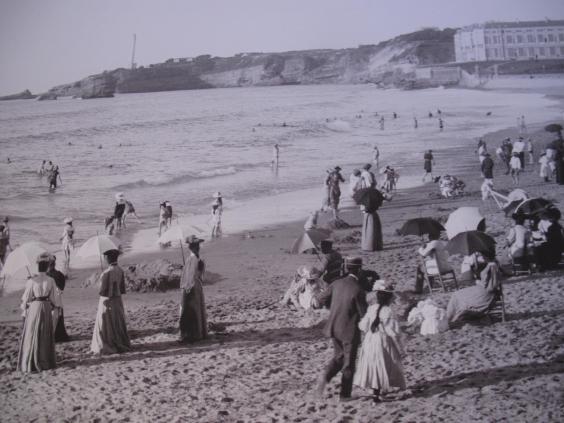
retrobiarritz.jpg
Biarritz was a popular holiday spot for Europe's high society

Go to church

The two most notable churches are open to visitors only on Saturday afternoons. The Chapelle Impériale (15) on Avenue de la Reine opens only 2-6pm, for guided tours that cost €3. Take Rue de l’Université Américaine to the Russian Orthodox Church (16) at 8 Avenue de l’Impératrice. Saturday from 3pm to 6pm is the only time non-worshippers are welcomed inside the church - which is officially named for "Alexander Nevsky and the Protection of the Mother of God".

An aperitif

Biarritz is perfectly placed for a sundowner. On the rooftop bar of the Hôtel Les Baigneuses (17) at 14 Rue du Port-Vieux, where a glass of rosé is a very reasonable €4 and a small beer is even cheaper. 

The Café de la Grande Plage (18) is actually the beach-level floor of the Casino. On the convivial terrace, you can order oysters to accompany your drink - though prices for both are among the highest in town. 

Dine with the locals

The area around Les Halles Centrales (19), the municipal market, is full of appetising options. Book in advance for Le B2 (20) at 5 Rue du Centre (00 33 5 59 24 34 66), where a short menu offers simple, tasty dishes based on locally sourced seafood and meat - such as fillet steak with Basque peppers and mashed sweet potato. Starters are under €10, mains €20.

Day two

Out to brunch

Les Halles Centrales (19) is also the best place to forage for coffee and croissants on the sabbath, with Bar Jean (21) at 5 Rue des Halles opening at 8.30am.

Take a hike

Sunday morning is an excellent time to appreciate the remarkable mix of architecture in Biarritz before the crowds gather. From the east end of Place Georges Clémenceau (6), go north along Avenue Edouard VII, which passes the Casino (18) and a small park on the left also named after the early 20th-century British monarch. The road becomes the Avenue de l’Impératrice, with the Hotel du Palais (7) dominant, and as you head north there are indulgent villas on both sides of the road.

At Mirasol (22), note the startling stained-glass façade on a maritime theme, and bear left along the Sentier des Vagues ( "path of the waves"). The path leads to a flight of steps, and halfway down you round a bend to get a tremendous view of the bay and the rocks scattered in the water – notably the hollowed-out Roche Ronde, resembling the head of a whale emerging from the waves.

A walk by the beach

Descend to the foot of the steps (23) and walk back along the Allée Winston Churchill, which runs beside the Grande Plage. Thread beneath the terrace of the Hôtel du Palais (7), then turn to admire the expansive grounds. Continue along the promenade, past the towering Casino (18) and a scattering of offshore rocks. Wander through the tiered gardens, planted with the city's characteristic fluffy tamarisk trees, to reach the Port des Pêcheurs (24) - a tiny fishing village crammed with crampottes (fishermen's huts).

Window shopping

Art and crafts from the nations of French West Africa are on sale at Le Caméléon Couleur d'Afrique (25) at 3 bis Rue du Port-Vieux, open 11am-10.30pm daily in July and August. At the inland end, Rue du Port-Vieux becomes Rue Mazagran, and a long, meandering thoroughfare of shops begins, stretching along via Place Sainte-Eugénie to Place Georges Clémenceau (6) - venue for the Galeries Lafayette (26) department store. It opens 10.30am-8pm on Sundays, from 9.30am on other days. 

Take a ride

A network of free buses shuttles around Biarritz, but the times are erratic; ordinary buses are more reliable and very cheap (€1 per ride or €2 for 24 hours). Bus 10 or 13 will take you south to the Milady district and the Cité de l’Océan (27) - the spectacular new addition to Biarritz, celebrating the city’s link to the sea. You learn about Basque fishermen’s exploitation of the North Atlantic, from Spitzbergen to Newfoundland, and the transformation of Biarritz into a glamorous resort.
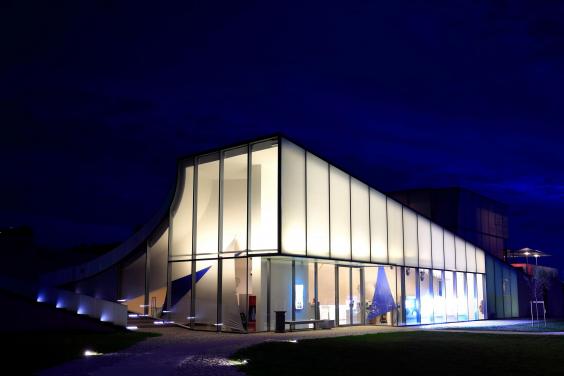
shutterstock_301721753.jpg
Cité de l’Océan (Shutterstock)

The icing on the cake

For a different perspective on the Côte des Basques, continue south to the fishing port of St-Jean-de-Luz (28), an antithesis to the glitz of Biarritz, with a pleasant central square ideal for a drink and dinner. By public transport from either the city centre or the Cité de l’Océan, take bus 13 to its southern terminus and then walk for about 20 minutes to Guéthary station (29), from which St-Jean-de-Luz is just seven minutes by train.

48 Hours in Montpellier: hotels, restaurants and places to visit in the capital of Languedoc-Roussillon

Travel Essentials

Why go now?

Bastille Day is just around the corner and the Tour de France (letour.com) also rolls into town on 13 and 14 July. 

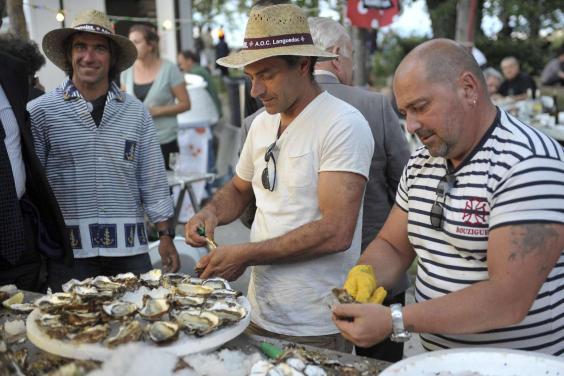
Between 8 July and 26 August, from 6-11.30pm every Friday, over 160 local wine makers from the surrounding vineyards of the Languedoc Roussillon set up stalls along the L’Esplanade Charles de Gaulle (1) for les Estivales de Montpellier (montepellier.fr) to showcase their wines. Two wine tastings cost €5. 

What began as a classical music festival now extends to many different genres, with over 200 performances around the city during the Festival Radio France Montpellier et Languedoc Roussillon (festivalradiofrancemontpellier.com), from 11 to 26 July. 

estivales-huitres-hommes-maillot-raye_free_format.jpg
Oyster stall at the Estivales de Montpellier 

Touch down

Montpellier airport (2) (montpellier.aeroport.fr) is just 8km south east of the city centre; easyJet (0843 104 5000; easyJet.com) flies from Gatwick and Luton and Ryanair (0871 246 0000; ryanair.com) from Leeds Bradford. Aer Lingus (03333 006 6920; aerlingus.com) also launched a new route from Dublin to Montpellier this summer. 

The airport shuttle bus 120 departs from outside the airport terminal on the hour every hour and takes about 15 minutes to the Place de L’Europe (3). Single fares cost €1.60. A taxi to the centre costs about €25 one-way.

Return rail travel from London St Pancras to Montpellier costs around £130 return and is a seven to eight hour journey with a change in Lyon, Lille or Paris (08432 186 186; eurostar.com). Montpellier’s St-Roch station (4) is close to the Old City.  

Get your bearings 

Set about 10km from the Mediterranean, the capital of the Languedoc-Roussillon is a city of both the very old and very new. The shield-shaped medieval Old Town is a tangle of mellow, cobble stoned streets dating from the 10th century. Its spiritual heart is the Place de la Comédie (5), one of the largest pedestrianised squares in Europe. To the southeast, bordered by the Lez river, are Montpellier’s more contemporary quarters; the neo-classical inspired Antigone designed in 1978 by Catalan architect Ricardo Bofill and Port Marianne, dotted with striking architecture such as the Hôtel de Ville (6), designed by Jean Nouvel and François Fontès and Philippe Starck’s fitness centre, bar and café, The Cloud (7) (lenuage.fr).

Montpellier’s main tourist office (8) is at 30 Place de la Comédie (00 33 4 67 60 19 27; montpellier-france.com). It opens Monday to Saturday from 9.30am- 6pm and Sunday 10am-5pm. 

Check in

Right on the Place de la Comédie is the newly restored Grand Hôtel du Midi (9), 22 Boulevard Victor Hugo (00 33 4 67 92 69 61; chateauxhotels.com) with 44 rooms and a Jazz-era tone to interiors. Doubles start at €180 including breakfast. 

Le Guilhem (10) 18 rue Jean Jacques Rousseau (00 33 4 67 52 90 90; leguilhem.com) is a 16th-century building with simple rooms tucked in one of the most atmospheric parts of the Old Town, close to the Place de la Canorgue. Doubles from €84, room-only. 

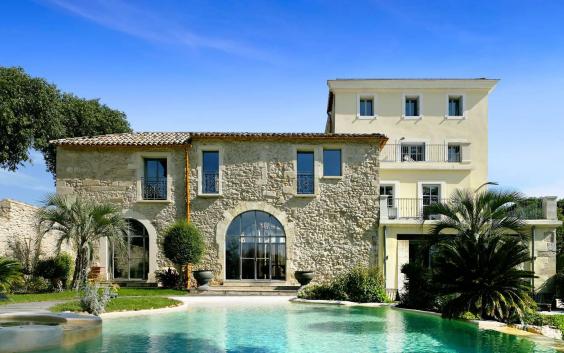
Surrounded by vineyards, 10 minutes from the centre, Domaine de Verchant (11), Boulevard Philippe Lamour, Castelnau le Lez (00 33 4 67 07 26 00; domainedeverchant.com) is a refined, 16th-century mansion with 26 contemporary furniture-filled rooms, three pools and gorgeous spa. Doubles start at €330, room-only.

domainedeverchant.jpeg
Domaine de Verchant

Day One

Take a hike

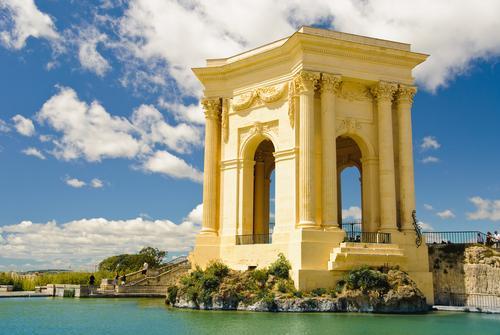
Start at one of the locals’ favourite places to rendezvous, the Fountain of the Three Graces on the Place de la Comédie (5). If it reminds you of Paris, that’s because it was remodelled in the 19th century in the same Haussmann-esque style as the capital. Bear right onto the cobblestoned Rue Jacques Couer and continue along the Embouque d’Or. Poke your head into the medieval style Gothic courtyard of the Hôtel de Varennes (12), one of 80 private mansions dotted around the Old City built between the 17th and 19th centuries. Bear left along la Petite Lodge to Place Jean Jaurès and continue up Rue de la Lodge, cross Rue Roch and along Rue de la Barralerie. Bear left onto Rue Montgolfier and then back on to the Rue Foch – on your right is the 19th-century, neoclassical-style Palais du Justice (13). Pass under the Arc de Triomphe (14), a 17th-century copy of the Parisian original built in honour of Louis XIV. You will arrive at the Place Royale du Peyrou (15); in front is the imposing Château d’eau monument (16) and stretching out in front of you, the Aqueduct Saint-Clement (17), built in 1754.

shutterstock_91666832_low_nwm_1.jpg
The Château d'eau (Shutterstock)

Lunch on the run

Join the queue outside Des Rêves et du Pain (18),10 Eugène Lisbonne (00 33 4 67 91 21 15; closed Sundays and Mondays) for one of its many delicious creations – it is considered to be one of the best bakeries in France. Or, order a cheese and charcuterie plate (€15) at specialist cheese shop La Fine Mouche (19), 12 rue Sainte Anne (00 33 4 67 54 70 47; lafinemouche.fr) and tuck in on the small square opposite. 

Window shopping

The Grand Rue Jean Moulin (20) is where you will find most of the big brand names. Rue Jacques Couer (21), Rue de l’Ancien Courrier (22) and the Rue Foch (23) are lined with small, interesting boutiques. Meanwhile, the shelves of Le Panier d’Aimé (24), 6 rue du Plan du Palais (00 33 9 83 2998 62; lepanierdaime.fr) are stacked with local specialities; honey, wine, cheese and confectionary, including local sweets Grisettes de Montpellier flavoured with honey or liquorice. 

An aperitif

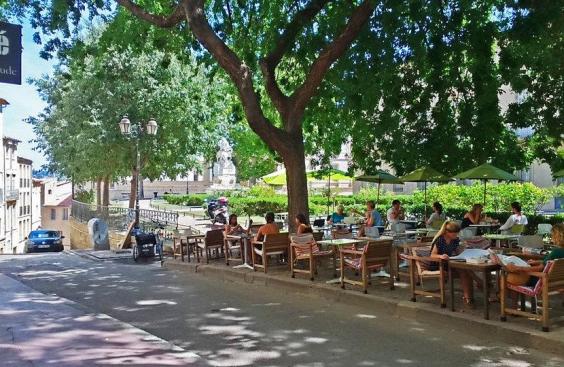
A glass of the local Languedocienne wine should be your preferred tipple and there are few more picturesque places to enjoy one than sitting at one of the outdoor tables overlooking the Place de la Canourgue, Montpellier’s oldest and most beautiful square. You can choose from a list of 32 wines from the local area and beyond at L’Atelier de la Canourgue (25), 3 Place de la Canorgue (00 33 4 67 55 06 65; latelierdelacanourgue.fr). €5. 

2-place-canourgue-marieh-3-.jpg
Place de la Canourgue

Dine with the locals

Le Petit Jardin (26) 20 rue Jean Jacques Rousseau (00 33 4 67 60 78 78; petit-jardin.com) has a magical courtyard garden and choice of two restaurants; a more formal affair and a casual bistro serving simpler dishes with salads, burgers and fish (€45). 

You can sit outside on the narrow street or in the small rustic dining room at Le Pastis (27) 3 rue Terral (00 33 4 67 66 37 26; pastis-restaurant.com). The short but delicious menu here is dictated by what the chef finds on his regular market trips (€50) such as marinated mackerel, peas, pickled shallots, mint and coriander. 

Day Two

Sunday morning: go to church

Montpellier has no shortage of beautiful churches, many of which are hewn from mellow, honey coloured stone. However, the fortress-like proportions of the Gothic-style Cathédrale Saint-Pierre (28), 1 rue Saint Pierre (00 33 4 67 66 04 12; cathedrale-montpellier.fr) is the most imposing. Its origins lie in a monastery and church built in 1364 by Pope Urban V. Mass is celebrated at 10.30am on Sundays. It opens daily from 9.30am-noon and 2.30-6.30pm and Sundays from 9am-noon.

Out to brunch

Set in the old Medical Royal College (29), La Panacée, 14 rue de l’École de Pharmacie (00 33 4 34 88 79 79; lapanacee.org) is an exhibition space and cultural centre dedicated to all things contemporary. It’s also home to a good café (lecafedelapanacee.com) that serves an extensive buffet brunch on Sundays from 10am (€18).

cafelapanacee.jpg
Café de la Panacée

A walk in the park

Montpellier’s shady Botanical Garden (30), 1 Boulevard Henri IV (00 33 4 34 43 36 20; umontpellier.fr) is one of the oldest in Europe, created in 1593 for Pierre Richer de Belleval – it was the blueprint for many that followed all over France including Paris. It’s now part of Montpellier University, but the botanists share its verdant avenues and greenhouses – filled with over 2,000 plants – with the general public six days a week. It opens Tuesday to Sunday noon-8pm, admission free. 

Take a ride

Montpellier has an extensive transport system with four tramway lines and a network of buses. The city also has over 120km cycle paths – you can easily pedal off to the seaside. The Vélomagg (00 33 9 69 39 00 99; tam-voyages.com) is the city’s rent-it-here, leave-it-there bike service with 56 stations dotted around the city. The first hour costs 50 cents and 50 cent per hour after that.

Cultural afternoon

The Musée Fabre (31), Boulevard Bonne Nouvelle (00 33 4 67 14 8300; museefabre.fr) is the city’s leading cultural institution, established in 1825 by the Montpellier-based painter François-Xavier Fabre. Its walls are hung with a rich collection of Flemish, Dutch, Italian, Spanish and French masters as well as temporary exhibitions. From now until 16 October it is staging a special exhibition dedicated to the work of Impressionist, Frédéric Bazille. It opens Tuesday to Sunday, 10am to 6pm, closed Mondays. Admission €7.  

François Rabelais and Nostradamus were just two of the distinguished former students of Montpellier University’s Faculty of Medicine (32) 1 rue de l’Ecole de Médecine. It was established in 1180 by Lord Guilhem VIII with an edict that anyone, regardless of their religion or nationality, could teach medicine at the school, which is the oldest continuously operating faculty in Western Europe. The adjoining Conservatory of Anatomy is an exceptional cabinet of curiosities with a collection of over 5,600 anatomical parts. Entry is only possible with a two-hour a guided tour booked through the tourist office (montpellier-france.com). Admission €12. 

1-entree.jpg
Le White Beach

Icing on the cake 

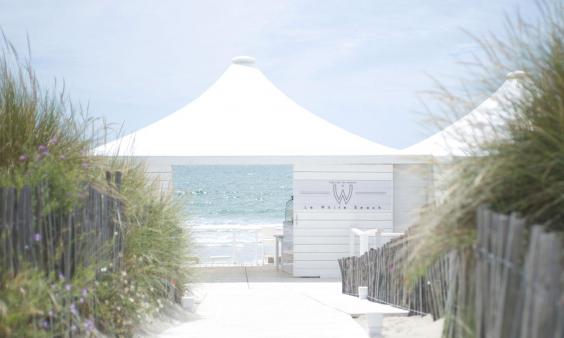
Montpellier lies just 11km from Mediterranean. In just 15 minutes you can be sunning yourself on one of the nearby beaches like Le Grand Motte. The White Beach (33) is a chic, private beach club with a restaurant and sun loungers for €19 per day (00 33 4 67 57 4098; lewhitebeach.fr). 

48 Hours in La Rochelle: restaurants, hotels and places to visit

Travel essentials

Why go now?

The world’s cliff-diving elite descends on this alluring city on France’s Atlantic coast this weekend for the Red Bull World Series. At least 75,000 people will throng the Vieux Port to watch the heart-stopping spectacle of professional divers launching themselves off the 14th-century Tour St-Nicolas (1). Once the hordes disappear, the port returns to its normal summer self – an agreeable mix of cafés, restaurants, craft stalls, buskers and chilled-out holidaymakers.

Touch down

Ryanair (0871 246 0000; ryanair.com) flies from Stansted and East Midlands; easyJet (0330 365 5000; easyjet.com) from Gatwick and Bristol; and Flybe (0371 700 2000; flybe.com) from Birmingham, Manchester and Southampton. 

The airport (2) is 5km from the centre. Bus no 7 runs to the central Place de Verdun (3) taking 15 minutes and costing €1.30 each way. From Monday to Saturday, it operates every 30 minutes, from 6.41am-8.33pm (yelo.agglo-larochelle.fr).

I travelled with Brittany Ferries (0330 159 7000; brittanyferries.co.uk), which has daytime and overnight crossings daily from Portsmouth to St-Malo, a three-and-a-half-hour drive away.

Trains (uk.voyages-sncf.com; eurostar.com) from the UK run via Paris and take around seven hours from London St Pancras to reach the city's grand-looking railway station (4).

Get your bearings

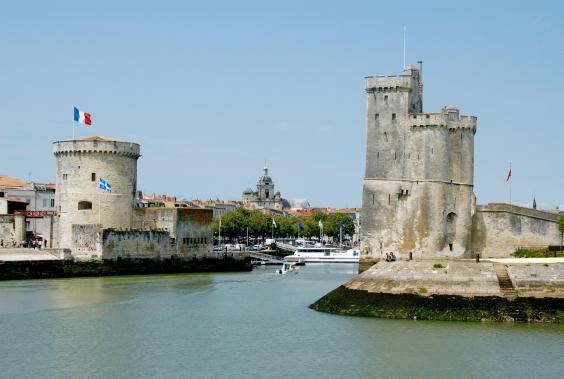
La Rochelle’s medieval towers – Tour St-Nicolas (1) and Tour de la Chaîne (5) – stand guard at the entrance to the Vieux Port and are the city’s emblems. Cafés fill two of the three quaysides, from which several pedestrianised streets fan out. Carry on through the elaborate 14th-century Porte de la Grosse Horloge (6) to the left of the port to reach the arcaded streets of the old town. South-west of the Vieux Port is Les Minimes, an enormous pleasure port, behind which is one of La Rochelle’s main beaches.

la_rochelle_towerscadam_batterbee.jpg
La Rochelle's medieval towers (Adam Batterbee)

The tourist office (7) is at 2 quai Georges Simenon south of the harbour in Le Gabut (00 33 5 46 41 14 68; holidays-la-rochelle.co.uk; en-charente-maritime.com), a district of colourful clapboard buildings that have more than a whiff of Scandinavia about them. About 500m south of here is the railway station (4).

Check in

The four-star Hotel La Monnaie (8) (00 33 5 46 50 65 65; hotelmonnaie.com) is in a handy location near the Tour de la Lanterne at 3 rue de la Monnaie. This 17th-century mansion has sleek, contemporary rooms as well as a small spa and works of modern art in the public areas. Doubles from €184, room only, and it’s worth upgrading from the standard size.

It’s only a short distance from the Porte de la Grosse Horloge (6), but the Vue sur Cour townhouse B&B (9) (00 33 5 46 27 70 59; vuesurcour.fr) at 10 rue Léonce Vieljeux is like staying in a French country cottage. Rooms flaunt antiques and tasteful florals, and some overlook the courtyard garden. Doubles from €120, including breakfast. 

Un Hotel en Ville (10) (00 33 5 46 41 15 75; unhotelenville.fr), at 20 Place du Maréchal Foch, stands out from its budget rivals thanks to its adorable roof terrace with views of the Tour de la Lanterne. Rooms are simple yet stylish, with doubles from €79, room only.

Day one

Take a hike

Start at the Tour de la Chaîne (5) on the Vieux Port’s western quay and wander past the row of restaurants. Head under the Porte de la Grosse Horloge (6) and stay cool under the porticos of rue du Palais. Eventually you’ll reach Place de Verdun (3) and St-Louis Cathedral (11). Veer right on to rue Gargoulleau towards Place du Marché (12), where the superb daily market takes place every morning both in the square and inside the 19th-century market hall.

Carry on past the shops along rue des Merciers, which leads to what remains of the Hotel de Ville (13). This splendid, 17th-century town hall was devastated by fire in 2013 and is in the process of being restored. After a stroll through the warren of arcaded streets, cross the pedestrian bridge from Quai Maubec (14) towards rue St-Nicolas, where there’s a Wednesday and Saturday all-day flea market. Turn right to walk through Le Gabut (15) and finish at Tour St-Nicolas (1).

Read more

  • 48 Hours in Montpellier: hotels, restaurants and places to visit in the capital of Languedoc-Roussillon
  • 48 Hours in Biarritz: restaurants, hotels and places to visit
  • 48 Hours in Aix-en-Provence: restaurants, hotels and places to visit
  • 48 Hours in Bordeaux: hotels, restaurants and places to visit in the capital of French wine country

Lunch on the run

Arrive early to find a table at any of the cafés surrounding the covered market (12). Oyster lovers can pick up a platter from one of the fishmongers in the market and take it to La Gerbe de Blé (16) (00 33 5 46 41 05 94) where, until 1pm, they’ll supply bread, butter and a table for €4.50. Throw in a glass of local wine for €3.

Window shopping

Rue St-Nicolas is the place for quirky, independent shops including 200km à La Ronde (17) at No 33, where all of its handmade jewellery, crafts and food products come from within 200km of La Rochelle. There are also wonderfully wacky gifts and artworks and at Pourquoi Pas (18) (boutique-pourquoipas.com) concept store at No 2. International shops are along rue St-Yon (19) and rue des Merciers, the latter home to a branch of Nature et Découvertes (20) (natureetdecouvertes.com) at No 9, possibly the trendiest outdoors shop you’ll come across.

Take a view

You’ve got three towers to choose from, and the combined ticket for €8.50 for all three is good value (tours-la-rochelle.fr; daily 10am-1pm and 2.15-6.30pm, closing 5.30pm October to April). Tour St-Nicolas (1), dating from 1376, shows signs of its past as a royal residence and a prison, and has a 37m rooftop terrace. Tour de la Chaîne (5) is slightly shorter, and within its 14th-century walls are engrossing exhibits telling the stories of French settlers in Quebec, Nova Scotia and Louisiana. Spiky Tour de la Lanterne (21) was rebuilt in the 15th century and still has graffiti etched into its stone walls from former prisoners.

Go to church

St-Sauveur Church (22) (00 33 5 46 41 16 70; paroisse-larochellecentre.fr) has had a battering history, and its flamboyant Gothic bell tower is its only remnant from the 15th century. The interior is a relatively restrained one, with simple vaulted ceilings giving it an intimate atmosphere. Until 20 September, there’s a fascinating exhibit of contemporary sculptures by French artist Claude Klimsza. Open Tuesday-Saturday 10am-12.30pm and 2.30-6pm, Sunday 4-7.15pm, with Mass at 6pm.

An aperitif

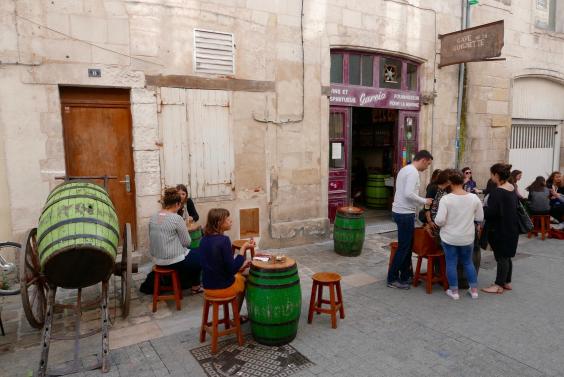
Mingle with the after-work crowd at Cave de la Guignette (23) (la-guignette.fr) at 8 rue St-Nicolas. It’s all industrial chic inside this friendly wine bar set in a old forge, where, alongside traditional French wines, you can drink its own refreshing version of light fruity wines for €8.50 a bottle. It’s purely for aperitif time, as it closes at 9pm.

cave_de_la_guignette_la_rochelle_cadam_batterbee.jpg
Cave de la Guignette (Adam Batterbee)

Cour du Temple manages to squeeze in several bars within this small square off rue du Temple, including lively Bar La Terrasse (24) and Mauvais Garçons (25)

Dine with the locals

Les 4 Sergents (26) (les4sergents.com) stands out among the long row of restaurants along pedestrianised rue St-Jean-du-Pérot between the Tour de la Lanterne (21) and Tour de la Chaîne (5). The cuisine is as classy as the greenery-filled atrium dining room, where two-course menus start at €20 and dishes include a slow-cooked egg with truffle cream and parmesan.

Day two

Sunday morning: out to brunch

Restaurant Prao (27) (prao.biz) at 10 rue St-Nicolas not only does excellent lunches and dinners, but also puts on a generous Sunday brunch from 11am to 2.30pm. You can have a “petit brunch” of eggs, pancakes and jam for €12, or go for “le québecois” blowout with eggs, bacon, sausage, roast potatoes and various extras for €22.

2005145d0ca0a3fcc3cfa7c7050eef08.jpg
Plage de la Concurrence

A walk in the park – and the beach

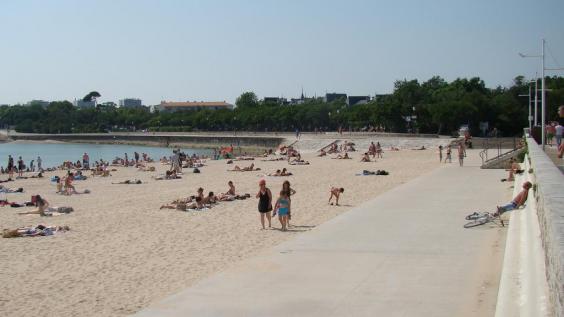
Flop on the sands at Plage de la Concurrence (28), west of the Vieux Port. It’s at the foot of Parc Charruyer (29), a narrow 350-hectare park that snakes its way north for nearly 2km. They’re La Rochelle’s lungs, with an animal park, mini golf, wooded paths and shaded streams.

Take a ride

From April to September, you can join a boat cruise and explore some of the islands in the Charente archipelago, including Ile d’Oléron (30) (France’s second largest) and tiny Ile d’Aix (31). Boats also give commentaries as they circle Fort Boyard (32), a fierce-looking fortress (and former location for a TV game show) built in the 19th century but deemed obsolete by the time it was finished. Boats leave daily from the jetty at Cours des Dames (33) and cost from €20 (holidays-la-rochelle.co.uk).

Cultural afternoon

The Musée Maritime de La Rochelle (34) (00 33 5 46 28 03 00; museemaritimelarochelle.fr) at Place Bernard Moitessier south of Le Gabut displays the long history of the city’s maritime industries, particularly fishing. You might need some French to get the most out of the exhibits in the main museum, but the chance to explore a retired meteorological frigate in the harbour is worth the cost of the €8 admission alone. Open daily from 10am to 7pm. 

While you’re on that side of the port, spare a couple of hours for the Aquarium (35) (00 33 5 46 34 00 00; aquarium-larochelle.com) in Quai Louis Prunier. It’s an enthralling and imaginative space, with 12,000 marine creatures in 83 aquariums as well as a tropical forest. Open daily from 9am to 11pm July and August; other times vary; admission €16.

shutterstock_35192341_low_nwm.jpg
The Ile de Ré (Shutterstock)

The icing on the cake

Cross the Pont de l’Ile de Ré (36) near La Rochelle’s airport and visit one of France’s most exquisite islands. It’s worth the €16 toll (payable only the way in) to explore this 30km by 5km island of whitewashed villages, long sandy beaches, vineyards and marshes filled with oyster beds and salt pans. Hourly buses go from La Rochelle’s train station (4) and Place du Verdun (3) and cost €5 for a day’s __travel (lesmouettes-transport.com).

48 Hours in Cartagena: restaurants, hotels and places to visit

TRAVEL ESSENTIALS 

Why go now?

Celebrate Spain’s Año del Modernismo 2016, the Year of Modernism, in a little-visited city with some prime some examples of early 20th-century architecture. But that is just the start. After the Spanish navy moved out of this magnificent deep-water Murcian port, the archaeologists moved in. Since then, the former naval base has been dramatically revived as a tourist hub that reveals the city’s history with a series of imaginative new attractions. The heritage of “New Carthage” makes Cartagena an ideal weekend escape, with easy access from the UK a bonus.

Touch down

Murcia San Javier airport (1) is only 20km north of Cartagena. You can fly in on easyJet (0330 365 5000; easyJet.com) from Bristol and Gatwick; on Jet2 (0800 408 1350; jet2.com) from Belfast, Leeds/Bradford, Manchester and Newcastle; and on Ryanair (0871 246 0000; ryanair.com) from Birmingham, Bournemouth, East Midlands and Manchester.

There is no direct bus from the airport to Cartagena. The main Murcia-Cartagena highway, which is served by bus, is 3km away. Otherwise a taxi will cost around €25.

If the fares to Murcia look too high, then consider Alicante and Madrid as alternative gateways; public transport from both is good, and you will arrive at either the handsome old railway station (2) or the distinctive bus station (3), topped with a tower that resembles a lighthouse. 

shutterstock_221565004_low_nwm.jpg
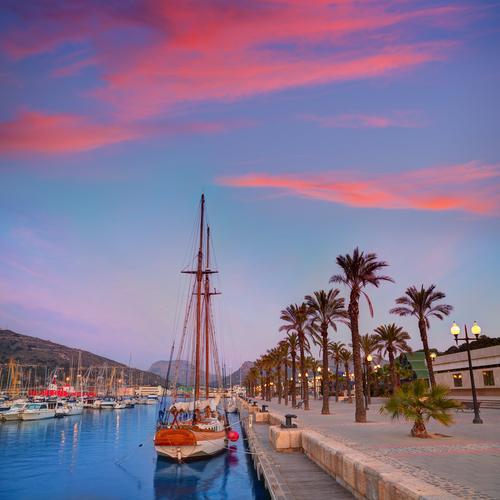
The port at sunrise (Shutterstock)

Get your bearings

Cartagena is poised between the Mediterranean and the Mar Menor, an “inland sea” on Spain's south-east coast

Most places of interest to the visitor are contained in an area enclosed by the city walls – long stretches of which are still intact. Wrapping around the old city are the broad Paseo de Alfonso XIII to the north, a strip of parkland and crooked avenue to the east, the seafront (and cruise terminal) to the south and the former naval docks to the west. 

The eastern tourist office (4) (cartagenaturismo.es) is built into the city walls on the Plaza Bastarreche. The western tourist office is part of the City Hall (5) on the Plaza del Ayuntamiento, Both open 10am-2pm and 5-7pm daily except Sundays (with the lunch break beginning at 1.30pm on Sundays); the western office also opens 10am-1.30pm on Sundays. 

Check in

Until the NH Cartagena (6) opened on the Plaza Héroes de Cavite (00 34 968 1209 08; nh-hotels.com), the city was short of an outstanding place to stay. The property brings boutique touches to an old naval building. Doubles typically cost €100-120, or a little more for a sea view. 

The three-star Hotel Los Habañeros (7), commemorating the port’s link with the Cuban capital, is close to the city’s eastern wall at Calle San Diego 60 (00 34 968 50 52 50; hotelhabaneroscartagena.com). Premium doubles cost €85, excluding breakfast.

The two-star Pensión Balcones Azules (8) is ideally located in the old city on the corner of Calle Balcones Azules and Calle Ignacio García (00 968 500 042; email pensionbalconesazules@hotmail.es). The clean and simple rooms are available for around €60, excluding breakfast.

DAY ONE

Take a hike

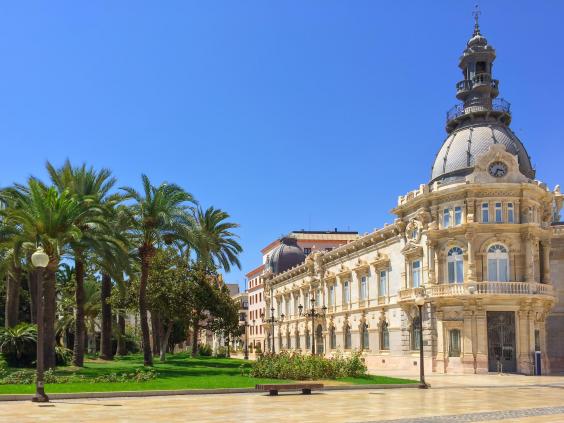
Calle Mayor and its continuations, Puerta de Murcia and Carmen, extend for barely more than a kilometre north-west from the Plaza de Ayuntamiento, but are full of interest. Start at the handsome City Hall (5), then note the Casa Cervantes (9) on the same side of the street a short way up - Víctor Beltrí began work on it in 1900, one of his earliest commissions in the city. The Capitanía General (10) is the opulent former naval headquarters, dating from 1738, while just across the Plaza San Sebastían the old Gran Hotel (11) - another work by Beltrí - is the city's the most lavish Modernista monument. HIs early 20th-century work continues in Casa Pedreño (12), with a final example of the city’s devotion to fine architecture in the neo-baroque flourishes of the Casa Dorda (13).

shutterstock_310793429.jpg
The Modernist City Hall (Shutterstock)

Window shopping

La Chinata (14), just back along Calle Carmen at number 33, is a delicatessen with a strong suit in extra virgin olive oil and sidelines in cosmetics. South of the muscular Artillery Headquarters (15), Calle San Fernando has some interesting gourmet locations – such as El Rincón Manchego (16) at number 34 (el-rincon-manchego.com).

The main produce market, Mercado Gisbert (17), is on Calle Gisbert. While it closes on Sundays, many other stores are open on the Sabbath so long as a cruise ship with more than 300 passengers is tied up in Cartagena.

Lunch on the run

You could assemble a picnic and enjoy it in one of the lovely squares, such as the Plaza de La Merced (18). But Cartagena has plenty of tempting lunch options, many of them offering a good-value menu del dia for €10-€12. Tucked away from the main drag at Calle Balcones Azules 12, the Cafetería El Molinete (19) offers something of the ambiance of the city before it was gentrified, and offers good-value seafood and meat dishes.

If you are happy to pay a little more, the Cibus gastrobar at the NH Cartagena (6) has an €18 menu including gazpacho, bacalao (cod) and dessert. 

Read more

  • Cordoba travel tips: Where to go and what to see in 48 hours
  • Malaga travel tips: Where to go and what to see in 48 hours
  • Menorca travel tips: what to see and do in 48 hours
  • 48 Hours in San Sebastian: restaurants, hotels and places to visit

Cultural afternoon

Cartagena’s history stretches back well before the birth of Christ. Carthago Nova became part of the Roman empire in 209BC, and was raised to a colony in 54BC – at which point investment poured in to create a forum and the amphitheatre. The layers are only slowly being peeled back, with some superb new attractions opening in the past decade. The fascinating Roman Theatre Museum (20), whose entrance is on the Plaza de Ayuntamiento provides an excellent preview for the amphitheatre (00 34 968 50 82 07; teatroromanocartagena.org). You wander from street level into a visitor centre designed by the leading architect, Rafael Moneo. It opens 10am-8pm from Tuesday to Saturday, 10am-2pm on Sunday, closed Monday; €6.

If Cartagena needed one more attraction to put it on the map, it has arrived in the ship-like shape of ARQVA (21), the Museum of Underwater Archaeology. Its half-submerged bulk occupies a stretch of the southern waterfront, just outside the walls (00 34 968 12 11 66; museoarqua.mcu.es). Highlights include remnants of a 7th-century BC wreck of a Phoenician ship, an Islamic serving dish depicting a ship and part of the cargo of the wrecked frigate, Nuestra Señora de las Mercedes - which sank in 1804 but whose treasure the Spanish government successfully claimed back from the US in 2012. It opens 10am-9pm from Tuesday to Saturday, 10am-3pm on Sundays, closed Mondays. Admission is free on Saturday afternoons (from 3pm) and Sundays; on other days, it’s €3.

An aperitif

Cartagena has only recently started to celebrate its waterfront, but since the marina was completed a string of bars has opened up along the shore - with Coyote (22) in the middle the most popular, if not the most authentic. For a more traditional tapas bar, just wander along Calle Mayor, where Cerverceria La Mejillonera (23) at number 4 (00 34 968 52 11 79) is among the best-value choices.

dsc_0016.jpg
El Encuentro

Dine with the locals

Infiltrating the old colonnade at Calle del Parque, 2, Taberna A La Brasa (24) offers a €20 tasting menu that includes salad, paella, a mixed grill and a drink. El Encuentro (25), on the corner of Calle Canón and Principe de Vergara, offers squid (€11) and a range of paellas, as well as the best steaks in town (elencuentrocartagena.com).

DAY TWO 

Sunday morning: go to church

At the Centre for the Interpretation of the Punic Rampart (26), an imaginatively conceived structure has been placed over excavations of a stretch of Carthaginian city wall created that predates the Roman era. You can roam around the structure - and discover the crypt of a late 17th-century Christian hermitage that nests within the rampart, complete with burial niches. It opens 10am-8pm daily, admission €3.50.

Take a view

On Calle Gisbert, an elevator (27) will lift you for a fare of €1 to the Castillo de la Concepción (28) – but before you explore the castle, take time to appreciate the view to the east from the top station of the lift, which includes the old bullring.

Walk up the zig-zagging path to the castle, which opens 10am-8pm daily, admission €3.75. The highest point in the city was originally the location for a Roman temple dedicated to the god of health, Asklepio, a Moorish citadel and, after the reconquest, the 13th-century castle bullt by Alfonso X. Climb to the top, both to admire the engineering prowess and more particularly the outstanding panorama – including the mighty headlands that protect the harbour, and which attracted waves of colonisers. During the Spanish Civil War, the air-raid siren was sounded from here (an air-raid shelter is adjacent to the ground station of the elevator).

Then walk west along the path that winds past the Roman Theatre (18), yielding even more views, and descend the steps to ground level.

Out to brunch

You emerge close to Plaza de Ayuntamiento, where the Chocolatería Valor (29) offers the indulgence of chocolate and churros (chocolateriasvalor.es). The best location for this Spanish treat, thought, is Churrería Tofi (30), on the corner of Calle Angel Bruna and Muralla de Tierra (churreriatofi.es). Note that it takes a break between 12.15-5.15pm each afternoon.

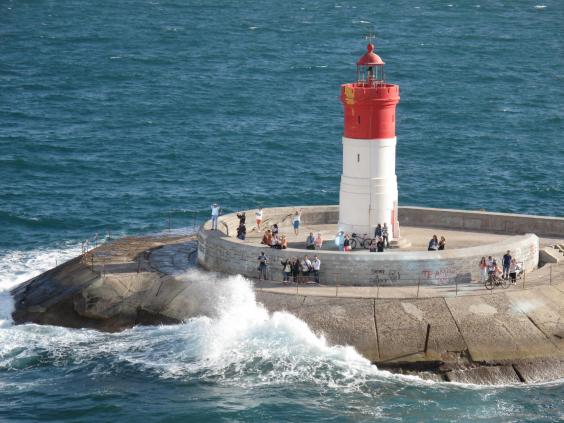
lighthouse.jpg
The lighthouse (Simon Calder)

Take a ride

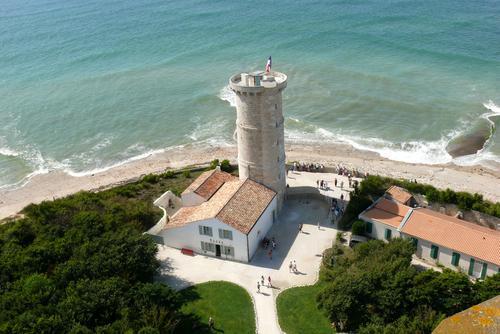
The Barco Turístico departs from the waterfront (31) each hour from 11am to 3pm, then half-hourly from 4.30-7.30pm for a trip around the harbour, providing a fresh dimension on the city and the chance to see the old submarine pens and the historic lighthouse (32) that guards the approach to Cartagena; fare €5.57 (cartagenapuertodeculturas.com). 

A walk in the park

The Molinete Archeological Park (33) is a 2012 addition to the cultural repertoire (00 34 968 50 00 93; cartagenapuertodeculturas.com). From the entrance on Calle Paraíso, you can roam across a hillside than includes relics of the Roman sanctuary, then study the meticulous archaeology that has laid bare the forum. The archaeological park has a canopy over the skeleton of the thermal baths and the atrium, together with some outstanding mosaics. It opens 10am-7pm daily except Tuesday,

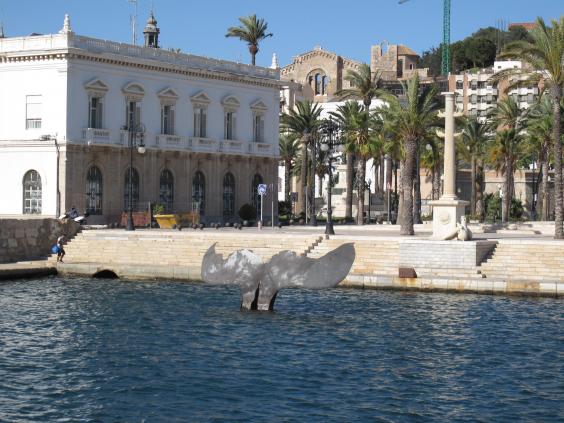
whaletailfin.jpg
The whale tail fin (Simon Calder)

Icing on the cake

Impressive street sculptures and military monuments are strewn around the city, including an old fighter plane on the eastern side, the Casa de Mar (34) to the south-east and a monument to Spanish struggles in Cuba in the Plaza Héroes de Cavite (35). The theme continues out into the water from here, in the shape of the tail fin of a whale.

Click here to view Spanish tours and holidays, with Independent Holidays.

Tuesday, 3 January 2017

Move over hygge, it's time for gemütlichkeit: How to spend a winter weekend in Berlin

Why go now?

The Scandinavians might have their hygge but the Germans have their own special take on that warm, cosy feeling: gemütlichkeit. And while Christmas may be over, gemütlichkeit is still very much in evidence in the city's cosy cafés and cool design shops.

Get your bearings

Though it’s no longer divided by a wall, Berlin is still a city of two halves, with two transport hubs and commercial centres, and even two zoos. The eastern half, in districts such as Mitte and Prenzlauer Berg, has most of the landmarks, museums and nightlife, though the latter still has fine shops and sights. Two roughly parallel waterways, the River Spree and Landwehr Canal, frame the centre.

  • Read more

Holiday in a tropical paradise inside a Berlin aircraft hangar

The transport network is divided into three zones; A, B and C. A single journey costs €2.70 in Zones A and B or €3.30 to Zone C. A day ticket costs €7, or €7.70 for all three zones. A Berlin Welcome Card combines a travel pass with discounts for attractions and tours and costs €19.50 for 48 hours.

Visit Berlin has a number of outpost dotted around the city, including a tourist office (1) by the Brandenburg Gate (2). It opens daily from 9.30am to 6pm. 

Day one

Take a view

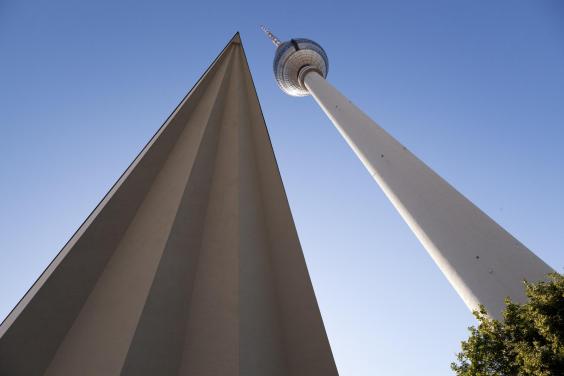
Almost as potent a symbol of the city as the Brandenburg Gate (2), the futuristic looking ball-topped spire of Berlin’s 1960s Fernsehturm (3) can be seen from all over. Pay a visit to the observation deck for a view of the city. Admission €13.

8413922218-3d350da39c-o.jpg
The space-age Fernsehturm (Philip Koschel/ visitBerlin)

Take a hike

Start outside the magnificent, Baroque-style Berlin Cathedral (4) the city’s biggest Protestant church, whose crypt contains several tombs of members of the powerful Hohenzollern dynasty. Cross over the River Spree and you’ll find yourself on Berlin’s best known promenade, “Unter den Linden”, immortalised in the song by Marlene Dietrich. As the name suggests, it’s shaded by linden trees, and it’s also lined with historic buildings such as the Deutsches Historisches Museum (5) and the State Opera House (6).

Continue until you reach Pariser Platz and the Brandenburg Gate (2), completed in 1791, which has been the backdrop for many momentous occasions in the city’s history.

Walk underneath then turn right and bear left on to Scheidemannstrasse until you arrive at Platz der Republik and the Reichstag (7). In 1999 British architect Lord Foster transformed the building and added its impressive glass dome.

4554958984-21708e26e6-o.jpg
Potsdamer Platz (Wolfgang Scholvien)

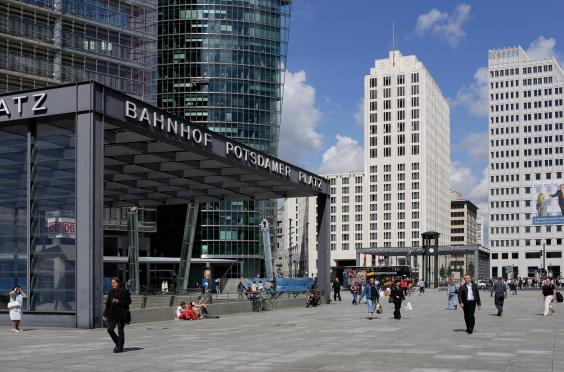
Retrace your steps past the Brandenburg Gate (2) and continue along Ebertstrasse; the Tiergarten (8) is on your left and to your right, the 2,711 concrete pillars of the Memorial to the Murdered Jews of Europe (9). Finish at the ultra-modern Potsdamer Platz (10), once a bombed-out wasteland, it has been transformed since the fall of the wall, with glossy contemporary buildings and a shopping arcade.

Lunch on the run

Invented in Berlin in 1949, currywurst is the ultimate local fast food: steamed and fried pork sausage slathered in a sauce made with ketchup and curry powder. The best currywurst is a hotly debated topic, but Bier’s Kudamm195 (11) has had a loyal following since it opened in 1965 and still draws crowds (€3.20).

Window shopping

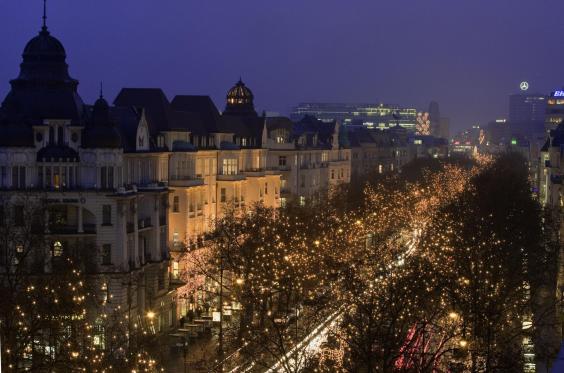
You can find all manner of shops, from chains to high-end international brands, on the Kürfurstendamm, remodelled in the 1870s to rival the Champs Elysees in Paris.

6052156781-7113af7c14-o.jpg
The Kurfürstendamm (Wolfgang Scholvien/ visitBerlin)

Opened in 1907, KaDeWe (12) is one of the city’s retail landmarks – don’t miss the gourmet shop on the 6th floor.

The nearby Bikini Berlin (13) is a West Berlin landmark built in 1957 by architects Paul Schwebes and Hans Schoszberger. It has been given a new lease of life as fashionable concept mall, with permanent and pop-up shops. 

An aperitif

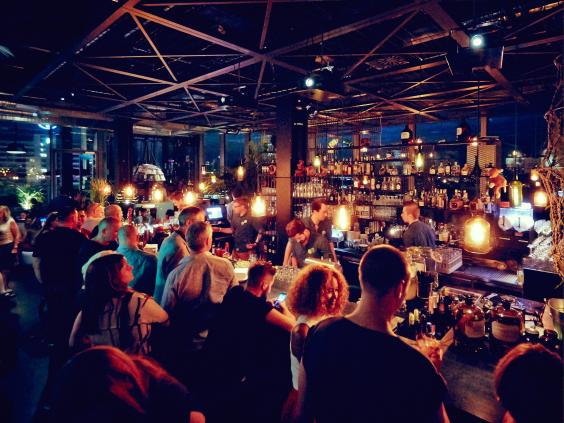
Set on the 10th floor of the 25Hours Hotel Bikini Berlin, in the Bikini building, the Monkey Bar (14) is one of the city’s hippest places for a pre-or post-dinner drink and has great views out over the zoo and Kaiser Wilhelm church from its floor-to-ceiling windows.

25hours-hotel-bikini-berlin-monkey-bar-farbe-gross-3.jpg
Monkey Bar

Dine with the locals

The brasserie-style Borchart (15) is where to come to spot the great and good of Berlin – be sure to book or you’ll have to join the never-ending queue. Wiener schnitzel served with potato salad and cranberry sauce is one of its specialties (€50).

The latest venture from two-star Michelin chef Tim Raue is Brasserie Colette (16), serving classic French fare like croquet monsieur, steak frites and moules (€40 for two courses).

Day two

Read more

  • Berlin's alternative nightlife, from cabaret to porno karaoke
  • In pictures: The world’s best cities for street art
  • Can you take Christmas crackers, frozen turkey and cheese on flights?

Sunday morning: Out to brunch

Brunch is something of a religion for Berliners. Although there are now more up-and-coming neighbourhoods, Kreuzberg remains one of the most boho and cosmopolitan parts of the city with a large Turkish community. Local hangout Le Bon (17) is the ideal place to tuck into eggs benedict, croque monsieur or granola. Brunch is served from 9.30am to 4pm on Saturday and Sunday. Booking advised.

A walk in the park

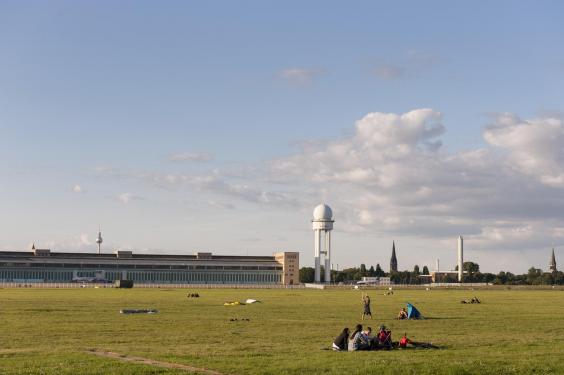
The abandoned Tempelhof airport (18) is one of the largest Fascist-built structures in Europe. Closed in 2008, this sprawling green expanse became Berlin’s newest and largest park in 2010 and was renamed Tempelhofer Feld.

8413998662-7623c209d1-o.jpg
Tempelhofer Feld (Philip Koschel/ visitBerlin)

Cultural afternoon

Berlin is one of the great museum cities with over 180, from the celebrated to quirky.

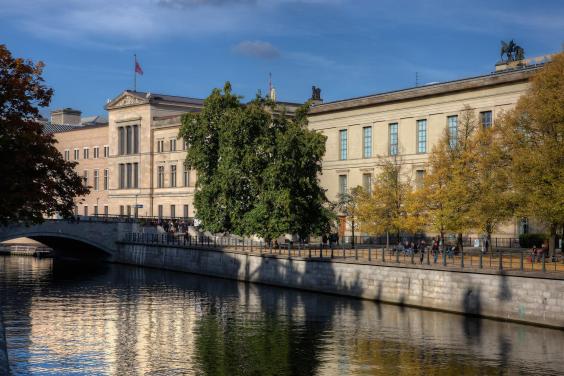
There is no shortage of cultural riches on the Unesco World Heritage-listed Museum Island (19). This cluster of five of Berlin’s finest institutions, built between 1830 and 1930 on an island in the Spree, includes the restored Neues Museum, the Altes Museum, the Alte Nationalgalerie, the Bode Museum and the Pergamonmuseum.

8413922148-91ea9f5ceb-k.jpg
Neues Museum (Wolfgang Scholvien/ visitBerlin)

The latter’s most precious exhibit, the monumental Ancient Greek Pergamon Alter, dating from 2BC, is currently off limits due to ongoing renovation; the entire complex is being remodelled. Open Tuesday-Sunday 10am-6pm. Closed Monday. A day-pass to all five museums costs €18.

The icing on the cake

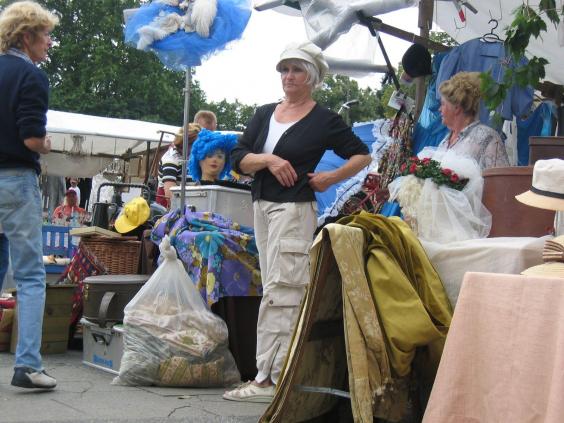
Must of the city shuts down on Sundays; do as the locals do and visit one of Berlin’s many flea markets. The Berliner Trödelmarkt (20), in the Tiergarten, is the largest with a trove of antique finds.

13979208-af4c80bec4-o.jpg
Berliner Trödelmarkt (Martino Sabia/Flickr)

Travel essentials

Getting there

Until the controversial new Berlin Brandenburg airport is finished (reportedly at the end of 2017), the city’s two main airports are Tegel (21), 9km northwest of the centre, and Schönefeld (22), 24km south east.

From the UK, Tegel is served by Flybe, BA and Germanwings, while Schönefeld is served by Ryanair, easyJet, Jet2 and Norwegian.

From Tegel, the X9 bus to Zoo station (23) takes 20 minutes; the TXL bus to Alexanderplatz (24) about 30 minutes. A taxi takes roughly 15 minutes (around €20).

From Schönefeld, take the train: Deutsche Bahn’s Airport Express runs every 30 minutes and takes around half an hour to reach Berlin Hauptbahnhof (25) (central station), while a taxi costs around €45 and takes about 40 minutes.

Staying there

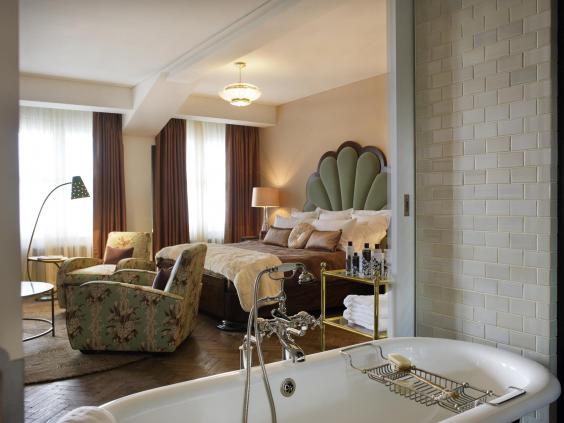
A former Bauhaus department store in Mitte is the backdrop for the enduringly fashionable Soho House Berlin (26). It’s done out in the group’s signature style – Damien Hirst spray-painted one of his sharks on a wall in reception. Doubles from €210, room only. 

berlin-bedroom.jpg
Soho House Berlin

Sir Savigny (27) is one of the newest arrivals on the Berlin hotel scene, a 44-room hotel set in a building dating from 1893 in the genteel neighbourhood of Charlottenberg. Doubles from €150, room only.

Neukölln is another one of the city’s hipster enclaves and the presence of the Hüttenpalast (28) is testament to its on-trend credentials. You can stay in retro caravans and cabins within this former vacuum cleaner factory, or opt for one of six hotel rooms. Cabins from €69 per night, room only.

Monday, 2 January 2017

48 Hours in Athens: hotels, restaurants and places to visit

Travel essentials

Why go now?

The Greek islands are renowned as summer hotspots, yet the capital is rarely seen in the same light. But Athens is a fine prospect in August, a starting point for twin-centre holidays which also visit the nearby Peloponnese peninsula, 50 miles to the west and - with a wealth of untouched little villages and ports - a rising star itself. The Athens and Epidaurus Festival (00 30 210 327 2000; greekfestival.gr), a feast of drama, dance and music staged at various venues, continues through the month.

Touch down

Eleftherios Venizelos Airport (1) (00 30 210 353 0000; aia.gr) is 17 miles east of the city. It is linked to the UK by Aegean Airlines (0871 200 0040; aegeanair.com) from Heathrow and Birmingham, and by British Airways (0344 493 0787; ba.com) from Heathrow. easyJet (0330 365 5000; easyjet.com) flies direct from Edinburgh, Manchester and Gatwick, while Ryanair (0843 504 7252; ryanair.com) offers a connection from Stansted.

Line Three of the Athens metro ties the airport to the heart of the matter, including central stations Monastiraki (2) and Syntagma (3), in 40 minutes; single fares are €10 (returns within 48 hours are €18). Airport bus X95 makes the journey to Syntagma Square (3) in 50 minutes, for €6. Taxis take 40 minutes at fixed rates of €38 in the daytime and €50 between midnight and 5am.

Get your bearings

Athens is located almost at the south-east corner of the Greek mainland, and is the capital of the Attica region as well as the country. It spreads out, as it has for at least 7,000 years, around the Acropolis (4) – its landmark rock bluff, crowned by the Parthenon (5) temple since 447BC.

It is easily explored on foot – although the three-line, 65-station metro system covers the city in detail. Single tickets for all journeys in the centre (metro, buses, trams; 00 30 214 414 6400; stasy.gr) cost €1.40, 24-hour passes €4.50. A tourist information kiosk (6) is open on Amalias Ave Dionissiou Areopagitou Street, daily 9am-9pm, between May and September (00 30 210 321 7116; thisisathens.org). A year-round kiosk is available at the airport (1) (daily 8am-8pm; 00 30 210 353 0390). Further details can be found at visitgreece.gr.

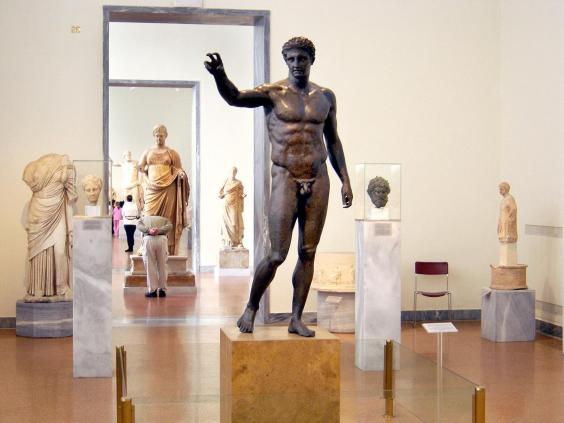
0028man-room3.jpg
Explore ancient history in the National Archaeological Museum (Ricardo André Frantz, WikiCommons)

Check in

The Hermes Hotel (7) is a three-star close to the heart of the action at 19 Apollonos Plaka in Plaka (00 30 210 323 5514; hermeshotel.gr), with a cool bar and a children’s play room. Double rooms from £64, with breakfast. 

St George Lycabettus (8) is a boutique gem - with a glorious rooftop pool - on the lower slope of Lycabettus Hill, above Kolonaki (2 Kleomensus Street; 00 30 210 729 0439; sglycabettus.gr). Doubles from €88, room only.

Hotel Grande Bretagne (9) (00 30 210 333 0000; grandebretagne.gr) is the five-star king of Syntagma Square (3) – all 19th-century echoes, with doubles from €230, room only.

Day one

Take a hike

Begin a morning wander into antiquity in central Monastiraki Square (2). Stroll south on Areos, past Hadrian’s Library (10), a seat of learning from the Roman era that was built in 132AD. It still stands firm, all staunch columns.

Find more of the same as you go south on Dioskouron – where the Roman Agora (11) was one of the city’s focal points in the 1st century BC. The Tower Of The Winds, a grand marble clocktower, is still visible.

shutterstock-449219146.jpg
Take a hike up Mount Lycabettus for an overview of Athens - or, if you're feeling lazier, hitch a ride on the funicular (Shutterstock)

From here, cut west on Polignotou, and take the path around Areopagus Hill. This gives a leafy view of the Acropolis. Continue to pedestrian drag Dionysiou Areopagitou, and follow it clockwise to number 15 – where the Acropolis Museum (12) is a treasure trove of ancient heritage (00 30 210 900 0900; theacropolismuseum.gr; entry €5). Open daily 8am-8pm (Monday to 4pm; Friday to 10pm), it makes a case for the return of the “Elgin Marbles” – the reliefs which were chiselled from the Parthenon (5) by aristocratic magpie Thomas Bruce from 1800 to 1803. A gallery displays the carvings which survived this act of appropriation – alongside replicas of those that currently reside in the British Museum.

Read more

  • Summer without the crowds: escape to Greece's quiet corners
  • Travel guide to... Mainland Greece
  • Five new hotels to check out in Greece

A walk in the park

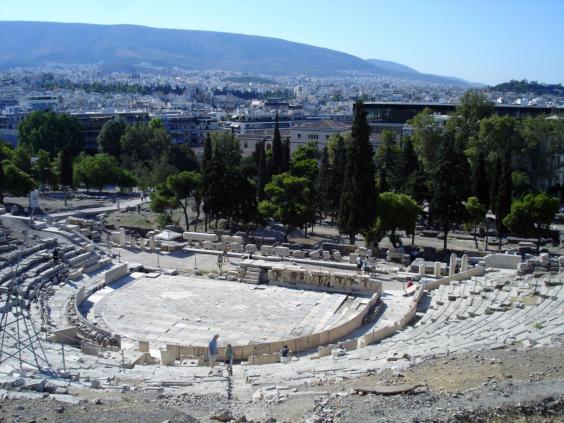
The main entrance to the Acropolis (4) (00 30 210 321 4172; odysseus.culture.gr; daily 8am-8pm; €20) is directly opposite the museum on Dionysiou Areopagitou. You need at least two hours to explore this craggy wonderland, hiking up towards a date with the Parthenon (5), the temple to the city’s patron ancient goddess, Athena. It ranks as an epic symbol of civilisation, as does the Theatre of Dionysus Eleuthereus (13), on the south side of the hill. Dedicated to the ancient Greek god of drama and wine, this 4th century BC auditorium held 17,000 people in its heyday – and retains its splendour in the present.

Lunch on the run

The eateries on nearby Makrigianni are tourist traps, but Yard Cafe (14) at No 17 (00 30 210 923 9792; yardcafe.blogspot.co.uk) is a solid pitstop, serving dishes such as pork fillet with figs for €12.

dionisov-teatar-u-akropolju.jpg
The Theatre of Dionysus is dedicated to the Greek god of drama and wine (Славен Косановић, WikiCommons)

Window shopping

Ermou is the city’s main pedestrian drag. Le Chocolat – Matsouka (15), at No 18 (00 30 210 331 8010; chocolat.com.gr), is a hive of olive oils, wine and Greek produce, as well as fancy chocolate.

The chic Kolonaki district, meanwhile, has some of Athens' best stores. Home décor specialist Box Architects (16) at 9 Charitos (00 30 210 724 8600; boxarchitects.gr) sells lights and lamps in an array of shapes. Jack In The Box (17) at 13 Charitos (00 30 210 725 8735; jackinthebox.gr) is a superb toy shop, full of tricycles and cuddly bears.

An aperitif

Set parallel to Ermou, Kolokotroni is an avenue abuzz with bars. Booze Cooperativa (18), at No 57 (00 30 211 405 3733; boozecooperativa.com), is one of the liveliest; part watering hole, part gallery, with modern artworks on the walls and craft ales for €4.

Dine with the locals

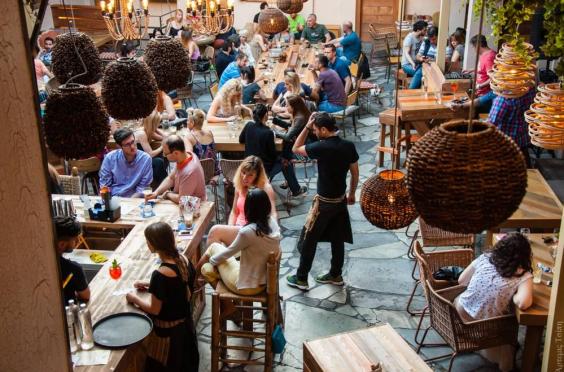
Thissio has many food options on the narrow lane of Herakleidon. The Sowl (19), at No 10 (00 30 210 345 0003; thesowl.com), is a Latin hotspot that dispenses a citrus-heavy seabass ceviche for €10.60.

Psirri is a maze of restaurants. Oineas (20) at 9 Aisopou (00 30 210 321 5614; facebook.com/oineas) serves modern Greek fare, including grilled octopus for €9.50. Liosporos Jazz Cafe (21), at 24 Miaouli (00 30 213 024 9151), clings to Greek traditions – such as soutzoukakia (minced lamb with tomatoes and basil) for €6. 

13301501-517395231779613-1898439984871874756-o.jpg
The Sowl is a sizzling Latin-themed hotspot serving a mean sea bass ceviche (The Sowl, Facebook) 

Day two

Sunday morning: go to church

A religious jewel on Plateia Mitropoleos, the Metropolitan Cathedral (22) (00 30 210 322 1308; daily 7am-7pm; Sunday mass at 6.30am) is one of the city’s most important buildings. It was one of the first landmarks constructed in the capital after Greece wrested itself away from Ottoman control in 1829 – built between 1842 and 1862, using masonry from 72 demolished churches, as a statement of national identity. A place of contemplation, it holds the tombs of two saints (Philothei and Gregory V of Constantinople) who were killed under Turkish rule. Adjacent, the Mikri Mitropoli (23), a tiny church, dates to the 13th century.

Out to brunch

Grab a bite next to the cathedral at Commerce (24) (00 30 210 322 5533) at 5 Evangelistrias, one of a clutch of eateries on this Monastiraki street that are raising their level above photos-on-menu mediocrity. A plate of grilled Crete sausages with sour cabbage is €9.

Cultural afternoon

If you want to experience more of the past, the National Archaeological Museum (25), at 44 Patission, in the slightly more northerly Exarcheia area (00 30 213 214 4800; namuseum.gr), is an Athens essential. Open daily 8am-8pm (€10), it has been a shrine to Ancient Greece since 1889. Exhibits include the Artemision Bronze – a sculpture of (probably) Zeus that was discovered in a shipwreck off the country’s northern coastline in 1926 – as well as the Mask of Agamemnon (a gold funeral mask, dated to 1,500BC, which supposedly belonged to the Mycenaean king who commanded the Greek forces at Troy).

5117913417-74d7391dcc-o.jpg
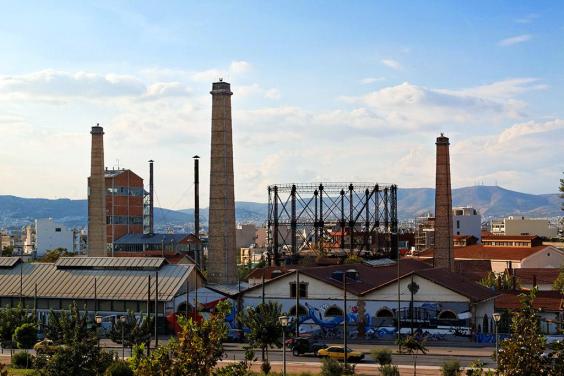
Athens' Technopolis is a 19th-century gasworks repurposed as a hipster-ish hive of music and art (Dinos P, Flickr)

To glimpse a more modern side of the city, try the Technopolis City of Athens (26) at 100 Pireos Street in the Gazi district (00 30 210 347 5518; technopolis-athens.com). A 19th-century gasworks reimagined as a hotspot of music and art, it includes the Industrial Gas Museum (daily except Monday, 10am-6pm; €1), which preserves machinery of this oil-rag era. It also has the Skywalk, an aerial nest of suspended bridges and walkways (daily 10am-10pm; free).

Take a view

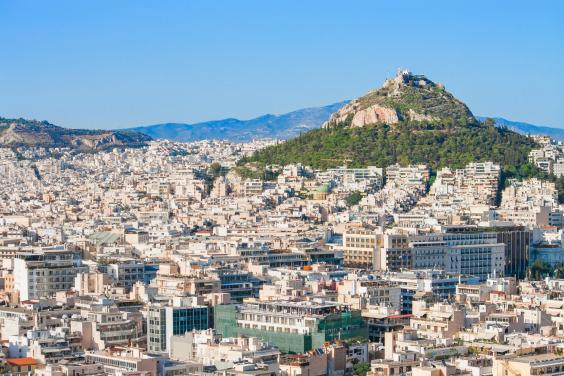
Rising to 908ft (277m), north-east of the centre, Mount Lycabettus (27) offers a wide snapshot of the city. You can approach the summit on foot, taking the trail which presents itself on Kleomenous, to the rear of the St George Lycabettus hotel (8) – an upward route which is awash with cacti and slow-moving tortoises. Or you can take the funicular - its base station waits at Aristippou 1 (28) (daily 9am-2.30am; €3.50 each way). This saves on shoe leather, though you have to walk up steep Ploutarchou to find it. The 19th-century Chapel of St George is a whitewashed joy on the hilltop.

The icing on the cake

Elsewhere on the summit, you can take in the sunset from the terrace at Orizontes Lycabettus (00 30 210 722 7065; orizonteslycabettus.gr) – a seafood specialist serving specialities including sautéed sea bream in citrus sauce for €19.

Click here to view our Classic Greece Tour, with Independent Holidays

48 hours in Dublin: hotels, restaurants and places to visit

Travel essentials

Why go now?

This time of year sees a number of festivals and events taking place in the capital. Many of the country’s historic properties fling open their doors with special events for National Heritage Week (heritageweek.ie), from 20 to 28 August. Microbreweries have been riding a wave of popularity all over the country, so much so, there’s now a festival dedicated to it. The Irish Craft Beer Festival (irishcraftbeerfestival.ie) takes place from 8 to 10 September at The Royal Dublin Society (1) and is a chance to sample a vast array and meet the makers. Tickets cost €10. And finally, Ireland’s theatrical credentials are well known the world over. The Tiger Dublin Fringe Festival (fringefest.com) takes place from 10 to 25 September with more than 300 performances over its run. 

Touch down 

There are numerous flights from the UK to Dublin with airlines including Ryanair (0871 246 0000; ryanair.com), Aer Lingus (0871 718 5000; aerlingus.com), CityJet (0871 666 5050; cityjet.com), Flybe (0871 700 2000; flybe.com) and British Airways (0344 493 0787; ba.com). There are also ferries to Dublin with Stena Line (0871 244 1545; stenaline.co.uk) and Irish Ferries (08717 300 400; irishferries.com) from around 190 return. 

Dublin Airport (2) is 12km north of the centre. There is no rail link but the 24-hour Aircoach shuttle (00 353 1 844 7118; aircoach.ie) provides a handy alternative, which runs every 10 minutes at peak times and stops throughout the city; €7 one-way, €6 if booked in advance online.

Dublin Bus (00 353 1 873 4222; dublinbus.ie) also operates the 747 Airlink to the Central Bus Station (3) priced at €6 one-way, and has just introduced a new 757 route - useful if you are staying on the south side of the Liffey with stops at Grand Canal Dock (4), Merrion Square (5) and St Stephen’s Green (6). A taxi will cost about €25 one-way.

Get your bearings

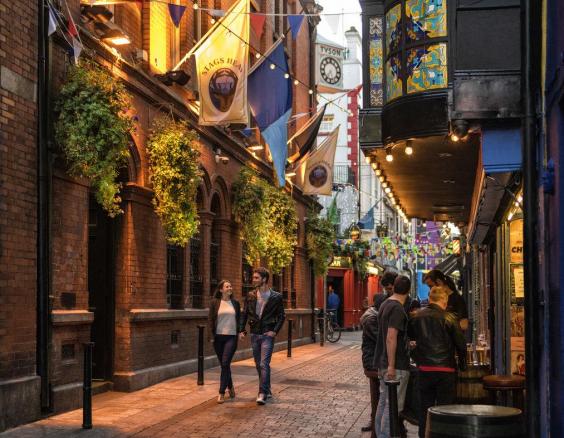
Dublin’s natural dividing line is the River Liffey, which flows languorously out towards Dublin Bay. O’Connell Street is the city’s spiritual heart and its monumental General Post Office (7) was where the main events of the Easter Rising took place 100 years ago, changing the course of Irish history forever.

South of the river is the cobblestoned streets of Temple Bar (8), Trinity College (9) and a mostly intact Georgian streetscape around St Stephen’s Green (6), Merrion (5) and Fitzwilliam Squares (10). Further east is the city’s regenerated Docklands area (11).

The Discover Ireland Centre (12) is set in the former Church of St Andrew on Suffolk Street (00 353 1 605 7700; visitdublin.com). It opens 9am-5.30pm Monday to Saturday, Sundays 10.30am-3pm.

medium-rdp-20140909-00457.jpg
Temple Bar is known for its lively nightlife and is a favourite spot for savouring a Guinness (Rob Durston)

Check in

The Merrion (13) on Upper Merrion Street (00 353 1 603 0600; merrionhotel.com) offers a glimpse into the grandeur of Georgian era Dublin - albeit with more modern luxuries - and spans four stately mansions opposite Ireland’s seat of parliament, known as The Dail (14). Doubles cost from €295 per night, B&B.

With rooms like Mod Pod and Punk Bunk, there’s a hip, youthful vibe at The Dean (15), 33 Harcourt Street (00 353 1 607 8110; deandublin.ie), a design-conscious spot carved from a terrace of Georgian townhouses. There’s a great cityscape from the rooftop Sophie’s Bar and Restaurant. Doubles from €155, room-only.

The Generator (16) on Smithfield Square (00 353 1 901 0222; generatorhostels.com) is one of the best budget options - with private rooms costing from €65 per night, B&B. 

Day one

Take a hike

Start on the northside of the River Liffey and cross via its main point, O’Connell Bridge (17), for fine views in both directions. Continue along Westmoreland Street and soon you will arrive at College Green (18); to your right is the imposing Bank of Ireland Building (19), the erstwhile seat of power under British rule.

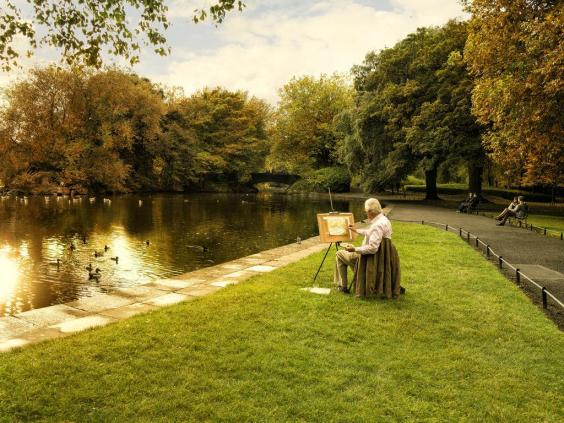
Bear left and pass under the landmark arch of one of Ireland’s most influential seats of learning, Trinity College (9). Cross the quad and pass the college’s leafy lawns and playing fields, exiting at Lincoln Place. Continue along Clare Street and bear right onto Merrion Square (5), bordered on all sides by elegant Georgian townhouses. To your left is the National Gallery of Ireland (20) and on Upper Merrion Street, The Dail (14). Bear right down Merrion Row and you will emerge onto St Stephen’s Green (6), Europe’s largest city square. 

medium-rdp-20140930-08073.jpg
St Stephen's Green is reputed to be the largest city square in Europe (Rob Durston)

Lunch on the run

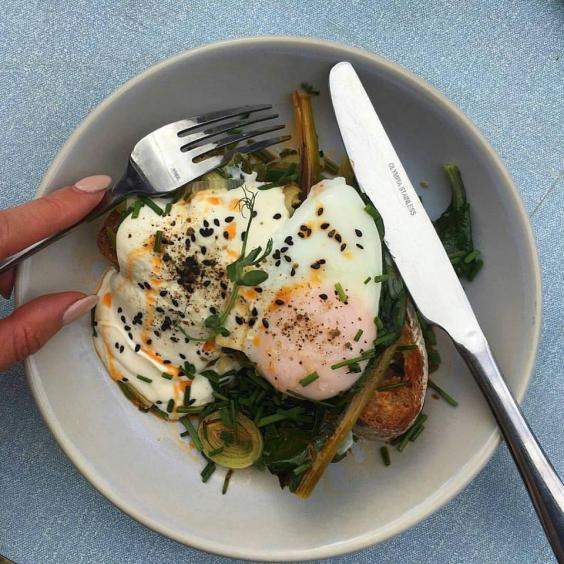
Named after a Bob Dylan lyric, the recently opened Meet Me in the Morning (21) (50 Pleasants Street, find them on Facebook), has swiftly risen to the top of foodies’ lists, garnering wild praise for its winning formula of interesting food and specialty coffee served up in friendly surroundings. The 'egg and greens' has already become a staple, while gazpacho with black kale on toast is another to try if it’s on the menu. From €10. 

Window shopping

Grafton Street is the city’s main upmarket retail row. Browse designer department stores Brown Thomas (22) at 88-96 Grafton Street (00 353 1 605 6666; brownthomas.ie) and Avoca (23), on neighbouring Suffolk Street (00 353 1 677 2451; avoca.ie). There's also a burgeoning scene of independent small boutiques on Drury Street (24)

An aperitif

Dublin has its fair share of urbane cocktail and wine bars, but for most people a highlight of any visit is the opportunity to sip a pint of Guinness in one of the many traditional pubs dotting the city. Try Grogans Castle Lounge (25) at 15 William Street (00 353 1 677 9320; groganspub.ie), a one-time haunt of literary giants like Patrick Kavanagh, J.P Donleavy and Flann O’Brien, who immortalised it in 1939 novel At Swim-Two-Birds

egg1.jpg
The egg and greens has become a staple dish at relaxed specialty coffee and food cafe Meet Me in the Morning (Meet Me in the Morning)

Dine with the locals

The just opened Charlotte Quay (26) at swish Millennium Tower (00 353 85 757 9198; charlottequay.ie) is Dublin’s latest must-dine. Slightly off the beaten path with a pleasant waterside location, it’s the latest venture from the team behind the city centre’s hopping Coppinger Row. A buzzy, casual atmosphere prevails and the menu looks towards the Middle Eastern for inspiration. Main meals here can nudge up to €30.

Or join the queue for a place at tiny Forest & Marcy (27), 126 Leeson Street Upper (00 353 1 660 2480; forestandmarcy.ie), an offshoot of Forest Avenue around the corner. It serves innovative sharing plates, like fermented potato bread with bacon and cabbage, and an impressive list of small-producer wines. Small plates cost anything between €4 and €20.

Day Two 

Sunday morning: a quick history lesson

This year Ireland celebrated the 100th anniversary of the Easter Rising - the armed insurgence of Irish republicans determined to end British rule in April 1916. While the uprising failed, it won more public support for republicanism and reset the course of Irish history. Richmond Barracks (28), off Bulfin Road in Inchicore (00 353 222 8400; richmondbarracks.ie), was where many of the insurgents were held before being moved to Kilmainham Gaol, and in June it opened an exhibition dedicated to their stories. It opens on weekdays from 10am to 4pm and on Saturdays and Sundays at 11am (access is only by pre-booked guided tours at the weekend). Admission and tour costs €8 total per adult. 

Ireland’s globetrotting diaspora is the subject of one of the city’s latest attractions, EPIC (29), at The chq Building, Custom House Quay (00 353 1 531 3688; epicirelandchq.com). The museum tells the story of the Irish abroad, revealing surpising insights into some well-known figures’ Irish ancestry - like Charles de Gaulle and Billy the Kid. It opens daily from 9am to 6pm and admission costs €16, advance booking recommended. 

medium-rdp-20141002-05018.jpg
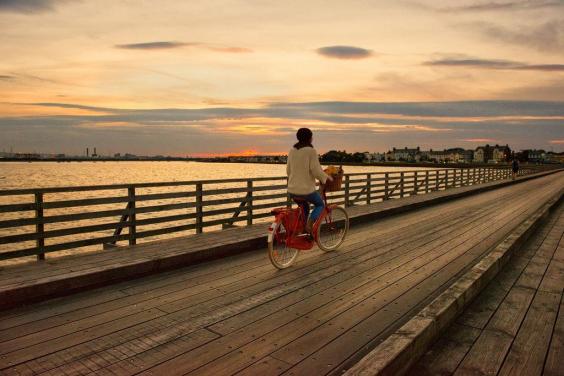
Cycling Dublin's sea walls is a lovely way to admire Dublin Bay. Pictured here is Bull Wall, which faces the longer Great South Wall (Rob Durston)

Out to brunch

Breakfast is a relaxed affair at The Fumbally (30) (00 353 1 529 8732; thefumbally.ie), which occupies a bright space on the busy Clanbrassil Street. Try Fumbally Eggs, €6, lightly scrambled with Gubbeen cheese on brioche. They also make a mean latte.

A walk in the park

The National Botanic Gardens (31) in Glasnevin (00 353 1 857 0909; botanicgardens.ie), just 3km from the city centre, are well worth a wander. Established in 1795, there are over 17,000 different plants cultivated here from all over the world, including six that are already extinct in the wild. Admission is free and guided tours are free on Sundays. From March to October it opens weekdays from 9am to 5pm, and at 10am to 6pm on Saturdays and Sundays. 

On your bike

Hire one of the bicycles from sharing scheme "dublinbikes" (dublinbikes.ie) and cycle along the sturdy granite flagstones of the Great South Wall (32). Extending for 4km into Dublin Bay, it's one of the longest sea walls in Europe. At the end is the distinctive Poolbeg Lighthouse, painted red to indicate portside for ships entering Dublin port, and there are sweeping views of Dublin Bay and its suburbs. 

medium-rdp-20140929-8232.jpg
For a proper Dublin experience, take a dip at The Forty Foot, a favourite bathing spot in Sandycove (Rob Durston)

The icing on the cake

One of Dublin’s most alluring traits is the ease with which you can leave behind the urban streets and escape to the seaside. Pack your swimming costume and take the DART (Dublin Area Rapid Transit) from Pearse Street Station (33) to Sandycove (a single to Sandycove is €3.25 for an adult). From there, it’s a short stroll to The Forty Foot, one of Dublin’s enduring bathing spots, mentioned in the opening chapters of James Joyce's Ulysses. Once the preserve of male bathers, now everyone takes the plunge together come rain or shine.  

Click here to view our tour of Waterford, Wexford and the Garden of Ireland, with Independent Holidays