Thursday, 4 May 2017

Why Costa Rica is on our wish list

Did you catch Channel 4’s Sunday night show Escape to Costa Rica? Environmental journalist Gaia Vince revealed how the country is leading the way in sustainable development and eco-tourism. And that’s not the only reason to visit. Here’s why Costa Rica is the place to be…

Costa Rica is one of the most eco-friendly places on the planet, and it’s easy to see how the Central American country is making the world more environmentally-friendly. Last year it managed a huge 299 days without burning oil, coal or natural gas, and already 99% of its electricity comes from renewable sources. The country even plans to become carbon neutral by 2021, and follow in Iceland’s footsteps.

And First Choice have a hand in sustainable tourism, too. Our RIU hotels, including the RIU Guanacaste, have set up a private conservation area in Costa Rica, covering over 200 hectares of land. This area provides a home to 250 plant and animal species which are facing extinction, and RIU also have plans to combat illegal hunting and prevent forest fires.

If that’s not reason enough, here’s why you should visit…

It’s the happiest country in the world

According to the Happy Planet Index, Costa Rica is the most satisfying place to live and one of the happiest countries in the world. The scale measures human well-being against environmental impact and, just to give you some comparison, Britain is 34th on the list! Besides living in an amazing tropical location, there are several things that make Costa Ricans happy. The peace-loving nation favour a simple lifestyle, have one of the highest literacy rates in the world at 97%, and an impressive life expectancy, with residents frequently living beyond 100. You’ll even find the United Nations University for Peace located in Costa Rica, which says everything really.

25% of the country is made up of National Parks and conservation areas

Costa Rica has everything you’d expect from a tropical paradise – thick rainforests filled with thousands of species of exotics plants, long stretches of white-sand beaches and soaring volcanoes, all ripe for exploring. A quarter of the country is made up of protected conservation areas, giving you the best pick of nature reserves and wildlife sanctuaries to explore. The Monteverde Cloud Forest is not to be missed. This silvery mist-shrouded jungle is not only filled with rare butterflies, toucans and hummingbirds, it’s also home to the famous eight hanging bridges where you can literally walk at tree top level.

Get stuck into extreme sports

Surfing, white water rafting, zip-lining – Costa Rica lines up so much for the adventurous traveller, you’ll be spoilt for choice. You might have been to Go Ape before, but the real zip-lining experience can be had in Rincon de la Vieja. Here there are seven zip-line platforms to cross and two Tarzan swings where you’ll fly through the impressive jungle spotting wildlife on the way. There are also dozens of volcanoes to hike – some of them still active. Arenal Volcano is one of the biggest standing at over 5,000ft high. The road to the top is pretty winding, but the breathtaking views are phenomenal. Plus, if you’re staying near Tamarindo, surfing is the sport of choice. You can either sign up to a surf school or take to the waves yourself.

Animal experiences

Animals and National Parks go hand-in-hand, meaning you’ll spot some amazing species in Costa Rica. Head to one of the protected parks and you’ll more than likely see toucans, the famous tree frogs and even sloths. Costa Rica happens to be the hummingbird capital of the world as well, with over 52 species to see, so keep that DSLR handy to get a rare snap of the super-speedy birds. If you’re a dedicated animal lover, you can visit an entire island full of 900 stray dogs called Land of the Strays, and there are several sloth sanctuaries on the island where orphaned and abandoned sloths are rescued and rehabilitated. Here are some of the sloths you can meet there.

Check out our __holidays to Costa Rica here. Or read 25 five fun facts about Costa Rica.

Brussels from £50 return: How to do this underrated - and dirt cheap - European capital in two days

Why go now?

Even in the depths of winter, the Belgian capital sparkles. Brussels is as accessible, compact and indulgent as ever, but the number of visitors has slumped following the attacks last March that killed 32 innocent people. 

To entice visitors back to Brussels, train fares from London are at their lowest ever – just £50 return. Hotel rates are also ridiculously low, especially at weekends, when politicians, bureaucrats and lobbyists leave the city to hedonists.

Get your bearings

The arrival point by Eurostar train is Brussels Midi (1), to the south of the city centre. North from here is the lower town, whose focal point is the Grand Place (2). With two official languages in Brussels – French and Flemish – each square and street has twin identities. Names are given here in French.

To the east, beyond Brussels Centrale station (3), the ground rises steeply to the upper town, location for the Bozar museum (4), the Royal Palace (5), Parliament (6) and other state institutions.

A handy tourist office (7), more grandly known as the House of the Capital Region, is located on Place Royale (00 32 2 563 6399; biponline.be). It is inside the Hôtel de Grimbergen – above the 15th-century ruins of a former chapel of the Dukes Palatine. It opens 10am-6pm daily.

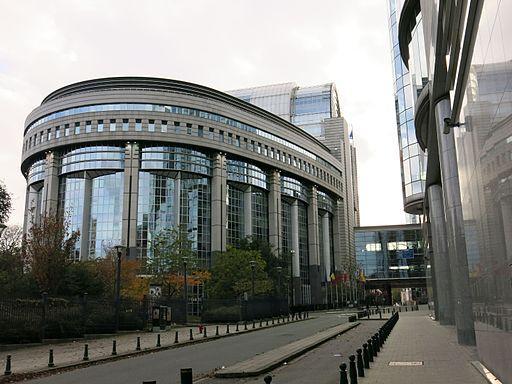
Further east are the key EU institutions of the European Parliament (8) and the Berlaymont (9) building, housing the European Commission.

Day one

Take a view

Just around the corner from the tourist office (7), the restaurant on the top floor of the Musical Instruments Museum (10) at Montagne de la Cour 2 (00 32 2 545 0130; mim.be) is open whenever the museum is: 10am-5pm at weekends, from 9.30am from Tuesday to Friday. You don’t need to buy an €8 ticket for the museum to enjoy a coffee with a view.

  • Read more

I spent a summer as a baggage handler and it was the worst job ever

Take a hike 

For a splendid slice of the city, turn right out of the Musical Instruments Museum (10) and down the steps to the Garden of the Mont des Arts (11), with a fountain, a statue of Albert I on his horse and a large and elaborate clock on the wall to the right, with a figure in a niche linked to each hour. 

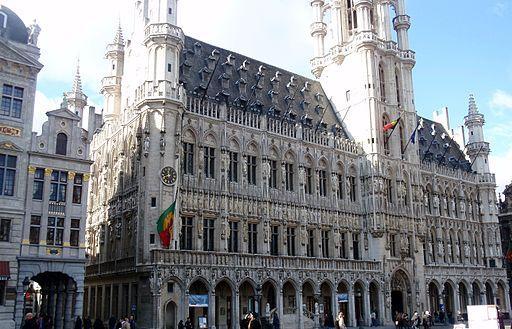
Cross Place d’Albertine and walk down Rue Madeleine to Place Agora (12) – you might want to investigate the long, elegant Galeries St-Hubert on the right. Turn left down the cobbled street beside the Superdry store, and you quickly emerge on the Grand Place (2) – one of the greatest squares in Europe, described by Victor Hugo in 1837 as “a miracle”. He rhapsodised over the Gothic Town Hall, calling it “a dazzling fantasy dreamed up by a poet, and realised by an architect”.

european-parliament-building-11055972456.jpg
The European Parliament building in Brussels (Wikimedia Commons)

Once dazzled, continue your westward progress along Rue au Beurre and Rue de la Bourse, which runs alongside the 1873 neo-classical Bourse (13) on the former site of the Convent des Recollets. It faces onto Boulevard Anspach, which was previously a busy road that bisected the city but has now been pedestrianised – making the Dansaert district on the west side much more accessible.

Rue Delvaux leads to Rue Sainte-Catherine, which emerges onto the Place dominated by the Eglise Sainte-Catherine (14) – a grand 19th-century mix of Gothic and neo-classical features.

brussels-town-la-grand-place-de-bruxelleshallp3040015.jpg
The Gothic town hall on Grand Place (Wikimedia Commons)

Lunch on the run

Almost at the end of Rue Sainte-Catherine, at number 42, Bar Monk (15) looks a busy, friendly pub – but at the back is an excellent eating area, known as the Buffet, which opens noon-3pm daily except Sunday (and every evening of the week). The speciality is spaghetti with several intriguing sauces (such as orval, emmental and parmesan cheeses), but other dishes are available.

Window shopping

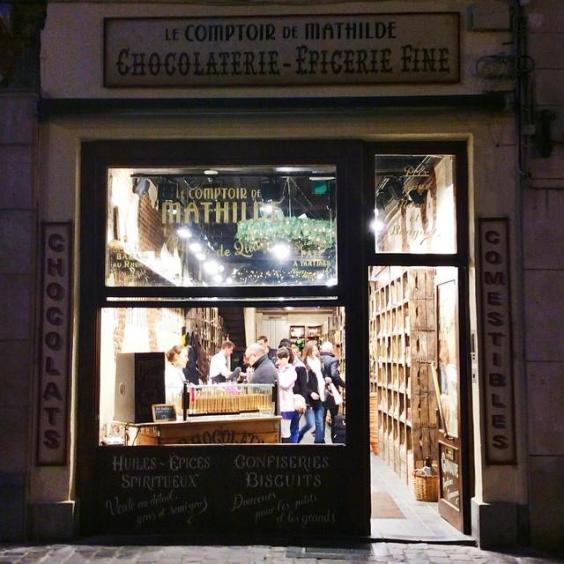
One street over, Rue Antoine Dansaert (16) is flanked with the stores of cutting-edge designers. For more traditional Brussels fare, the most interesting chocolate store is Le Comptoir de Mathilde (17) (00 32 2 503 3398; lecomptoirdemathilde.com/en) on the corner of Rue de Midi and Rue au Beurre, where a tablet of dark chocolate with lavender or white chocolate with strawberry costs €4. 

10650026-10152462772777919-4798535454317864356-n.jpg
Try gourmet chocolate at Le Comptoir de Mathilde (Facebook)

An aperitif

In a city rich in good places to drink beer, Delirium (18) at Impasse de la Fidélité 4 (not to be confused with the smaller, uninteresting bar on the corner) stands out. Its cheerfully rambling, retro-decorated interior is claimed to be home to 3,162 beers – more than any other bar in the world. Just a couple from the Huyghe Brewery will keep your spirits high: Campus, the 5 per cent house blond, just €4.30 for half a litre; and Delirium Tremens, which costs €3.60 for a smaller glass of a 9 per cent brew.

Dine with the locals

In Dansaert, Fin de Siècle (19) at Rue des Chartreux 9 (00 32 2 512 5123) is just the place for generous helpings of excellent Belgian cuisine in a venue with fading Art Nouveau elegance – and eccentric pricing: the daily soup is €4.72, while a rich, tasty saucisson carbonnade is €14.32. With good food and beer at prices that don’t demand a eurocrat’s salary, demand is high so you may need to queue.

Day two

Sunday morning: Go to church

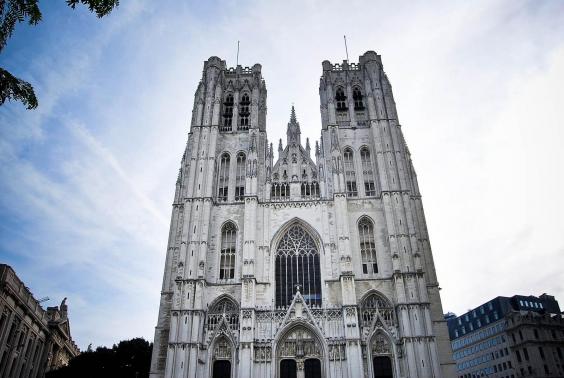
Slightly stranded on the edge of the lower town, the Cathedral of Saints Michael and Gudula (20) (00 32 2 217 8345; cathedralestmichel.be) is a mostly 16th-century Gothic structure whose elaborate pulpit dominates the nave. It was given cathedral status only in 1962. It opens for visits 8.30am-6pm at weekends, from 7am on weekdays. For €1 you can see the underground remains of the 11th-century Romanesque church, which contains the relics of St Gudula.

10192547324-99ce1ee67c-h.jpg
The Cathedral of Saints Michael and Gudula (Maria Firsova/Flickr)

Out to brunch

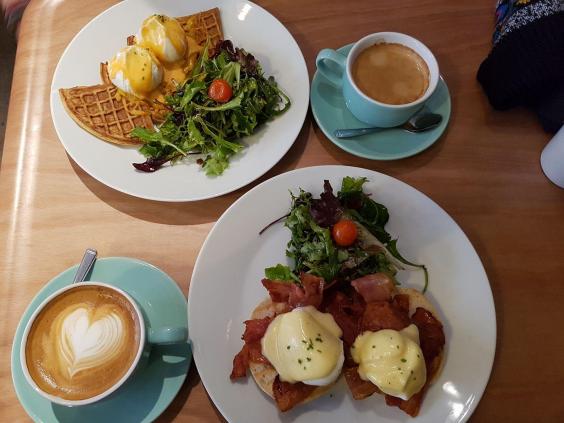
Peck47 (21) at Rue Marché Aux Poulets 47 (00 32 2 513 0287) promises “fresh-made food daily with lots of love” in the shape of dishes such as eggs benedict on waffles, as well as Italian-grade coffee. 

16112716-10154964439027708-592962972566771605-o.jpg
Eggs benedict on waffles at Peck47 brunch (Facebook)

Take a ride

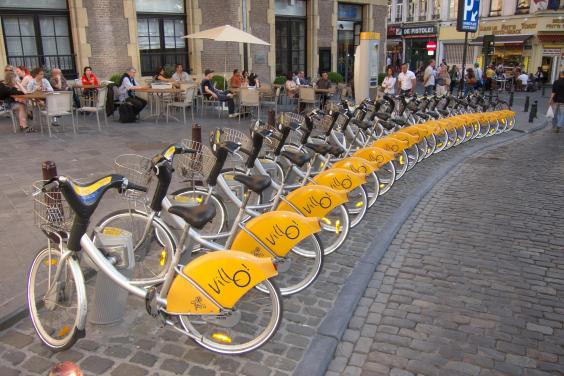
Brussels has an easy-to-use city bike scheme, Villo!, with stations dotted around the city, about 450 metres apart. A one-day subscription costs €1.60, including all rides less than half-an-hour (up to one hour costs an extra 50 cents). Use a bike to explore the parks east of the centre.

11023023543-af997c4242-k.jpg
The cheap Villo! bike scheme is easy to use (Thomas Quine/Flickr)

A walk in the park

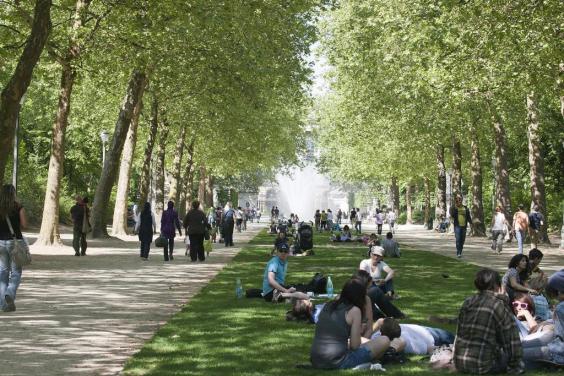
Brussels has three very different parks. The Parc de Bruxelles (22), unfolding north of the Royal Palace (5), is flat and formal, with statues of forgotten figures. Parc Leopold (23), which tumbles down from the European Parliament (8), is more of a jumble, with a pretty pond at the foot. It opened in 1880 – the same year as the Parc Cinquantenaire (24), which was intended to commemorate Belgium’s 50th anniversary but wasn’t fully ready. Today it houses AutoWorld (25) (00 32 2 736 4165; autoworld.be), a lavish collection of cars stretching back to 1885. Open 10am-6pm at weekends, and until 5pm on weekdays, admission €10.

4649463206-c4c14d61d6-b.jpg
A summer day in Parc de Bruxelles (William Murphy/Flickr)

Cultural afternoon

Sharing the park, the Cinquantenaire Museum (26) (00 32 2 741 7301; kmkg-mrah.be) was the creation of Leopold II to house artefacts appropriated elsewhere in the world – ranging from Egyptian sarcophagi to a giant moai from Easter Island. It opens 10am-5pm at weekends (weekdays from 9.30am), admission €8.

Back in the city centre, the name of the Bozar museum (4) (00 32 2 213 1919; bozar.be) at Rue Ravensteinstraat 23 is a play on Beaux-Arts. The 1928 structure itself is a work of art squeezed grudgingly into an awkward site by the architect, Victor Horta.

Today, as the Centre for Fine Arts, it houses a frequently refreshed series of exhibitions – such as Picasso Sculptures, which runs until 5 March, for which admission is €9; you can access the main building free of charge. It opens 10am-6pm daily except Monday, with late opening on Thursdays to 9pm.

The icing on the cake

The Cafe Victor, within the Bozar museum (4), celebrates Victor Horta’s vision – it occupies the shopfronts that he was ordered to incorporate into the building. A Victor Burger (€15.90) will set you up for the journey home.

Travel essentials

Getting there

Eurostar (03432 186 186; eurostar.com) runs eight trains a day from London St Pancras to Brussels Midi station (1), taking an average of 2 hours 8 minutes (less from Ebbsfleet or Ashford). Fares are as low as £50 return if you book via snap.eurostar.com. This is an intermittently available deal for which you must sign in with Facebook; you choose the date and time of day, and a service is assigned to you shortly before departure.

You can take a train from Midi to Centrale station (3). A single journey is €2.

By air, Brussels airport (27) is served from a wide range of UK airports, with Brussels Airlines (0333 222 0777; brusselsairlines.com) flying from Belfast, Birmingham, Bristol, Edinburgh, Heathrow, Manchester and Newcastle. British Airways (0844 493 0787; ba.com) also flies from Heathrow.

The airport (00 32 9007 0000; brusselsairport.be) is eight miles north of the city. Trains run from the airport to the Centrale station (3) in the city centre; tickets cost €8.50. 

Staying there

Place Agora (12) is ideally located on the western edge of the lower town, a couple of minutes’ walk from Centrale station (3). Pick of the bunch is the four-star Hotel NH Brussels Carrefour de l’Europe (00 32 2 504 9400; nh-hotels.com), which occupies a handsome old building with plenty of character. A comfortable double costs €84.55, even at the last minute, or €112.87 with breakfast included. The adjacent Novotel and Ibis are competent alternatives.

Book Now

Wednesday, 3 May 2017

Two days in New Orleans: From restaurants and nightlife to Garden District architecture

There’s something winningly classic about New Orleans - from the French Quarter’s elegant European architecture to its celebrated Creole cuisine, and an almost sacred notoriety as the birthplace of jazz. But while it’s true all this gives the city a unique, almost cinematic character, there’s more to explore beyond age-old tradition: post-Katrina, a number of neighbourhoods are being revitalised with ambitious modern art projects and an influx of new, creative businesses. The perfect trip, then, should make time for both classic and contemporary Nola. And it’s now easier than ever to access the Big Easy, as British Airways (ba.com) launched the first non-stop service from the UK on 27 March. The new flights take off four times a week from Heathrow. 

Get your bearings

Most popular on the visitor’s hit-list are the French Quarter (1), New Orleans’ most historic neighbourhood and a picturesque mish-mash of colonial Spanish and French influences; and the leafy Garden District (2), known for 19th-century mansions built by well-to-do Americans after a swathe of Louisiana was bought from the French. The former is adjacent to Downtown, sitting on a bend in the Mississippi River, while the latter lies around four miles south-west and is best accessed by streetcar. 

More up-and-coming areas that are beginning to garner attention include hip Bywater (3), east of the French Quarter, and the new Arts District (4), separated from the French Quarter by the high-rises of the Central Business District (5).

Day one

Window shopping 

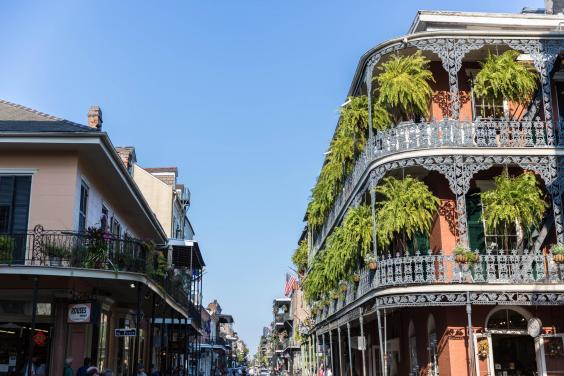
Get an immediate fix of French Quarter romance with a stroll along Royal Street (6). The antithesis of its neon-charged neighbour, hen-do favourite Bourbon Street (7), this elegant thoroughfare is known for its antique shops and iron lace balconies strung with hanging baskets. Enjoy a leisurely nosey, passing the odd horse-and-buggy ride or busking brass band. Don’t miss Frank Relle Gallery (8) (frankrelle.com), which rotates exhibitions of the photographer’s striking shots of New Orleans and Louisiana swamp country. Serious antiques hunters: head for M.S. Rau Antiques (9) (rauantiques.com), which sells everything from Baccarat to Tiffany.  

zsmith-2016-11-15-2075.jpg
Iron lace balconies on Royal Street ( Zack Smith)

Lunch on the run

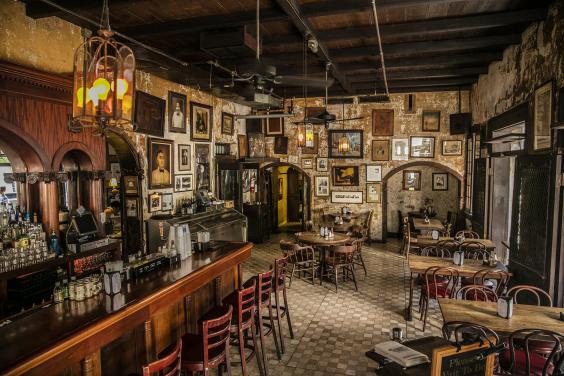
New Orleans has always been a cultural melting pot, thanks to its trade links at the mouth of the Mississippi. One of the most glorious examples of this fusion is 200-year-old Napoleon House (10) (napoleonhouse.com), most famously owned by a Sardinian former mayor of the city, who was plotting to rescue Napoleon from exile in St Helena and make it his refuge. Napoleon died before the plan could come together, but the name stuck. Then, in 1914, it was bought by a Sicilian family who started serving its now legendary muffulettas - ginormous meat-and-cheese-stuffed sandwiches. The story goes that the family poured Pimm’s to keep customers at the bar longer, as drinkers tended to retire early when swigging bourbon. Recently sold to a local restaurant group, Napoleon House today has the distinction of feeling like a bohemian Parisian bar, all snug alcoves and peeling paint, while offering Sicilian sandwiches and British booze. Get there for midday, or expect queues. 

napoleon-house-bar-into-dining-room.jpg
Grab a Sicilian sandwich and a Pimm's Cup at Napoleon House (Chris Granger)

A walk in the park 

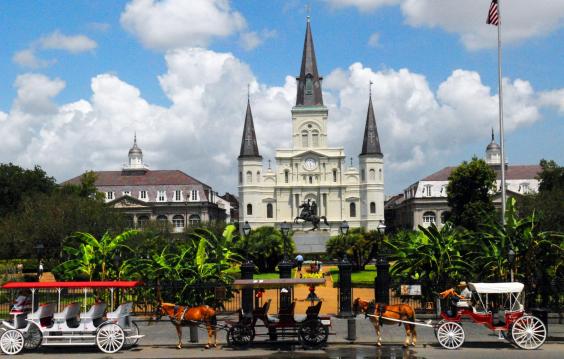
Facing the riverfront, Jackson Square (11) was the heart of old New Orleans. Catch jazz quartets performing in front of The Cabildo (12) - once the seat of the Spanish colonial government, and now home to the Louisiana State Museum (louisianastatemuseum.org) - and browse the artists’ colony bordering all four sides of the square. There’s everything from classic New Orleans scenes, to painterly portraits of Teenage Mutant Ninja Turtles. 

Cultural afternoon 

Next to The Cabildo (12), Saint Louis Cathedral (13) (stlouiscathedral.org) is a fairytale-worthy landmark, its three steeples stretching grandly from an all-white facade. Inside, stained glass windows recreate scenes from the life of Louis IX King of France, to whom the church was originally dedicated; buy a self-guided tour brochure at the entrance for $1. To the right is The Presbytère (14) (louisianastatemuseum.org). Formerly a courthouse, the ground floor now hosts a fantastic permanent exhibition about Hurricane Katrina. Videos and interactive exhibits tell the story of the storm, from build-up to impact, how infrastructure failed the city, and hear from those who fought to save their neighbourhoods.  

jackson-square.jpg
St Louis Cathedral, as seen from Jackson Square

An aperitif 

The white columns, low-hanging ceiling fans and potted palms at Arnaud’s (15) (arnaudsrestaurant.com) speak to the traditional flavour of this French Quarter restaurant, open since 1918. Kick off your evening with a cocktail in its adjoining French 75 Bar, where staff in white jackets and bow-ties mix up the brandy and champers. Whether you dine at the restaurant or just pick at the bar snacks, don’t miss the soufflé potatoes - like airy, puffed-up pub chips, best dunked in the accompanying bearnaise sauce. 

Day two

Out to brunch

For one last fling with the French Quarter, head to the daily Jazz Brunch at The Court of Two Sisters (16) (courtoftwosisters.com), served 9am-3pm. The courtyard setting is fairly unbeatable, shaded with overgrown vines and set around a red-brick fountain, while the all-you-can-eat buffet is your chance to try all the staples - think jambalaya, gumbo and turtle soup. A jazz trio provides a live soundtrack. It costs $30 per person. 

Take a ride

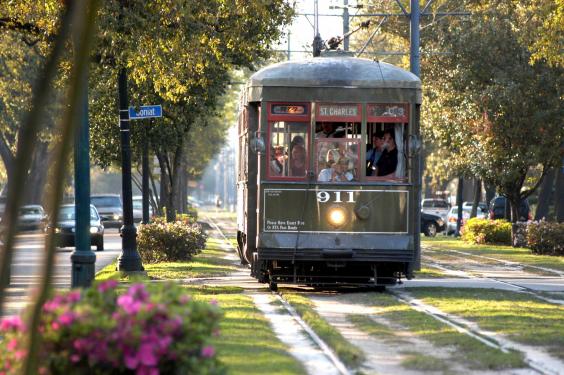
Now hop on the creaky St Charles streetcar (17) (norta.com, single fare $1.25) at Gravier Street for an old-style ride over to the Garden District (2). It’s been rumbling along since the mid-1800s and passes the masses of gorgeous pre-Civil-War mansions along oak-lined St Charles Avenue. Get off at Washington to start exploring. 

st.-charles-streetcar.jpg
The St Charles streetcar trundles along oak-lined St Charles Avenue

Take a hike 

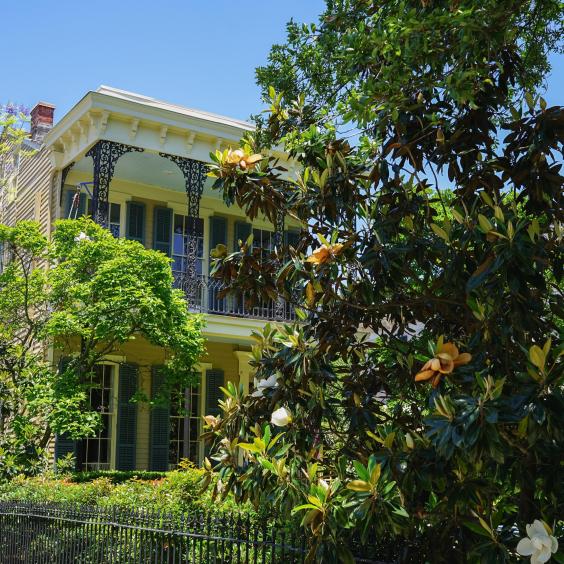
You don’t have to follow any kind of route - or be any sort of architecture buff - to enjoy the Garden District’s collection of incredible houses, built to show off the wealth accrued from booming Mississippi River merchantry. Wandering the blocks between Washington Avenue (18) and Magazine Street (19) is pure property porn, though if you want to seek out particular buildings, look up the likes of Sandra Bullock’s Swiss-cottage-style estate, and the columned house once home to an adolescent Anne Rice. (Alternatively, book a small group walking tour at $30 per person from gardendistrictwalksnola.com, meeting on Washington.) When you hit Magazine (19), have a browse of the indie boutiques, selling everything from New Orleans tees to local art. 

Dine with the locals

For homey food and casual company, family-owned Joey K’s (20) (joeyksrestaurant.com) is a neighbourhood favourite - one of its most loyal customers is John Goodman, who lives down the street. Sure, there’s fried catfish and po' boys aplenty, but better still are signature standouts Eggplant Napoleon (stacked fried eggplant with fried shrimp and crawfish cream sauce) and Shrimp Magazine (garlicky butterfly shrimp, ham and artichoke hearts on a bed of delicate angel-hair pasta). 

notmc-30333.jpg
The Garden District's mansions are pure property porn

Take a view 

New rooftop bar Hot Tin at the recently refurbished Pontchartrain Hotel (21) (thepontchartrainhotel.com) on St Charles Avenue gets packed on warm evenings - inevitable, given its lofty balcony views over Downtown and zippy seasonal house tipples. Stuffed with young professionals fresh from the grind, and playing indie Brit classics instead of the uniform jazz, the vibe here is a lot more contemporary than the French Quarter. 

The icing on the cake

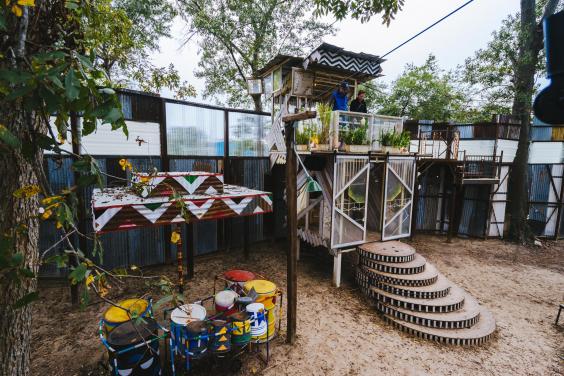
Bywater (3) is home to Music Box Village (22) (musicboxvillage.com), a “musical sculpture” meets art installation and performance venue. Comprising a series of musical treehouses and other structures-turned-instruments (a phone booth; a water tower) that play sounds when you enter or engage with them, it’s a sort-of sonic playground hidden in a yard that previously belonged to a steel fabricating plant (yup, on-trend). Or head into the formerly dilapidated Warehouse District, now the revitalised Arts District (4) (artsdistrictneworleans.com), where Julia Street (23) offers a cluster of 15 galleries showing local, modern works. 

notmc-36328.jpg
Explore the musical treehouses at Music Box Village

Staying there 

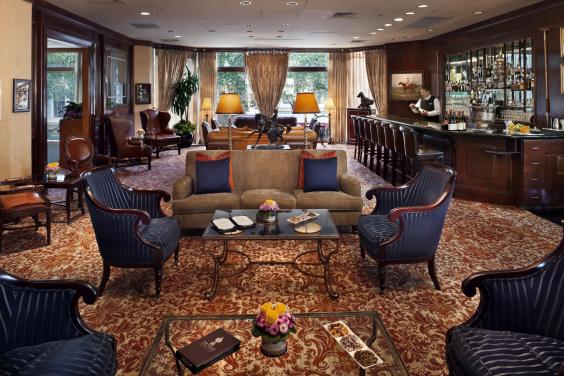
The Windsor Court Hotel (24) (windsorcourthotel.com) was built in 1984 by a local, Anglophile developer who wanted to create something echoing the style of his favourite London hotel, Claridge’s. That pleasantly old-school, upper-crust feel remains today, even after a recent $22 million restoration. The hotel is a five-minute walk from the French Quarter and rates start at $326 (£252) per night, room only.  

For something completely different, brand-new boutique hotel The Troubadour (25) (jdvhotels.com) is all up-to-the-minute cool - think craft coffee drinks in the mini-bar and live bands in the mezzanine lounge. Also a short walk from the French Quarter, rooms here start from $198 (£153) per night, room only. 

windsor-court-hotel-polo-club-lounge-2.jpg
The Polo Club Lounge at Windsor Court Hotel

Truly budget hotels are hard to come by, but it’s worth seeking out deals with the likes of Best Western (bestwestern.com) or Holiday Inn (ihg.com) if you’d rather pay around the $150 (£116) mark. 

Getting there

Touchdown is at Louis Armstrong International Airport (26), around 11 miles west of Downtown. Cab rides carry a flat rate of $36 (£28) to the French Quarter for up to two passengers, or $15 (£12) per person for three or more. The E2 Airport bus costs $2 (£1.50) and should reach Downtown in a little over half an hour (jeffersontransit.org).

More information

neworleanscvb.com

visittheusa.co.uk