Monday, 30 January 2017

Discover the other side of Florida – Naples

A beach on the west coast of Florida is alluring enough. Even better: a beach with a fun city attached, with an abundance of places to eat, drink and shop. I’ve driven the coast so that you don’t have to, and have concluded the ideal location is Naples.

I first arrived here in the Eighties — yes, I was very young at the time, thanks — as I drove the Tamiami Trail. This road, also known as Highway 41, was carved through the Everglades in the Twenties to connect Tampa with Miami — hence the name. The highway provides an artery for a region rich in nature, in the sensuous shapes of the Ten Thousand Islands and the ever-mysterious Everglades. It’s worth discovering, so take advantage of seven days’ hire of a compact car from Miami International Airport from £166 or upgrade to a Chevrolet Camaro Convertible from £263 through Hertz.co.uk

Base camp for my expedition is the Lemon Tree Inn, promising “A Touch of Key West in the heart of Old Naples”, this marvellous throwback to the 1960s is cheap, cheerful and close to the action on 5th Avenue.

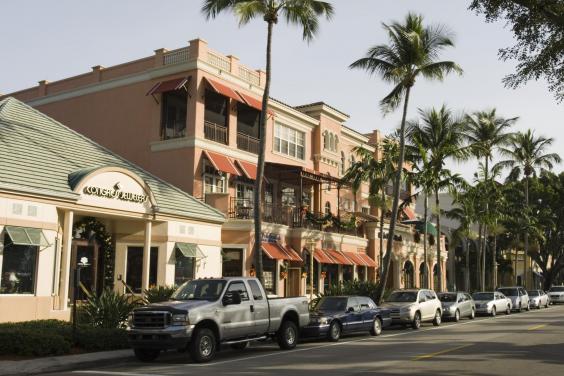
Other streets with this name are available — I believe there’s one in New York City — but the version in Naples is low-rise and instantly likeable. For example, as you window-shop or gaze at the works in some of the 100-plus art galleries, you can park for free. Don’t try that in Manhattan.

gettyimages-126935451.jpg
5th Avenue, Naples

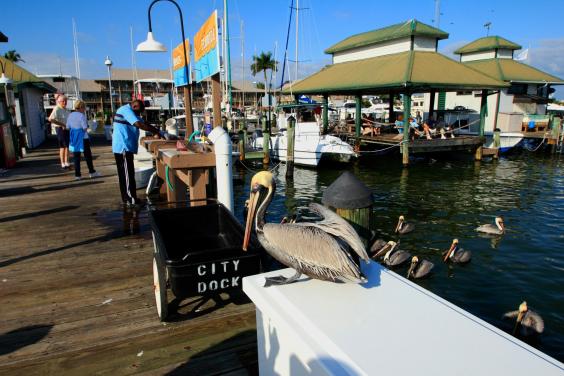
Despite its 21st Century ambiance as a great place to relax, Naples is also a working port, with dozens of fishing vessels based at Crayton Cove, where the bay infiltrates inland.

Forty years ago a young man called Vin DePasquale arrived here from California and decided that what Naples needed was a waterside restaurant. And The Dock at Crayton Cove was born. Initially, the price for oysters was 30 cents each. They’re slightly more expensive these days, but diners still pack the place like sardines.

cnkwka-alamy.jpg
Crayton Cove, Naples

Mangroves, crabs and alligators

The south-west corner of the Sunshine State is called Florida’s Paradise Coast. South from Naples, the Ten Thousand Islands are scattered across the Gulf: fragments of land, swathed in mangrove and rich in wildlife. Hire a good captain, and you can step ashore on your own desert island, where the sands and shells tell a story.

Back on the highway there’s plenty of roadside Americana. The smallest post office in the US puts its stamp on the Tamiami Trail, and close by there’s a corrugated iron barn that’s been turned into Joanie’s Blue Crab Cafe. No prizes for guessing what’s on the menu. Joanie's gets very busy, especially at the weekend. You may be waiting a while, but as they say here: “If you want fast food, keep driving — 42 miles west, 66 miles east.”

everglades-gettyimages-72438687.jpg
Everglades, Florida

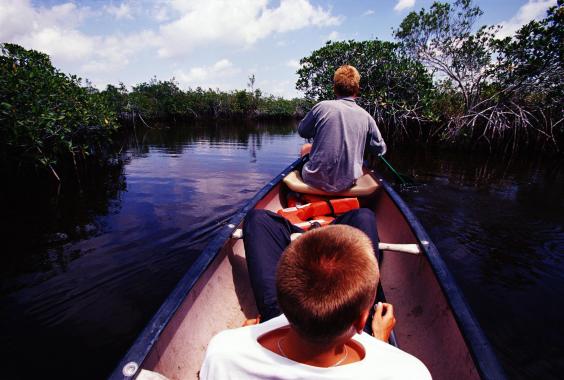
If, however, you want a close, safe encounter with an alligator, step aboard an airboat — a launch fitted with a giant fan rather than a propeller, to avoid entanglement in these shallow, mysterious waters. You can travel at 40mph through the mangrove swamps of the Everglades — natural thoroughfares that lead deep into the past of the planet.

Discover more at Visit Florida

Wednesday, 25 January 2017

Brussels from £50 return: How to do this underrated - and dirt cheap - European capital in two days

Why go now?

Even in the depths of winter, the Belgian capital sparkles. Brussels is as accessible, compact and indulgent as ever, but the number of visitors has slumped following the attacks last March which killed 32 innocent people. 

To entice visitors back to Brussels, train fares from London are at their lowest ever — just £50 return. Hotel rates are also ridiculously low, especially at weekends when politicians, bureaucrats and lobbyists leave the city to hedonists.

Get your bearings

The arrival point by Eurostar train is Brussels Midi (1), to the south of the city centre. North from here is the lower town, whose focal point is the Grand Place (2). With two official languages in Brussels —  French and Flemish —  each square and street has twin identities. Names are given here in French.

To the east, beyond Brussels Centrale station (3), the ground rises steeply to the upper town, location for the Bozar museum (4), the Royal Palace (5), Parliament (6) and other state institutions.

A handy tourist office (7), more grandly known as the House of the Capital Region, is located on Place Royale (00 32 2 563 6399; biponline.be). It is inside the Hôtel de Grimbergen — above the 15th-century ruins of a former chapel of the Dukes Palatine. It opens 10am-6pm daily.

Further east are the key EU institutions of the European Parliament (8) and the Berlaymont (9) building, housing the European Commission.

Day one

Take a view

Just around the corner from the tourist office (7), the restaurant on the top floor of the Musical Instruments Museum (10) at Montagne de la Cour 2 (00 32 2 545 0130; mim.be) is open whenever the museum is: 10am-5pm at weekends, from 9.30am from Tuesday to Friday. You don’t need to buy an €8 ticket for the museum to enjoy a coffee with a view.

  • Read more

I spent a summer as a baggage handler and it was the worst job ever

Take a hike 

For a splendid slice of the city, turn right out of the Musical Instruments Museum (10) and down the steps to the Garden of the Mont des Arts (11), with a fountain, an equestrian statue of Albert I on his horse and a large and elaborate clock on the wall to the right, with a figure in a niche linked to each hour. 

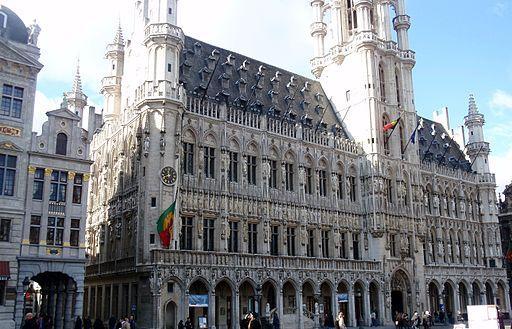
Cross Place d’Albertine and walk down Rue Madeleine to Place Agora (12); you might want to investigate the long, elegant Galeries St-Hubert on the right. Turn left down the cobbled street beside the Superdry store, and you quickly emerge on the Grand Place (2) — one of the greatest squares in Europe, described by Victor Hugo in 1837 as “a miracle”. He rhapsodised over the Gothic Town Hall, calling it “a dazzling fantasy dreamed up by a poet, and realised by an architect”.

european-parliament-building-11055972456.jpg
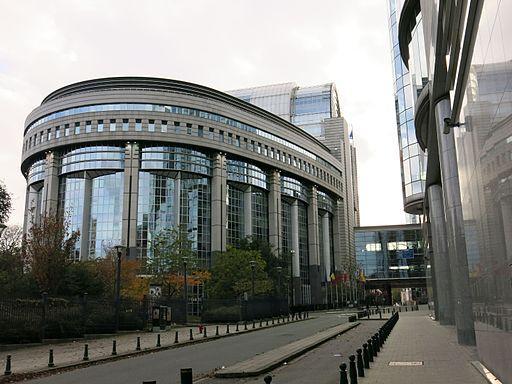
The European Parliament building in Brussels (Wikimedia Commons)

Once dazzled, continue your westward progress along Rue au Beurre and Rue de la Bourse, which runs alongside the 1873 neo-classical Bourse (13) on the former site of the Convent des Recollets. It faces onto Boulevard Anspach, which was previously a busy road that bisected the city but has now been pedestrianised — making the Dansaert district on the west side much more accessible.

Rue Delvaux leads to Rue Sainte-Catherine, which emerges onto the Place dominated by the Eglise Sainte-Catherine (14) — a grand 19th-century mix of Gothic and neo-classical features.

brussels-town-la-grand-place-de-bruxelleshallp3040015.jpg
The Gothic town hall on Grand Place (Wikimedia Commons)

Lunch on the run

Almost at the end of Rue Sainte-Catherine, at number 42, Bar Monk (15) looks a busy, friendly pub — but at the back is an excellent eating area, known as the Buffet, which opens noon-3pm daily except Sunday (and every evening of the week). The speciality is spaghetti with several intriguing sauces (such as orval, emmenthal and parmesan cheeses), but other dishes are available.

Window shopping

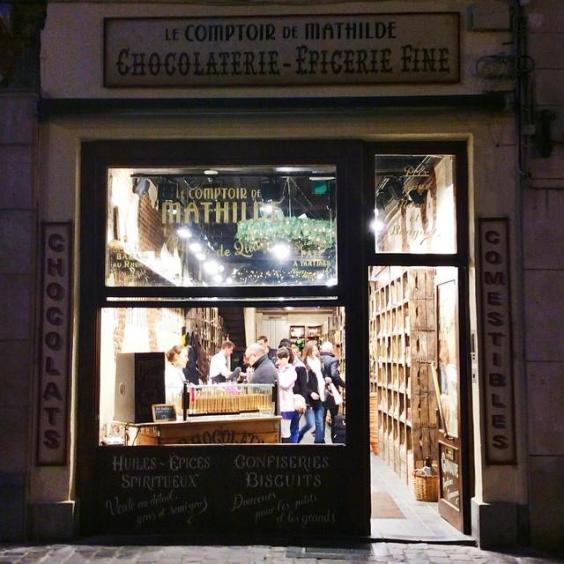
One street over, Rue Antoine Dansaert (16) is flanked with the stores of cutting-edge designers. For more traditional Brussels fare, the most interesting chocolate store is Le Comptoir de Mathilde (17) (00 32 2 503 3398; lecomptoirdemathilde.com/en) on the corner of Rue de Midi and Rue au Beurre, where a tablet of dark chocolate with lavender or white chocolate with strawberry costs €4. 

10650026-10152462772777919-4798535454317864356-n.jpg
Try gourmet chocolate at Le Comptoir de Mathilde (Facebook)

An aperitif

In a city rich in good places to drink beer, Delirium (18) at Impasse de la Fidélité 4 (not to be confused with the smaller, uninteresting bar on the corner) stands out. Its cheerfully rambling, retro-decorated interior is claimed to be home to 3,162 beers — more than any other bar in the world. Just a couple from the Huyghe Brewery will keep your spirits high: Campus, the 5 per cent house blond, just €4.30 for half a litre; and Delirium Tremens, which costs €3.60 for a smaller glass of a 9 per cent brew.

Dine with the locals

In Dansaert, Fin de Siècle (19) at Rue des Chartreux 9 (00 32 2 512 5123) is just the place for generous helpings of excellent Belgian cuisine in a venue with fading Art Nouveau elegance — and eccentric pricing: the daily soup is €4.72, while a rich, tasty saucisson carbonnade is €14.32. With good food and beer at prices that don’t demand a eurocrat’s salary, demand is high so you may need to queue.

Day two

Sunday morning: Go to church

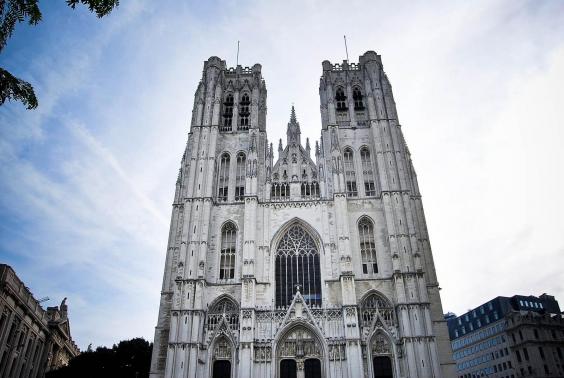
Slightly stranded on the edge of the lower town, the Cathedral of Saints Michael and Gudula (20) (00 32 2 217 8345; cathedralestmichel.be) is a mostly 16th-century Gothic structure whose elaborate pulpit dominates the nave. It was given cathedral status only in 1962. It opens for visits 8.30am-6pm at weekends, from 7am on weekdays. For €1 you can see the underground remains of the 11th-century Romanesque church, which contains the relics of St Gudula.

10192547324-99ce1ee67c-h.jpg
The Cathedral of Saints Michael and Gudula (Maria Firsova/Flickr)

Out to brunch

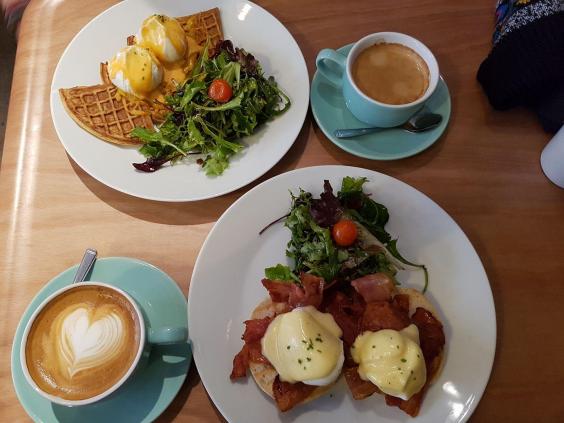
Peck47 (21) at Rue Marché Aux Poulets 47 (00 32 2 513 0287) promises “fresh-made food daily with lots of love” in the shape of dishes such as eggs Benedict on waffles, as well as Italian-grade coffee. 

16112716-10154964439027708-592962972566771605-o.jpg
Eggs Benedict on waffles at Peck47 brunch (Facebook)

Take a ride

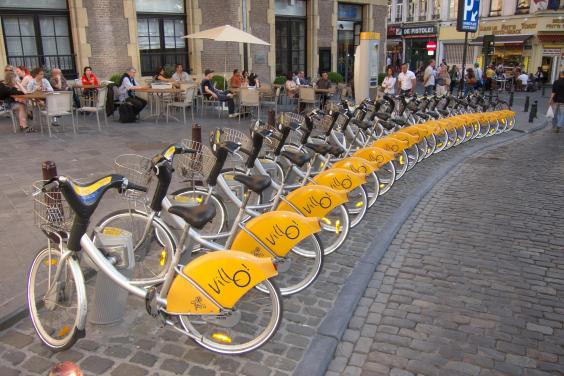
Brussels has an easy-to-use city bike scheme, Villo!, with stations dotted around the city, about 450 metres apart. A one-day subscription costs €1.60, including all rides less than half-an-hour (up to one hour costs an extra 50 cents). Use a bike to explore the parks east of the centre.

11023023543-af997c4242-k.jpg
The cheap Villo! bike scheme is easy to use (Thomas Quine/Flickr)

A walk in the park

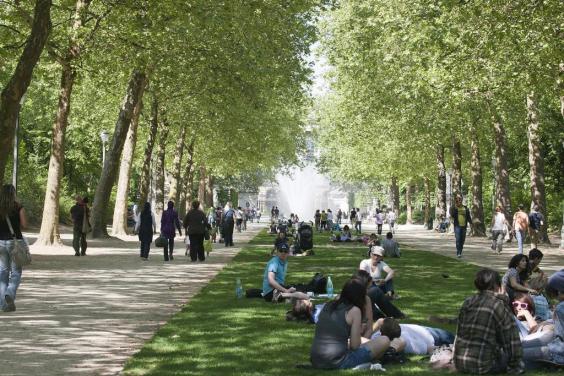
Brussels has three very different parks. The Parc de Bruxelles (22), unfolding north of the Royal Palace (5), is flat and formal, with statues of forgotten figures. Parc Leopold (23), which tumbles down from the European Parliament (8), is more of a jumble, with a pretty pond at the foot. It opened in 1880 — the same year as the Parc Cinquantenaire (24), which was intended to commemorate Belgium’s 50th anniversary but wasn’t fully ready. Today it houses AutoWorld (25) (00 32 2 736 4165; autoworld.be), a lavish collection of cars stretching back to 1885. Open 10am-6pm at weekends, and until 5pm on weekdays, admission €10.

4649463206-c4c14d61d6-b.jpg
A summer day in Parc de Bruxelles (William Murphy/Flickr)

Cultural afternoon

Sharing the park, the Cinquantenaire Museum (26) (00 32 2 741 7301; kmkg-mrah.be) was the creation of Leopold II to house artefacts appropriated elsewhere in the world — ranging from Egyptian sarcophagi to a giant moai from Easter Island. It opens 10am-5pm at weekends (weekdays from 9.30am), admission €8.

Back in the city centre, the name of the Bozar museum (4) (00 32 2 213 1919; bozar.be) at Rue Ravensteinstraat 23 is a play on Beaux-Arts. The 1928 structure itself is a work of art squeezed grudgingly into an awkward site by the architect, Victor Horta.

Today, as the Centre for Fine Arts, it houses a frequently refreshed series of exhibitions — such as Picasso Sculptures, which runs until 5 March, for which admission is €9; you can access the main building free of charge. It opens 10am-6pm daily except Monday, with late opening on Thursdays to 9pm.

The icing on the cake

The Cafe Victor, within the Bozar museum (4), celebrates Victor Horta’s vision — it occupies the shopfronts that he was ordered to incorporate into the building. A Victor Burger (€15.90) will set you up for the journey home.

Travel essentials

Getting there

Eurostar (03432 186 186; eurostar.com) runs eight trains a day from London St Pancras to Brussels Midi station (1), taking an average of 2 hours 8 minutes (less from Ebbsfleet or Ashford). Fares are as low as £50 return if you book via snap.eurostar.com. This is an intermittently available deal for which you must sign in with Facebook; you choose the date and time of day, and a service is assigned to you shortly before departure.

You can take a train from Midi to Centrale station (3). A single journey is €2.

By air, Brussels airport (27) is served from a wide range of UK airports, with Brussels Airlines (0333 222 0777; brusselsairlines.com) flying from Belfast, Birmingham, Bristol, Edinburgh, Heathrow  Manchester and Newcastle. British Airways (0844 493 0787; ba.com) also flies from Heathrow.

The airport (00 32 9007 0000; brusselsairport.be) is eight miles north of the city. Trains run from the airport to the Centrale station (3) in the city centre; tickets cost €8.50. 

Staying there

Place Agora (12) is ideally located on the western edge of the lower town, a couple of minutes’ walk from Centrale station (3). Pick of the bunch is the four-star Hotel NH Brussels Carrefour de l’Europe (00 32 2 504 9400; nh-hotels.com), which occupies handsome old building with plenty of character. A comfortable double costs €84.55, even at the last minute, or €112.87 with breakfast included. The adjacent Novotel and Ibis are competent alternatives.

48 Hours in Bordeaux: hotels, restaurants and places to visit in the capital of French wine country

Why go now?

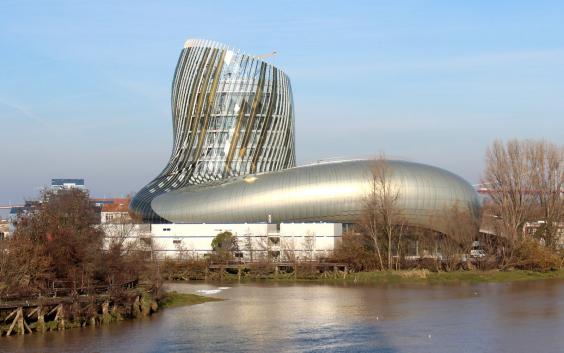
Following the meticulous 15-year renovation of its magnificent, Unesco-listed 18th-century city centre and the launch of a sleek new tramway system – cars are painted a jaunty forest green, median strips are turfed – Bordeaux has just inaugurated the £65m La Cité du Vin (1) (laciteduvin.com). Designed by Paris-based architectural firm XTU, the swirling gold, aluminium and glass building on the banks of the Garonne River north of the city’s historic heart aspires to be the world’s largest cultural centre devoted to wine.

The epicurean French city is also in the midst of a restaurant boom, and the Bordeaux Wine Festival (23-26 June; bordeaux-wine-festival.com), which sees 80 wine pavilions opening along the riverfront is a good occasion to discover some of these new tables. The eight appellations of the Bordeaux region are represented, and aside from tippling from stand to stand, other activities include cask-rolling competitions, a street art exhibition from the Institut Culturel Bernard Magrez, and nightly performances of Beethoven’s 5th Symphony on the opposite bank at Hall Darwin (2). Each night, the festival closes with a 20-minute sound and light show, followed by fireworks.

The 2016 Uefa Euro 2016 championship (uefa.com) takes place in France from 10 June to 10 July. Bordeaux will welcome up to five matches, including one quarter-final, in its brand new 43,000 seat stadium (3). A giant "fan zone" (4) will also be set up on the Esplanade des Quinconces where all of the matches will be broadcast on a giant screen.

Touch down

Bordeaux is served direct by easyJet (0843 104 5000; easyJet.com) from Gatwick, Luton, Bristol, Glasgow and Liverpool; Flybe (0871 700 2000; flybe.com) from Birmingham, Cardiff (11 June only) and Southampton; Ryanair (0871 246 0000; ryanair.com) from Stansted, Bristol and Edinburgh; and British Airways (0344 493 0787; ba.com) from Gatwick.

Merignac airport (5) (bordeaux.aeroport.fr/en) is located 12km west of Bordeaux. The navette shuttle bus (30direct.com) to Bordeaux St-Jean train station (6) takes 30 minutes and operates from 8am-11pm daily; a one-way ticket costs 7.20, a return ticket 12.30. Depending on traffic and the time of day, taxis average €25 to €30.

Eurostar travels from London St Pancras, Ebbsfleet and Ashford to Bordeaux St-Jean (6) in six hours 47 minutes with a change in Lille or Paris (03432 186 186; eurostar.com). When the new TGV (high-speed) train service between Paris and Bordeaux is inaugurated next year, the journey will be reduced by 90 minutes.

St-Jean train station (6) is located just south of the city centre, which is easily reached by tramway or bus (infotbc.com); it runs daily from 5am to 1am. Unlimited day passes cost €26, two-day passes €33, and three-day passes €40. Individual tickets cost €1.50 and can be purchased on trams and buses; these tickets allow for free transfers between buses and trams. 

shutterstock_240209107.jpg
The Garonne (Shutterstock)

Get your bearings

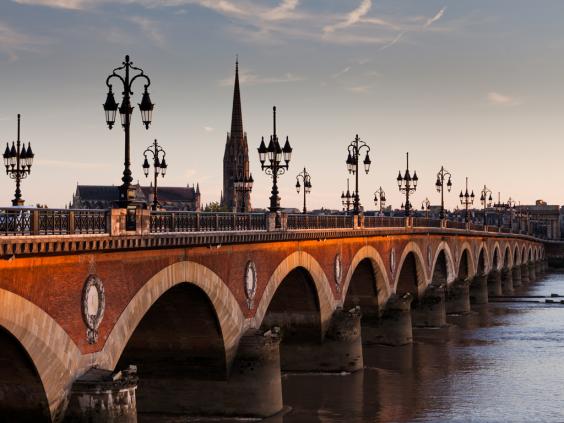
Built on a quarter-moon-like bend on the Garonne river in the Aquitaine region of southwestern France, Bordeaux – the country’s fifth largest metropolis – is lyrically known as the “Port de la Lune” (port of the moon). The Garonne river runs north-south, and so does Bordeaux, which was founded by Celtic tribes around 300 BC as Burdigala. It was conquered by the Romans, who brought grape vines to the region in 60BC.

The city has many rent-it-here, leave-it-there bicyles for hire at 166 stations. The first 30 minutes of any rental, which is paid for by credit or debit card, are free, and then cost €2 afterwards.

The main tourist office (7) (00 33 5 56 00 66 00; bordeaux-tourism.co.uk) is located at 12 Cours du XXX Juillet and is open from 9am-6.30pm Monday to Saturday, closed Sunday; there are also branches at Gare St-Jean (6) and Merignac airport (5). The tourist office offers a free Bordeaux app, which is very useful and can be downloaded from its website. It also sells one, two and three day City Passes that offer free access to museums and exhibitions and unlimited public transportation (€24, €31 and €33 respectively).

Check in

Located in a handsome, 19th-century townhouse in the heart of the city, the recently opened twelve-room Yndo Hotel (8) (00 33 5 56 23 88 88; yndohotelbordeaux.fr) at 108 rue de l'Abbé de l'Epée is furnished with high-end contemporary furniture from makers such as Edra and features amenities rarely found in hotels of this size in France, including 24-hour room service and air-conditioning. Doubles start at €440, room only.

A cosy, 12-room boutique hotel with a convenient location from which you can walk or ride the tram to the most of the city’s attractions, the Hotel de Tourny (9) (00 33 5 56 81 56 73; hoteldetourny.com) at 16 rue Huguerie has comfortable rooms with contemporary décor and a friendly young staff. Doubles start at €160, room only.

With Philippe Starck as its headliner designer, the Mama Shelter (10) chain has acquired a reputation for hip good-value lodgings in Paris, Marseille and Lyon. Its 97-room hotel in Bordeaux (00 33 5 57 30 45 45; mamashelter.com) occupies a renovated office building just on the edge of the historic centre at 19 rue Poquelin Moliere. Rooms are comfortable, well-designed and kitted out with iMacs, and the bar and pizzeria are busy with a young local crowd nightly. Doubles from €69, room only.

Day One

Take a view

The best view of Bordeaux is from the 8th floor Belvedere gallery at La Cité du Vin (1) at 134-150 Quai de Bacalan (00 33 5 56 16 20 20; citeduvin.com; daily 9.30am-7.30pm, admission €20 for adults, and €8 for children), which proffers 360-degree views of the city. Below, some 20 themed audio-visual modules present the history, culture and making of wine according to various themes. The museum also includes three tasting laboratories that include specially designed multi-sensory spaces for a total immersion in wine; a dock from which to embark on visits to the wine chateaux up and down river; a special exhibition centre; and various restaurants. Seen from the viewing terrace Victor Hugo’s description of Bordeaux makes senses: “Take Versailles, add Antwerp, and you have Bordeaux.”

la-cite-du-vin-bourdeax-wine0516.jpg
The Cité du Vin

Take a hike

From the Cité du Vin (1), take tram line 8 to the Place de la Bourse (11) and its handsome 18th-century customs houses on the banks of the Garonne that are the traditional heart of the city. These horse-shoe-shaped buildings also house two interesting museums, the Musée National des Douanes (12) (Costumes Museum) (musee-douanes.fr, Tuesday to Sunday, 10am-6pm, tickets €3) and Bordeaux Patrimoine Mondial (13), which explains how the city’s architectural heritage and urban landscape evolved and became a Unesco listed world heritage site (open daily 10am-1pm and 2-7pm, free entry).

Afterwards, follow the riverfront north to the Cours du Chapeau Rouge, which runs west from the river, and continue until you arrive at the Grand Théâtre de Bordeaux (14), one of the finest 18th-century theatres in the world (00 33 5 56 00 85 95). Next, head south on the rue Sainte Catherine, the pedestrianised high street, to the rue du Loup. Turn west here to visit the gothic Cathédrale Saint André (15) where the 15th-century bell tower offers another superb view over the city.

Lunch on the run

Head for Le Flacon (16) at 43 rue de Cheverus (00 33 9 81 86 43 43, dishes €6-18). It serves a good selection of wines by the glass and small dishes such as Réunion-style steamed pork-and-citrus dumplings and mini veal-shank hamburgers. Nearby, the Saint Pierre quarter has morphed into one of Bordeaux’s best and busiest restaurant districts. Here, seek out Belle Campagne (17) at 15 rue des Bahutiers to lunch on a chalkboard menu of south-western French dishes made from local, seasonal and usually organic produce. Current dishes include goat's cheese mousse with walnut oil, a charcuterie plate from the celebrated Basque producer Ospital, and sturgeon with green lentils and a chorizo condiment (00 33 5 56 81 16 51; belle-campagne.fr; starters  €4-8; main courses 14-25).

Window shopping

Bordeaux’s chicest shopping streets are the Cours de l’Intendance (18), where you’ll find major French luxury brands like Hermès, and the charming Allée de Tourny with one-of-a-kind shops such as L'Intendant des Grands Vins de Bordeaux (19) (00 33 5 56 48 01-29; intendant.com) – one of the best places to buy fines wines in Bordeaux. Further along, Cadiot-Badie (20) (cadiot-badie.com) is an old-fashioned chocolate shop at No. 26 that was founded in 1826.

An aperitif

Aux Quatre Coins du Vins (21) at 8 Rue de la Devise (00 33 5 57 34 37 29, Open Mon-Sat. 6pm-12am; auxquatrecoinsduvin.com) is a popular new wine bar where every customer receives a magnetic card that allows him or her to serve themselves from a selection of grand cru wines by the glass; you pay up when you leave.

Otherwise, head for the terrace at Le Regent (22), 52 Cours du Chapeau Rouge (00 33 5 56 51 27 30, open daily) a café across from the Grand Theatre (14), for a lillet, an aperitif produced in the village of Podensac south of Bordeaux from wine and citrus liqueurs, and some first-rate people watching.

Dine with the locals

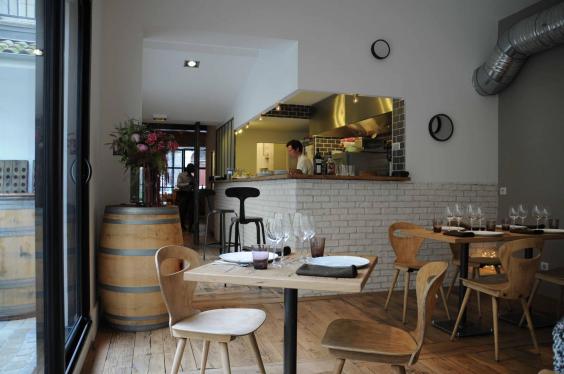
Chef Tanguy Laviale’s superb contemporary French restaurant Garopapilles (23), 62 rue de l’Abbé de l’Epée (00 33 9 72 45 55 36; garopapilles.com; prix-fixe dinner menu 69) is easily the most sought-after reservation in Bordeaux, so book well in advance. The menu changes regularly but runs to dishes such as pan-roasted scallops on a bed of shitake mushrooms in parsnip cream and veal filet with poached pears, cockles, and squid’s ink gnocci.

garopapilles-5.jpg
Garopapilles

If you can't get a table, Miles (24), 33 rue du Cancera (00 33 5 56 81 18; restaurantmiles.com; average à la carte dinner for one without wine €35) is a great example of the young bistros that are making Bordeaux a seriously good food city. The quartet of chefs here hail from four different countries, which explains dishes like veal tartare with a seasame-seed-oil marinated egg yolk and and swordfish with Madras curry leaf gelée and coconut-coriander gremolata.

Day two

Sunday morning: go to church

Inspired by the church of the Gesù in Rome, the baroque exterior of the church of Notre Dame (25) on Place du Chapelet belies its strikingly simple Romanesque interior. The church and adjacent Cour Mably also include the surviving vestiges of 13th-century Dominican monastery. The great organ (1775) is used year-round for concerts of religious music (open Monday 2.30-6pm, Tuesday-Saturday 8.30am-6pm, Sunday 10am-noon, 5-8pm).

Out to brunch

With bare wooden tables, flea-market chairs and a good-value €20 menu that includes scrambled eggs with local asparagus, roasted potatoes and bacon, La Cagette (26), 8 Place du Palais (00 33 9 80 53 84 35 lacagette.com) serves from 11.30am-3.30pm and is very popular.

A walk in the park

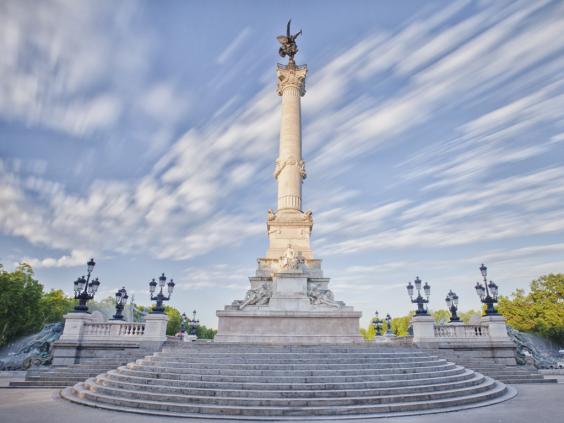
The tree-lined lawns of the Esplanade des Quinconces (4) (the word refers to the way the trees are planted in staggered rows) runs from the Garonne River to the Place des Quinconces where the opulent 19th-century Monument aux Girondins is a riot of allegory referring to the Girondin faction during the French Revolution and the values of the French Republic.

esplanade_des_quinconces.jpg
Monument aux Girondes

For more fresh air, head north along the Cours de Verdun to the beautifully landscaped Jardin Public (27). The park includes a children’s playground and puppet theatre (open 7am-9pm, June-August; 7am-8pm, September; 7am-7pm, October; 7am-6pm, November-December; 7am-8pm, January-May; closed 4-11 January).

Take a ride

As is true of many port cities, the best views are to be found from the water, so the 90-minute cruises on the Garonne river offered by Croisières Burdigala are not only fascinating but relaxing. Commentary is offered in French and English and tickets may be booked via the Bordeaux tourist office website (bordeaux-tourism.co.uk; if purchased online, they must be printed to be valid. Tickets cost €15 for adults, €2 for children.

The embarkation point is Quai Richelieu, Ponton d’Honneur (28). Schedule: 3:30 pm: Saturdays in February and March + Sunday, March 20 and 27 and Monday March 28; Wednesdays, Saturdays and Sundays in April; Tuesdays, Wednesdays, Saturdays, Sundays in May and June + Thursday, May 5; Friday, May 6; Monday, May 16. 3.30pm, 5.30pm daily in July and August.

Cultural afternoon

Of the 11 museums in Bordeaux, the two not to miss are the Musée des Beaux-Arts (29), 20 Cours d’Albret (00 33 5 56 10 20 56; musba-bordeaux.fr; open 11am-6pm, closed Tuesday, €4, free admission the first Sunday of every month), the city’s fine arts museum with a rich collection that includes works by Perugino, Van Dyck, Van Goyen, Rubens, Chardin, Corot, Delacroix, and Matisse, and the Bordeaux-born artists Odilon Redon and Andre Lhote; and the Musée d'Aquitaine (30), 20 cours Pasteur (00 33 5 56 01 51 00; musee-aquitaine-bordeaux.fr, open 11am-6pm, closed Monday, €4, free admission the first Sunday of every month), which recounts the history of Bordeaux and the surrounding Aquitaine region. 

shutterstock_358482668.jpg
The Margaux wine region (Shutterstock)

Icing on the cake

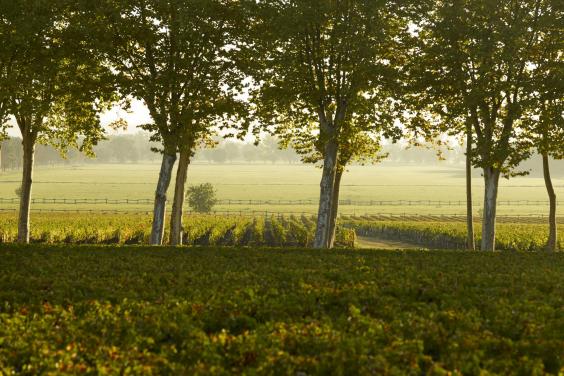
A variety of half-day excursions to the wine towns, including Saint Emilion, and estates surrounding Bordeaux are detailed on the tourist office’s website (bordeaux-tourism.co.uk). Among the best is the English speaking half-day tour to the Margaux wine region with a personal guide-driver offered by Ophorus tours (orphorus.com); it includes a visit and a wine tasting at one of the “cru bourgeois” châteaux of the Margaux appellation (€75 per person, available from April to October, 8.30am-1pm on Tuesdays and Fridays, 2-6.30pm on Saturdays).

Click here to view our latest __travel offers with Independent Holidays
Monday, 23 January 2017

48 Hours in Toronto: hotels, restaurants and places to visit in Canada's largest city

Travel essentials

Why go now?

Despite a brief flurry of snow in mid-May, the people of Toronto are enjoying the onset of summer. The city wears shirtsleeves from June to September, and celebrates its astonish cultural diversity with events such as Taste of Toronto (23-26 June, tasteoftoronto.com) – in which top chefs conduct cooking classes and demonstrations. For British visitors, reaching Canada’s biggest metropolis has never been cheaper nor easier, with intense competition from budget airlines. 

Touch down

Air Canada Rouge, the budget offshoot of Air Canada (0871 220 1111; aircanada.com), has just launched flights from Gatwick to Toronto. The airline competes on the route with both Air Transat (020 7616 9187; airtransat.com) and WestJet (00800 5381 5696; westjet.com). Fares as low as £300 return are available in the next few weeks. All three airlines also compete from Glasgow. 

Flights from Birmingham (Air Transat), Edinburgh (Air Canada Rouge), Heathrow (Air Canada and British Airways; 0344 493 0787; ba.com) and Manchester (Air Canada Rouge and Air Transat) are more expensive.

Toronto Pearson airport (1) is the busiest in Canada, and has three terminals. Transport links are easiest from Terminal 1. The UP Express runs every 15 minutes to Union Station (2); UP stands for “Union Pearson”. The one-way fare is C$12. 

A cheaper, slower alternative is to catch the Rocket bus from the airport to Kipling station (3), a journey of around 20 minutes with departures every eight minutes. The fare of C$3.25 includes a transfer to the Subway system, known as TTC. The trip to downtown Toronto takes about half-an-hour more. You can then transfer to a bus or streetcar (tram) if your journey requires it. 

Get your bearings

The area of Toronto chiefly of interest to visitors comprises a ragged square about two miles across, between Bloor Street to the north and the waterfront to the south – though downtown is cut off from Lake Ontario by the hideous Gardiner Expressway.

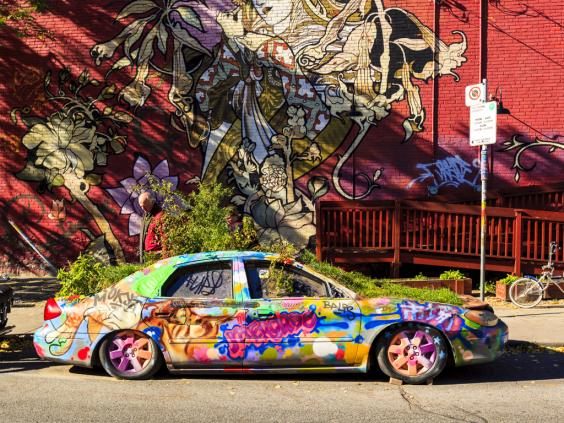
The chief landmarks include Union Station (2); the CN Tower (4), a thin needle piercing the skyline; St Lawrence Market (5); the Ontario Parliament at Queen’s Park (6); and the Royal Ontario Museum (7). But the great appeal of Toronto resides in its neighbourhoods. For example, the biggest of several Chinatowns is centred on Spadina Avenue and Dundas Street West. It merges with the faintly hippie Kensington Market area on Baldwin Street and Augusta Avenue, while Little Italy takes over to the north-west along College Street.

shutterstock_371774542.jpg
The colourful Kensington Market neighbourhood (Shutterstock)

Toronto has a Subway (a mostly underground railway), but it is weird. The main line, number 2 (coloured green), runs for many miles east-west through the north of the city, along the line of Bloor Street. It intersects at three stations with line 1 (yellow). This is a very odd line, in the shape of a narrow U, whose base is at Union Station (2). 

There are a couple of suburban offshoots to lines 1 and 2 that are unlikely to trouble the visitor. The system runs 6am-1.30am, except on Sundays when things don’t get going until 9am.

More appealing to the tourist are the streetcars (trams), of which Toronto has an impressive network. They tend to run either east-west or north-south, and stop every couple of hundred yards. 

The payment system is straightforward. You can pay C$3.25 in cash, or buy tokens (minimum three) at C$2.90 each. When you put the money in the slot on a streetcar or into the Subway gates you should pick up a transfer, which is both your proof of purchase and ticket to further travel in the same general direction within a “reasonable” time.

There are also buses, which take part in the same transfer system.

Check in

In summer the budget accommodation stock increases, because many student residences are let out to short-term visitors. I paid C$131 including breakfast for a double room at College Backpackers Inn (8), at 280 Augusta Avenue (001 416 929 4777; collegebackpackers.ca), a fairly basic but friendly and comfortable hostel.

At weekends, when business travel declines, there are plenty of deals at upmarket properties. For example, the Westin Harbour Castle (9) on the waterfront (001 416 869 1600; westinharbourcastletoronto.com) has rooms in June for Saturday and Sunday night for around C$240 per double, excluding breakfast.

The grande dame venue is the Royal York (10), facing Union Station (2) (001 416 368 2511; fairmont.com), where a double room typically costs around C$400 excluding breakfast.

Day One

Take a view

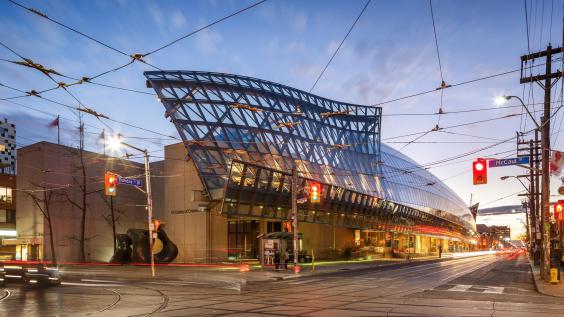
… on, and from, Frank Gehry’s first work in Canada: the Art Gallery of Ontario (11) at 317 Dundas Street West (001 416 979 6648; ago.net; open at 10.30am daily except Monday, to 5.30pm at weekends, to 5pm on Tuesday and Thursday, to 9pm on Wednesday and Friday; C$19.50). Inside Gehry’s mighty reinvention of the original building, you find two millennia of Canadian culture from early Inuit art to the Thomson Collection – donated by Ken Thomson, part of the Thomson media and travel dynasty. Rubens, Rodin, Monet, Picasso and Van Gogh are represented, along with the world’s largest public collection of works by Henry Moore.

single_column_figure32x-16.jpg
Art Gallery of Ontario

Take a hike

From St Patrick Subway station (12), walk south along University Avenue. Almost at once, on the right, the Royal Canadian Military Institute is an officers’ club with a difference: the ground floor is a replica of the neo-classical original, topped with a brand-new 42-storey apartment block. Continue south, then turn left at the McMurtry Fountains (13) to head past the Superior Court of Justice, decorated with sculptures celebrating human rights. Then walk across Nathan Phillips Square (14), which includes a Peace Garden and a pool in which a giant, three-dimensional TORONTO sign is reflected.

Across the square, the handsome, red-brick Old City Hall (15) is dwarfed by the surrounding skyscrapers. It faces south down Bay Street, and so should you. In the block between Adelaide and King Street, look for three handsome financial institutions: the Canadian Permanent (16) and the Bank of Montreal, facing the Bank of Nova Scotia. The Design Exchange (17) at 234 Bay Street (001 416 363 6121; designexchange.org; noon-4.30pm at weekends, 9am-5pm Tuesday-Friday; free) celebrates 20th-century Canadian design, including a preponderance of plastic chairs.

Turn right into Wellington Street, and at the Royal Bank Plaza sign climb to the walkway and head south into a swarm of mobiles. Descend the stairs and dip into the Royal York Hotel (10) to gaze at the extravagant Fairmont Imperial Room.

From the hotel’s main entrance, admire the heroic facade of Union Station – at present a massive building site.

Window shopping

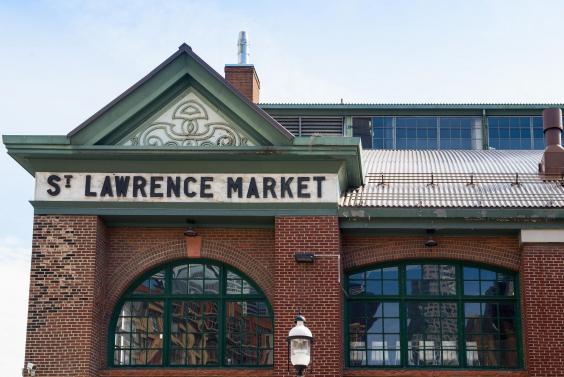
Just along Front Street East, St Lawrence Market (5) overflows with fresh produce, colour and clamour on two storeys. It also has an exhibition about its history on the lower level on the north side (5am-5pm on Saturday, 8am-6pm from Tuesday to Thursday, 8am-7pm on Fridays; stlawrencemarket.com).

shutterstock_410534476.jpg
St Lawrence Market (Shutterstock)

Lunch on the run

The Paddington Pump at St Lawrence Market has all-day breakfasts. Alternatively, Alexandro’s (18) at 5 Bay Street East (001 416 367 0633), serves the best pork and chicken gyros (kebabs) in town from a tiny shack for around C$6. Officially open 11am-4pm daily, often closing much later.

Take a ride

The car-free Toronto islands, just offshore, provide a great summer escape from the city, with bikes to rent and trails to explore (as well, at the western end, as an airport). From the Jack Layton Ferry Terminal, in the shadow of the Westin Harbour Castle (9), a C$7.50 return ticket takes you to Centre Island (19), Hanlan's Point (20) and Ward's Island (21), all of which are interconnected (bit.ly/TorontoIs).

shutterstock_259926443.jpg
Centre Island (Shutterstock)

An aperitif

When you return, take the lift to the Toulà Restaurant & Bar at the top floor of the Westin Harbour Castle (9). A glass of the local Ontario riesling is C$12, and ideal to sip as you drink in an excellent panorama of the city. 

Dining with the locals

You can barely walk 10 yards in Toronto without stumbling upon a good restaurant, and the city has immense diversity in cuisine as well as culture. Templeton's Cafe (22) – also known as “The Temp” – at 319 Augusta Ave (001 416 922 7423) offers Canadian-Asian fusion, with a shabby chic interior enlivened with carvings from Indo-China and everything from burgers to Pad Thai on offer in generous quantities.

Day Two

Sunday morning: go to church

The Church of the Holy Trinity (23), concealed in the middle of downtown, was built by Mary Lambert Swale of Settle in North Yorkshire, on the stipulation that all pews must be free and unreserved. Its interior is austere,  but the church is notable for its social activism. The Toronto Homeless Memorial on the south side remembers the many hundreds who have died on the streets since 1987. Visitors are invited to “Stop, Pause, and remember all these people.” Open 8am-4pm on Sunday (11am-3pm from Monday to Friday).

Out to brunch

Kensington Market is bustling on Sundays, and Our Spot (24) at 80 Baldwin Street (001 647 349 7767; 8am-3pm on Sundays) has the busiest tables in town for Greek-Canadian dishes: a bumper breakfast of fruit, eggs and salad for just C$4.50, or a Greek feta potato omelette (C$7.95).

A walk in the park

Queen’s Park (6) is a well-kept oasis just north of downtown, and home to the Ontario Parliament as well as some impressive Imperial statues. Just west, the original St George campus of the University of Toronto is open to the public and features the Philosophers’ Walk (25), which meanders north to Bloor Street – the main east-west axis through the northern part of the city. 

Cultural afternoon

From University Avenue, the Royal Ontario Museum (7) looks a prim, formal Victorian venue (001 416 586 8000; rom.on.ca; 10am-5.30pm daily, to 8.30pm on Fridays; C$17). But when you round the corner into Bloor Street, the building erupts in a crystalline series of cubes. The collection is themed on eight “Centres of Discovery” from ancient civilisation to contemporary Canada.

Directly opposite, the Gardiner Museum (001 416 586 8080; gardinermuseum.on.ca; 10am-5pm at weekends, to 6pm other days, C$15) is Canada’s ceramics museum, with more than 3,000 pieces and a mission to “inspire and connect people, art and ideas through clay, one of the world’s oldest art forms.”

edgewalk08.jpg
EdgeWalk at the CN Tower

Icing on the cake

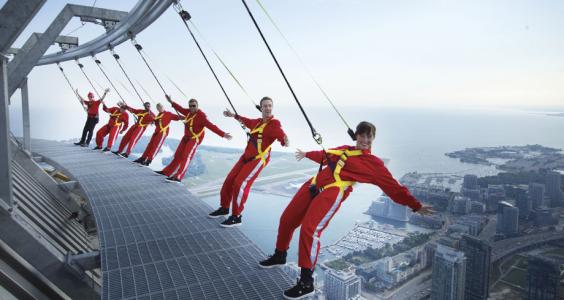
One of the world’s newest art forms is the EdgeWalk from the CN Tower (4). While it is no longer the tallest free-standing structure on the planet, it does offer “the world’s highest full-circle hands-free walk.” A quarter-mile above the city, a 5ft-wide ledge encircling the visitor centre. You are hooked on via an elaborate and safe harness system, and a guide invites you to lean back over the city. If the weather is inclement, or you prefer not to spend C$195 on the experience, then content yourself with the C$35 visit to the observation platform; the glass floor might be quite enough of a thrill (001 416 868 6937; cntower.ca; open 9am-11pm daily in summer).

At the time of writing, C$1 = £0.55 / US$0.80

Friday, 20 January 2017

48 Hours in Lima: hotels, restaurants and places to visit in the Peruvian capital

Travel essentials

Why go now?

The Peruvian capital just got a lot easier to reach thanks to direct British Airways (0344 493 0787; ba.com) flights from Gatwick, which launched today – the first since 1982.

It will surely be an enticing prospect for the legions of travellers that dream of visiting this mystical land, home to ancient civilisations, crumbling citadels and the world’s most famous trek.

But don’t head off on the Inca Trail bound for Machu Picchu too hastily – Lima is a city that surprises and delights. Furthermore, at this time of year, it hosts some of its most interesting religious and cultural events, including the Festival of the Crosses and the feasts of Saints Peter and Paul, on 29 June.

Touch down

Flights arrive at Jorge Chavez International Airport (1), located in the Callao district around 12km west of the city centre. The new BA service is scheduled to land at 8.25pm, when, in theory, the traffic choking Lima’s notoriously congested streets should be starting to ease.

Indirect flights are offered by Air Europa (0871 423 0717; aireuropa.com) from Gatwick via Madrid, Iberia (0870 609 0500; iberia.com) from Gatwick and Heathrow via Madrid, Air France/KLM (0871 231 0000; klm.com) from a range of UK airports via Paris or Amsterdam and American Airlines (0844 499 7300; americanairlines.co.uk) from Heathrow via Miami.

From the airport, make life easier for yourself by avoiding the complicated public transport system and taking a taxi. A ride to Miraflores District will cost 60 Peruvian sols (S60) and take at least one hour while the Centro Histórico district is slightly cheaper at S50 but no speedier.

I travelled to Lima with Journey Latin America (020 3393 7286; journeylatinamerica.co.uk), which offers tailored trips throughout Peru.

shutterstock_314674094.jpg
The Barranco neighbourhood

Get your bearings

On first impressions, Lima is not the prettiest of cities. Home to flyovers, skyscrapers and 8 million people, it’s blanketed under an almost perpetually grey sky between April and October – a fog known locally as garua – but there’s colour beneath the gloom, with colonial squares, busy fishing communities and lively nightlife to discover.

Founded by Francisco Pizarro in 1535, it went onto become one of the most important cities in the Spanish Empire. Today, it is South America’s only coastal capital. Its heart remains the atmospheric Centro Histórico, while the coastal and bohemian neighbourhoods of Miraflores and Barranco offer a flavour of Lima’s contemporary flair.

The main tourist information office (2) is at Pasaje Santa Rosa 145 (peru.travel; 8.30am-5.30pm daily).

Check in

Plush rooms, a heavenly spa and sea views await at the Belmond Miraflores Park (3) on Avenida Malecon de la Reserva (00 51 1 610 4000; belmond.com), one of the most luxurious hotels in the city. Doubles start at US$418 room only.

Hotel B (4) at Saenz Pena 204 (00 51 1 206 0800; hotelb.pe) may well be Lima’s most chic property, located in an early 20th-century Belle Epoque mansion in Barranco and filled with bold art. Doubles start at US$343, including breakfast.

Situated in the heart of Miraflores is Hostal El Patio (5) at Calle Ernesto Diez Canseco 341 (00 51 2 444 2107; hostalelpatio.net) with just 23 rooms and a charming terrace. Doubles from US$55, including breakfast.

Day one

Take a view

From up high in the historic heart of the city, downtown Lima is all cobbled streets, church spires, pretty squares and canary yellow colonial buildings and a pleasing contrast to its other less scenic parts. A good vantage point is the belltower in the Church and Monastery of Santo Domingo (6) at Jiron Camana 170 (00 51 1 426 5521; 9am-1pm; free).

Take a hike

From Santo Domingo church (6), wander south-east towards Plaza de Armas (also known as Plaza Mayor) (7), the grand birthplace of the city. Spanish explorer Francisco Pizarro laid the foundations of Lima here upon a site previously occupied by an indigenous tribe. Today it’s home to some of the city’s boldest architecture, most notably the baroque stone cathedral (8) (00 51 1 427 9647; S15) which stands on the square’s eastern side and is renowned for its gold-plated altar. 

02_cathedral_of_lima.jpg
The cathedral

From Plaza de Armas (7), stroll east along Jiron Junin, turning left on Jiron Lampa heading towards the narrow Rimac River and pretty Parque la Muralla (9) (9am-6pm daily). Step inside to see the bronze statue of Pizarro and the excavated ruins of the old city walls. 

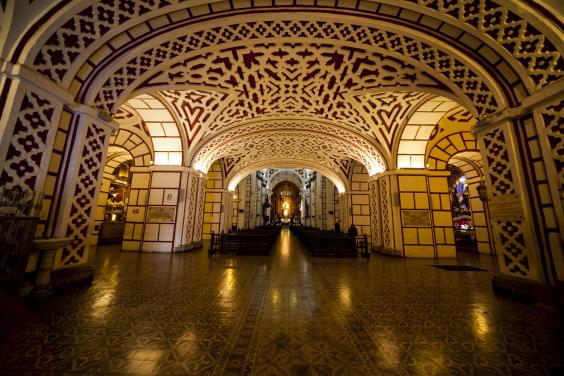
From there, it’s a stone’s throw to the mighty monastery of San Francisco (10) (00 51 1 426 7377; 9.30am-5.30pm daily; S15). Once inside, look out for the wooden staircase that dates back to 1625 and the spooky catacombs, formerly part of Lima’s first cemeteries. It’s believed more than 75,000 bodies were buried here. 

Lunch on the run

El Cordano (11) at Ancash 202 (00 51 1 427 0181; restaurantecordano.com, 8am-8pm daily) is a cosy spot with a brown and white tiled floor and old photos of past customers, all suited and booted, framed lopsidedly on the walls. It opened in 1905 and has long been popular with Peruvian presidents. Try the parihuela, a fish stew with boiled yucca and red onions (S28).

Window shopping

There’s no shortage of opportunities to pick up souvenirs and handicrafts in Lima. Choices range from Inca carvings to garments of the softest alpaca wool. Two recommended spots are the arcades around Santo Domingo church (6) or from the Mercado Indio market (12) on Avenida Petit Thouars (10am-8pm daily). Some shops are closed on Sunday. 

An aperitif

It’s widely agreed that the old-fashioned El Bolivarcito bar inside the Gran Hotel Bolivar (13) at Jiron de la Union 958 (00 51 1 427 2788; elbolivarcitoperu.com; 7am-9pm daily) is the place to go for the city’s best pisco sour (S25) It was certainly among the first to serve it. This much loved drink – a sharp tipple of pisco (the national spirit), bitters and citrus juice - was rumoured to have been invented here by a barman in the early 20th century. The place is now dubbed the Cathedral of the pisco sour. Judge for yourself.

Dine with the locals

Feast on Amazonian delicacies at Amaz Restaurant (14) at Avenida La Paz 1079 (00 51 1 221 9393; amaz.com.pe; 12.30pm-11.30pm Monday-Saturday to 4.30pm Sunday). The menu features yucca empanadas and churros pishpirones – giant Amazonian snails stewed with chorizo and chilli. The jungle-themed interior, including bar stalls carved from fallen trunks from the world’s largest rainforest, completes the experience. Mains from S60. 

Fine dining Perroquet (15), part of the Country Club Hotel at Los Eucaliptos 50 (00 51 1 611 9007; hotelcountry.com; 6.30am-11.30pm daily), is regarded as one of the best restaurants in South America. Highlights of the menu include zesty sea bass with mashed corn. Mains from S70. 

Day two

Sunday morning: go to church

By now, having explored the Centro Histórico neighbourhood, you’ll have already seen the cathedral (8) on Plaza de Armas, so head instead to arty Barranco, famed for its pretty central square with colourful flowerbeds and colonial buildings.

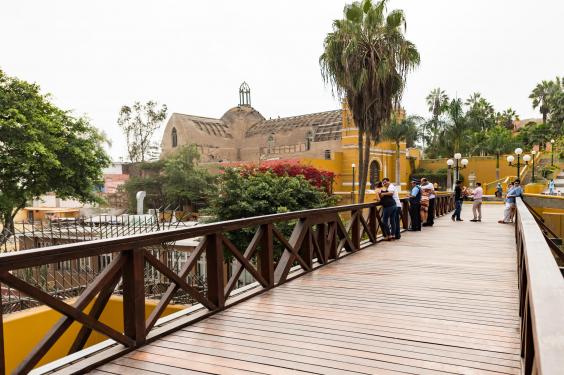
La Iglesia Ermita (16) - located beside the wooden and well-known Bridge of Sighs footbridge built over a ravine in 1876 - was originally a small chapel used by local fishermen but was rebuilt after being burnt to the ground during the Chilean invasion in 1881. It’s closed to the public but its handsome mustard-coloured façade and twin belltowers are worth admiring from outside.

Out to brunch

Across the road from Parque Municipal, Barranco’s charming central square, and housed in a train wagon – one of the first to come to Peru from Europe in 1909 – is Café Expreso Virgen de Guadalupe (17) at Avenida San Martin 16  (00 51 1 252 8907; 9am-2am daily). Secure a small marble table in the charming interior, with stained glass windows, and order an omelette with cheese and mushrooms (S16) and a cup of coca tea (S7) or, perhaps, a Machu Picchu cocktail of orange juice, grenadine and, of course, pisco (S21).

545.mate-museo-mario-testino-lima-meltingbutter.com-art-hotspot1.jpg
Mario Testino's Mate gallery

Cultural afternoon

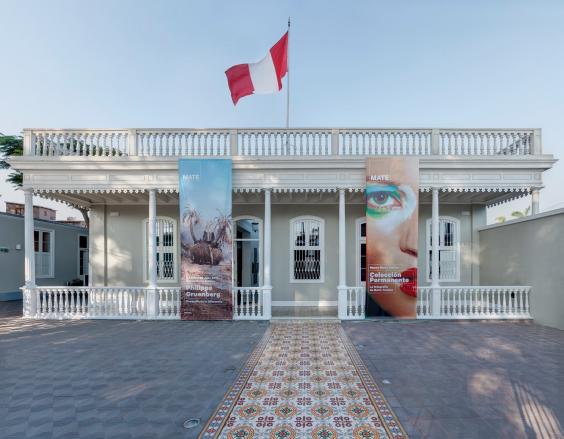
See another side to Peru’s most celebrated contemporary photographer, Mario Testino, at Mate (18) at Avenida Pedro de Osma 409 (00 51 1 251 7755; mate.pe; 10am-7pm, closed Monday; S10), the museum dedicated to his work including portraits of stars such as Kate Moss, Princess Diana and the Rolling Stones. The Alta Moda collection focuses on Peruvians local to the Andes around Cusco in festive costume.

Alternatively go back in time, to the pre-Columbian days at Museo Larco (19) at Avenida Bolivar 1515 (00 51 1 461 1312; museolarco.org; 9am-10pm daily; S30). Housed in a grand, former mansion and charting 5,000 years of history, its exhibits include erotic art and ancient archaeological finds as well as jewellery and textiles. Don’t miss the Sacrifice Ceremony room detailing the unsavoury custom of spilling blood to appease the Gods in centuries gone by.

A walk in the park

Limeños (locals from Lima) have been fond of Parque de la Reserva (20) located between Avenida Arquipa and Paseo de la Republica (00 51 1 331 0353; parquedelareserva.com.pe; Tuesday-Sunday, 3pm-10.30pm; S4) since it opened in 1929. 

These days it’s more popular for the synchronised light show that takes place in the 13 fountains that dance to Peruvian music each night at 7.15pm, 8.15pm and 9.30pm. It remains a pleasant spot to  stroll outside of these times, its eight hectares filled with large lawns and palm trees.

shutterstock_365089655.jpg
Ceviche (Shutterstock)

Icing on the cake

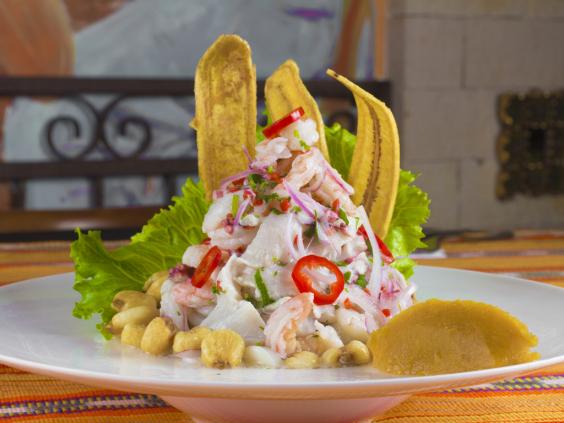
The best ceviche in town? Opinions vary but the busy stands within Mercado Central (21) on Jiron Ucayali (8am-6.30pm daily) are testament to the quality of the food. Choose from the freshest grouper, tuna and tilapia drizzled copiously with zingy limes (S15) and washed down with a papaya juice (S6).

The conversion rate at the time of publishing was 21 Peruvian sols / £1 and US$1.4/£1 

Thursday, 19 January 2017

48 Hours in Montreal: hotels, restaurants and places to visit

Travel essentials

Why go now?

The “city of 100 steeples” blends European old-world charm with North American modernity like nowhere else; a multicultural community and distinct French accent stands shoulder-to-shoulder with a burgeoning hipster foodie scene and plenty of high culture.

The summer sunshine brings with it an enviable events calendar, including what claims to be the world’s largest jazz festival (29 June-9 July; montrealjazzfest.com), and a globally renowned comedy festival (13-31 July; hahaha.com).

And now there are even more ways to access this charming Canadian city. This month, Icelandic airline Wow Air (01183218384; wowair.co.uk) launched a route from Reykjavik to to Montreal, with connections from UK airports.

Touch down

I flew with Wow Air, which takes off for Montreal’s Pierre-Elliot-Trudeau International Airport (1) from Gatwick, Bristol, and – from 13 July – Edinburgh. Returns from Gatwick start at £322.

British Airways (0344 493 0787; ba.com) and Air Canada (0871 220 1111; aircanada.com) fly from Heathrow, and Air Transat (0207 616 9187; airtransat.com) flies from Glasgow and Gatwick.

A taxi from the airport to the centre of Downtown is a fixed rate of C$40 (£21) and takes around 35 minutes. 

The 747 express bus runs 24/7 and takes between 45 and 60 minutes. Departing every 15 minutes, the bus drops off at the central bus terminal, Gare d’autocars de Montréal (2) and the Berri-UQAM metro station (3). Tickets are C$10 (£5.40) for a single and can be purchased in the airport arrivals or on board and are valid for 24 hours. 

Currently, £1 = C$1.85 and US$1 = C$1.29.

Get your bearings

Sitting in the south-eastern tip of the province of Quebec, on the banks of the St Lawrence River, Montreal was founded by the French in 1642, and remains the largest French speaking city in North America. 

Downtown is the beating heart of the metropolis, along with the historic cobbled streets of Old Montreal to the east.

From here, the majority of the sights are within walking distance, but there is a reliable metro system with just four lines, along with city buses for outlying areas. Tickets are available to buy at the stations and cost C$3.25 (£1.70) for a single journey, which is valid for 120 minutes from activation. 

Montreal’s bike hire system, Bixi (montrealbixi.com), has 460 bike stations, and is free on Sundays. Choose a 24-hour pass (C$5), or pay C$2.95 for a single trip. You can also download the free app to find the stations. 

The tourist information centre (4) is at 1255 Rue Peel (001 514 844 5400; quebecoriginal.com). Open 9am-6pm, 9 May to 9 October, until 5pm the rest of the year. 

Check in

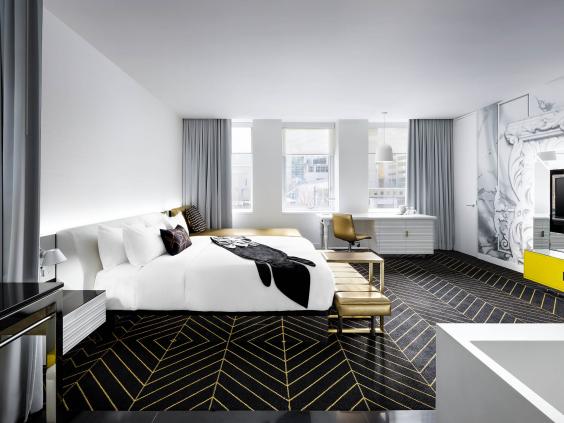
Downtown, in the old Banque du Canada building at 901 Square Victoria, is the super-sleek W hotel (5) (001 514 395 3199; wmontrealhotel.com). It has chic and spacious tech-friendly rooms with iPod docks and USB sockets, along with monsoon showers. Doubles from start from C$316, B&B. 

w-hotel-montreal.jpg
The super-modern W hotel sits within an old bank

Auberge Bonsecours (6) at 353 Rue St-Paul Est (001 514 396 2661; aubergebonsecours.com) in the Old Town has doubles from C$190 with breakfast. The renovated stable is a 10-minute walk from the Basilica; rooms have exposed brick and are set around a courtyard. 

For budget travellers, the Hotel St-Dennis (7) at 1254 Rue Satin-Dennis (001 514 849 4526; hotel-st-denis.com), in the Latin Quarter, offers comfortable and spacious doubles from C$139, room only. 

Day one

Take a view

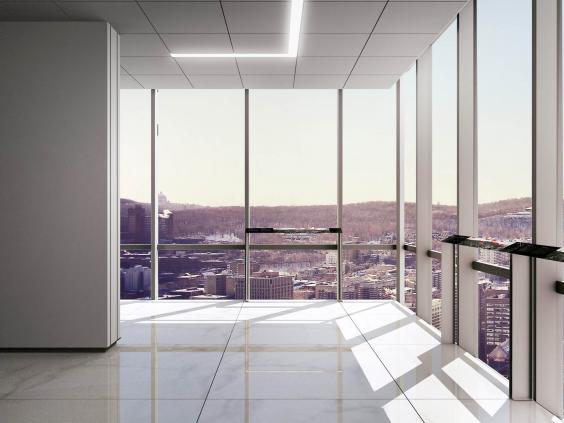
Opening in June is a new first stop for tourists. The Au Sommet Place Ville Marie observation gallery (8) on the 46th floor of the cross-shaped Place Ville Marie building (001 514 812 5279; ausommetpvm.com), offers 360-degree views over the city through floor-to-ceiling windows. Visit the floor below for an interactive exhibition on the city, which will be open until 8pm during the summer.

au-sommet-place-ville-marie-observatoire-press-image.jpg
The soon-to-open Au Sommet Place Ville Marie observatory

Window shopping

Head south-west to Rue Ste-Catherine for 11km of Montreal’s best shopping. Even more lies underground in the network of shops known as the Underground City, made up of adjoining plazas spread across 32km of Downtown. You’ll find larger outlets, including the department store La Maison Simons (9) at 977 Rue Sainte-Catherine (simons.ca) while the former Mount Royal Hotel at 1455 Rue Peel has been converted into Les Cours Mont-Royal (10) shopping centre (lcmr.ca), full of luxury boutiques. Both close at 5-6pm most days, with late-night shopping (to 9pm) Thursday-Friday.

Lunch on the run

The family-run Schwartz’s Deli (11) at 3895 Boul St-Laurent (001 514 842 4813; schwartzdeli.com) uses its own secret recipe to smoke beef brisket. Since its humble beginnings 80 years ago, the deli has become a Montreal classic – and a hearty one at that, with multiple slices of beef wedged between bread, topped with a garnish of mustard. Tradition states it’s eaten with a pickle and a can of Cherry Coke. Open 8.30am-12.30am, later on Friday and Saturday. 

A walk in the park

The city’s highest point is Mont Royal (12) (themountroyal.qc.ca), which locals call “the mountain”. At 233m, it’s really more of a hill, but atop it stands a giant cross which is illuminated at night.

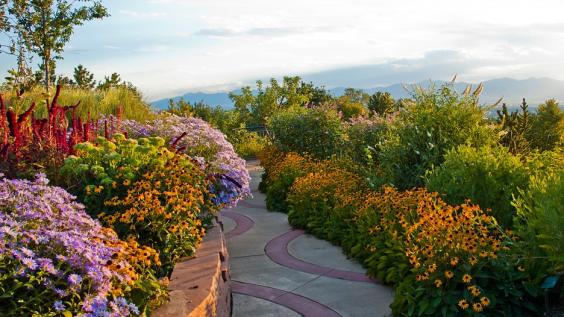
The surrounding park was designed by Frederick Law Olmsted, the brains behind New York’s Central Park. Enter from Avenue des Pins and walk up the winding paths that snake between the dense trees towards the Kondiaronk Belvedere viewing point. The semi-circular plaza is adorned with tulips in the spring and has the best views of Downtown, where the skyscrapers rise above old churches, with the Lawrence River encasing the city on the horizon.

Take a ride

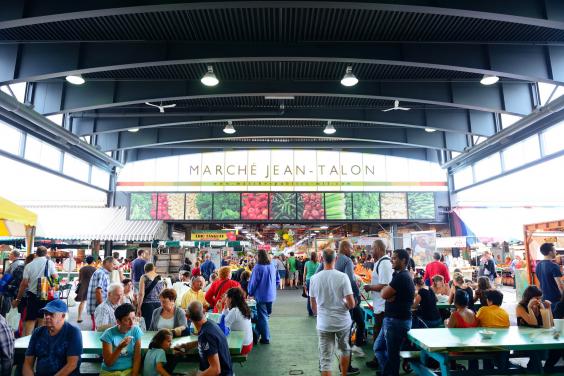
Exit close to the Université de Montréal metro station (13) - you'll need to walk a little way through the university campus to get there - and pick up a Bixi bike (14) from the junction of Avenue Darlington and Chemin de la Côte-Ste-Catherine. Pedal for about 20 minutes over to Avenue Casagrain, where you’ll find Marché Jean-Talon (15) (marchespublics-mtl.com) – one of just three farmers’ markets in the city. Alternatively, you can take the orange metro line all the way to Jean-Talon station (16)

marche-jean-talon-montreal.jpg
Marché Jean-Talon (Shutterstock)

An aperitif

Neatly arranged stalls of artisan food and produce make up the market (15); find stall 176 for a cooling bottle of Bec Cola for around C$2.75. The locally-made drink is made from the nation’s favourite, maple syrup, which replaces sugar – although it’s unlikely to be any better for you. Or pick up a bottle of ice cider - a thick, sweet tipple make from frozen apples. Take a seat outside and listen to the buskers playing jazz. Marché Jean Talon is open 7am-6pm Monday-Wednesday, until 8pm Thursday-Friday and until 5pm Sunday.

Dine with the locals

One of the newest restaurants in town is Hvor (17), at 1414 Rue Notre-Dame Ouest (001 514 937 2001; hvor.ca; Wednesday-Sunday 5pm-11pm). Expect creative and modern gastro cuisine, where the roof of the restaurant is home to a beehive and a terrace garden is the source of many of its vegetables. The weekly changing menu has vegetarians and vegans in mind.

If you’re in town on the fist Friday of the month, get the metro out to the Olympic Park (18) for First Fridays Food Truck Festival (parcolympique.qc.ca; 4pm-11pm). Now in its 5th year, the initiative shows off the best of the city’s culinary side; try the fermented raspberry and mint ice tea from the Lab truck.
Day two

Sunday morning: go to church

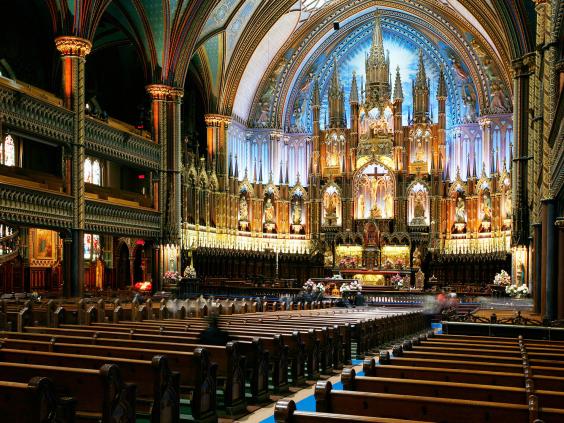
Notre-Dame Basilica (19), with its imposing twin towers is a masterpiece of gothic revival architecture, located at 110 Rue Notre-Dame in Old Montreal. The opulent interior is infused with hues of blue and yellow from the stunning stained-glass windows. Visit for Sunday Mass (8am, 9am, 11am and 5pm) or take a tour, 9am-4.30pm Monday-Friday, to 3.30 Saturday, 1pm-3.30pm Sunday; C$5. And anyone can get married in the basilica – as long as you don’t mind a two-year waiting list. 

montreal-notre-dame-basilica-rex-featuers.jpg
Notre-Dame Basilica (Rex Features)

Out to brunch

Nowhere in Montreal does brunch quite like Mile End and this hip suburb is where the locals get their fill. Fabergé (20) at 25 Avenue Fairmount Ouest (001 514 903 6649; faberge514.com; Monday-Friday 8am-3pm, Saturday and Sunday 8am-4pm) is a sure-fire hit with breakfast favourites from eggs benedict, smoked salmon and cream cheese bagels to waffles and omelettes starting from C$9 (£4.80). But be sure to book a table.

Take a hike

Mile End’s pretty streets are dotted with one-off shops. Drawn & Quarterly (21) at 211 Rue Bernard Ouest (drawnandquarterly.com) is a comic book publisher and bookshop, while just down the road at No 159 is Dragon Flowers (22) (001 514 278 8818; facebook.com/pages/Dragon-Flowers), a florist with birdcages and vibrant flowers cascade down the exterior. 

From here head north to and turn right on to the wide Boul St-Laurent. Known as the “Main”; this vibrant boulevard has long been the landing place for immigrants in the city and is still very diverse. Turn left on to Duluth Avenue, entering La Fontaine Park (23) on the corner of Avenue du Parc and Rue Rachel. 

Near the entrance are two joining lakes with a central fountain; here you can rent paddleboats, or relax on the grass with the city’s sun-worshipers. 

Leave the park via the south-east exit and walk along Rue Cherrier admiring the classic architecture, turning left on to Place St-Louis (24). Here you’ll find beautiful stone homes in a 19th-century neo-Gothic style, with wrought iron exterior staircases and brightly coloured roofs and doors, synonymous with this bohemian area, Le-Plateau-Mont-Royal. From here walk south on Rue St-Denis until you get to the Quartier des Spectacles.

Cultural afternoon

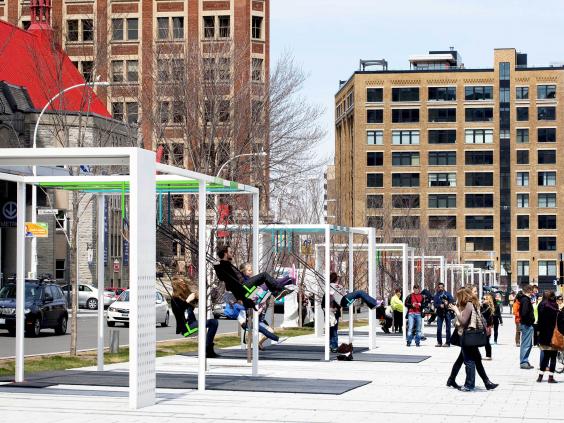
Quartier des Spectacles (25) (quartierdesspectacles.com), is the city’s booming arts and entertainment district in eastern Downtown, hemmed in by Rue Saint-Hubert, Rue City Councillors, Rue Sherbrooke, and Boulevard René-Lévesque. The areas hosts outdoor films in summer and the roads are often pedestrianised, making way for continually changing art and music installations, including the 21 balancoires – swings which each play a different musical note. 

swings-montreal-credit-tourism-montreal.jpg
Swings at Quartier des Spectacles (Tourism Montreal)

Icing on the cake

As the birthplace of the world’s most famous circus, the big top at the Old Port (26) showcases the latest dizzying acrobatic performances from Cirque de Soleil (cirquedusoleil.com; tickets from C$44). The most recent show, Luzia, is an incredible Mexican-inspired affair. 

48 Hours in Salt Lake City: hotels, restaurants and places to visit in Utah's state capital

Travel essentials

Why go now?

High in the Wasatch Range of the Rocky Mountains on the south-east periphery of the Great Salt Lake, Salt Lake City is about more than Mormons. A new direct Delta Airlines route from London has made it easier to explore Utah’s state capital, which is enjoying something of a renaissance as hipsters from nearby Colorado and Oregon flock to the city to escape rising rent rates, arriving with attendant craft breweries and artisan coffee shops.

Quality of life is excellent, with hiking trails winding out of the city and into the mountains and many of the state’s 14 ski resorts a short drive away, not least the newly created Park City, America's largest ski resort.

Read more

  • How Utah's Park City became the biggest ski area in the USA

Utah is also home to five national parks, many of which are hosting special events to celebrate the National Park Service’s centennial this year and are easily accessible from Salt Lake City: Arches, Bryce Canyon, Canyonlands (setting for Danny Boyle’s grisly biographical drama, 127 Hours), Capitol Reef and Zion.

America As You Like It (020 8742 8299; americaasyoulikeit.com) offers six-night fly-drives to Utah  from £1,239pp, including non-stop return flights on Delta, six days' fully inclusive economy car hire, two nights' room only at the Hotel Monaco in Salt Lake City and four nights' B&B at the Gonzo Inn in Moab. 

For more information, see visitutah.com/uk.

Touch down

Delta (0871 221 1222; delta.com) launched the first direct flights between the UK and Salt Lake City earlier this month. The airline departs daily from Heathrow for Salt Lake City International Airport (1). Alternatively, British Airways (0344 493 0787; ba.com) offers connecting flights from Heathrow – via Dallas and Chicago, for example – to Salt Lake with its partner American Airlines. KLM (0871 231 0000; klm.com) flies from a range of UK airports via Amsterdam, with connections on partner airline Delta. 
The airport is a 10-minute drive from downtown and a number of international agencies offer car rental at the airport. A cab into town costs $25, or you can catch the three-line light rail, Trax (001 801 743 3882; rideuta.com), whose green line runs from Terminal 1 to downtown every 15 minutes between 5.30am and 11.30pm on weekdays, with a more limited service at weekends. A single is $2.50.

Get your bearings

Like many American cities, Salt Lake is arranged on a grid and its prosaic road naming system makes it easy to navigate. Every street has a coordinate based on its location in relation to the Mormon HQ at Temple Square (2); so the street 200 South (or 2 South) is two roads south of Temple Square and so on.

The easiest way to get around is to hire a car, but the downtown area around Temple Square is easily walkable. Trax runs through Salt Lake on three lines: as well as the green airport line, red runs from the University of Utah through downtown and blue begins downtown and runs south. __travel on public transport is free for nine downtown stops.

The city is very cycle friendly, with demarcated paths and wide roads – supposedly so because Brigham Young, who led Mormon settlers to Utah in the 19th century, wanted streets wide enough to turn his wagon around. The cycle hire scheme GREENbike (greenbikeslc.org) offers a 24-hour pass for $7.

Check in

A major commercial hub in the Mountain West, Salt Lake City has its fair share of chain hotels aimed at business travellers. Here are some of the more unique options.

Hotel Monaco (3) sits in the heart of downtown, in a building that was once a bank, at 15 200 South (001 801 595 0000; monaco-saltlakecity.com). The boutique hotel offers fun perks such as a free, hosted wine tasting every evening, take-away pressed green juices at breakfast and a yoga mat in every room. Doubles start from $157 a night, room only.

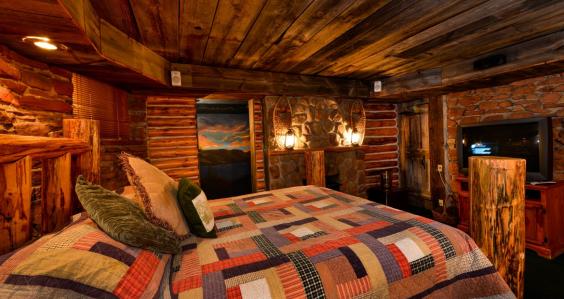
A little further out, The Anniversary Inn (4), a converted Victorian mansion at 678 East South Temple (001 801 363 4950; anniversaryinn.com) has 13 themed suites, including Mysteries of Egypt and Jungle Safari, starting at $149 for a weeknight, room only.

anniversary_inn.jpg
The Mountain Hideaway suite at The Anniversary Inn

The Avenues Hostel (5) at 107 F Street offers basic, cheap accommodation, but is well located for downtown and hikes into the mountains (001 801 539 8888; saltlakehostel.com; dorm beds from $23, room only).

Day one

Take a hike

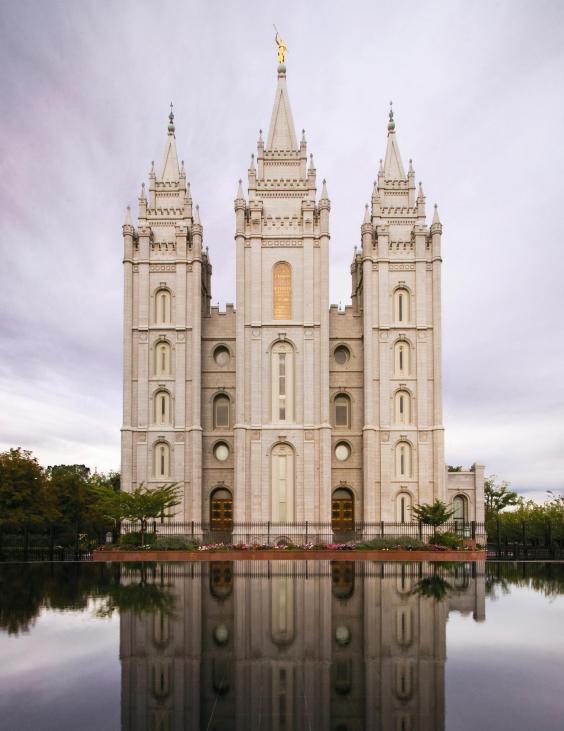
The Church of the Latter Day Saints, whose members are Mormons, began in New York in the 1830s. Its early followers, whose polygamous relationships made them taboo among other settlers, were driven west until they arrived in Salt Lake in 1847, where they settled by a creek now marked by the Eagle Gate (6) on the corner of State Street and South Temple. Start here and walk west along South Temple, past Beehive House (7) and Lion House (8), mansions where Brigham Young housed his many wives and children, to Temple Square (2). 

The Mormon equivalent of Vatican City encompasses the Church’s museum (9) and library (10), administrative buildings, Tabernacle or concert hall (11) and fabulous floral displays as well as the iconic, castle-like Temple (12) itself. The Square is open to explore daily from 9am-9pm and most Church buildings charge no admission and are open to visitors, except the Temple, which is open to Church members only.
temple_final_credit_matt_morgan.jpg
The Temple (Matt Morgan)

Lunch on the run

Head through the sumptuous interior of the Joseph Smith Memorial building (13) on 15 East South Temple to The Garden Restaurant (14) on the 10th floor (001 801 539 3170; templesquare.com; 11am-9pm Mon-Thurs, until 10pm Fri-Saturday, closed Sunday). The glass room, which has a retractable roof, commands impressive views of the city, and the fried dill pickles, at $8, are incredibly moreish. As this is a Church-run restaurant, there is no alcohol or coffee for sale.

Window shopping

With an artificial, carp-filled creek winding between shops and fountains choreographed by the team behind Las Vegas’ Bellagio displays, the City Creek Shopping Center (15) on 50 South Main Street is no ordinary mall (001 801 521 2012; shopcitycreekcenter.com; 10am-9pm, closed on Sundays). As well as a Macy’s and a Nordstrom, the center has a luxury zone that includes branches of Tiffany’s and Swarovski.

An aperitif

Dive into the craft cocktail trend at the The Copper Common (16) on 111 East Broadway (001 801 355 0543; coppercommon.com; 5pm-1am), which offers some extraordinarily potent whisky-based drinks, including the $12 Scotch Your Nose, a blend of scotch, cherry liqueur, cynar, fernet branca and with an islay rinse. Bring your passport: all bars in Salt Lake City ask for ID; a driver’s licence is not sufficient.

Keys on Main (17) (001 801 363 3638; keysonmain.com; 7pm-1am), at 242 Main Street, is a duelling piano bar that also does karaoke and cocktails. Closed Sunday and Monday.

Dine with the locals

Dinner at Current Fish and Oyster (18) (001 801 326 3474; currentfishandoyster.com) is only a short stagger away, at 279 300 South. All exposed brickwork and metal, it specialises in generous portions of East and West Coast oysters for around $10. There’s wagyu sirloin for the meat eaters and plenty of salads for veggies. Dinner is 5pm-10pm except Sundays, when it’s only open for brunch.

current_fish_and_oyster.jpg
Current Fish and Oyster

Day Two

Sunday morning: go to church

The Latter Day Saints’ services last about three hours; so if you’re pushed for time head to the Catholic Cathedral of the Madeleine (19). The Romanesque building on 331 East South Temple (001 801 328 8941; utcotm.org; 7am-9pm), was completed in 1909 and features some spectacular stained glass windows. Sunday Masses take place between 8.30am and 11am, and again at 3pm and 6pm. 

Out to brunch

As well as winding up locals by naming one if its beers “Polygamy Stout”, Squatters’ brewpub (20) on 147 West Broadway (001 801 363 2739; squatters.com) serves up huge portions of classic American fare, including buffalo wings ($10.99) and a “Roadhouse skillet”, or grill. Brunch – which also includes pancakes with sausages or bacon, breakfast burritos, huevos rancheros and plenty more – is served until 3pm.

Cultural afternoon

Utah’s sweeping plains and red rock deserts were once home to hundreds of species of dinosaurs. Live out your Jurassic Park fantasies at the Natural History Museum (21) (001 801 581 4303; nhmu.utah.edu; 10am-5pm daily except Wednesdays, when it’s open until 9pm; $13), set in the foothills at 301 Wakara Way. Its 30,000 paleontology specimens include Allosaurus and Utahraptors as well as a new species of Tyrannosaur. The museum’s building is beautiful; built with guidance from local Native Americans, its curving terraces blend seamlessly into the surrounding rock.

red-butte-garden-and-arboreteum-29836.jpg
Red Butte Garden

Icing on the cake

The Bonneville Shoreline Trail, which stretches 100 miles along the western edge of the Wasatch Mountains, skirts behind the Natural History Museum (bonnevilleshorelinetrail.org). Join it at the Living Room trailhead (22) on Colorow Drive and hike up about two miles into the foothills to enjoy sunset atop the giant flat stone slabs that mark the “Living Room” (23) – pack a torch for the journey back. The walk is moderately difficult, so if hiking isn’t your thing take a stroll around the nearby Red Butte Garden (24) at 300 Wakara Way (001 801 585 0556; redbuttegarden.org; 9am-9pm May-August and for shorter hours off-season; $12).

Discover the other side of Florida - Amelia Island and St Augustine

In Florida, the far north means Amelia Island, nudging into the Atlantic just below the Georgia state line. The isle measures 13 miles by 2 miles, making it the same size and shape as Manhattan, but rather more relaxed.

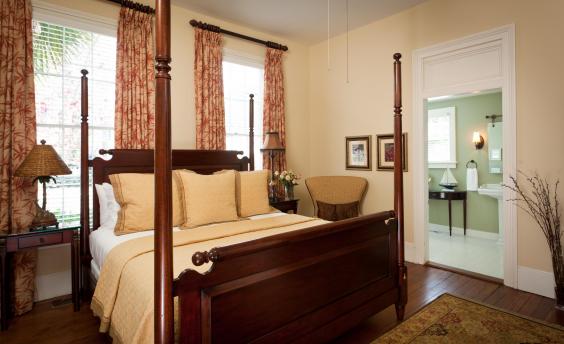
The island’s only city, 350 miles up the Atlantic coast from Miami, is Fernandina Beach. It does a good line of B&Bs in historic properties, such as the Addison. The proprietors, Bob and Shannon, are Canadians who came here on vacation in 2007 and were hooked. They sold up and set up at 614 Ash Street. The furnishings in the 14 guest rooms are Old Florida style with four-poster beds and hardwood floors.

addison2011-rooms-1-01-1208744005-o-sgrlhpan7dla8ut-c8kwtdu18q0ablzbh.jpg
Addison B&B, Fernandina Beach

Millionaires, smugglers and pirates

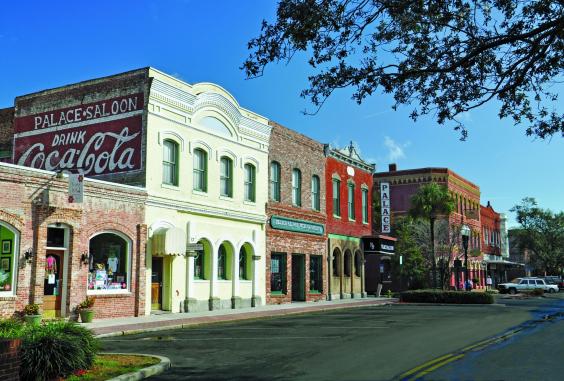
In the city centre, the Palace Saloon is Florida's oldest. Millionaires, smugglers and pirates have all raised a glass here. The Palace has been serving drinks almost continuously since 1903; during Prohibition in the 1920s, when alcohol was banned, it sold ice cream, gasoline and cigars. The proprietor is Johnny Miller, who’s also the city’s mayor.

dsc-0191-snwkonrau8bm-gbnxfcyk1r18q0ablzbh.jpg
Palace Saloon, Fernaninda Beach

At the far north of the island, the cannons on the rampart of Fort Clinch are testament to the number of flags that have flown over Amelia Island: France, Spain, England, the Patriots, Florida’s Green Cross, Mexico, the Confederates and the Stars and Stripes. The fort is surrounded by a state park and you can rent a bike from Fort Clinch Visitor Centre and cycle through the Maritime Forest Canopy.

If you want to stay in the Sunshine State — and frankly who wouldn’t? — the only way is south, to the place where Florida began.

Due South

Heading south, of course, means taking to the road. Seven days’ hire of a compact car from Jacksonville International Airport costs from £170, or you can upgrade to a Chevrolet Camaro Convertible from £287 with Hertz. Then it’s on to Highway A1A, which is one of my favourite Florida roads, tracing many of the best stretches of the Atlantic shore, and officially known as a “Scenic and Historic Coastal Byway”. 

There’s a bonus on the journey south — a ferry ride across the St John's River ($6 cars). The five-minute ferry ride saves a long drive through the city of Jacksonville, and provides an extra dimension to a road trip.

The waterway is Florida’s longest: more than 300 miles long. Yet between the headwaters and its mouth it drops only 30 feet.

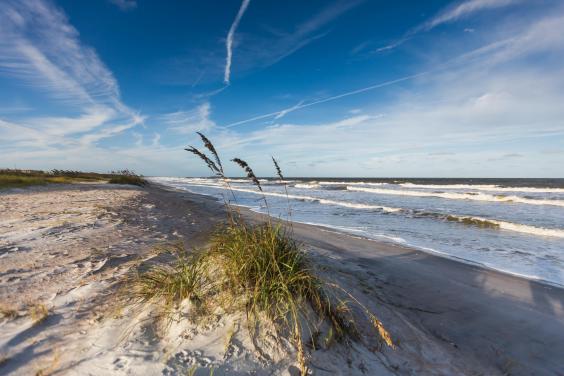
South of the river, the road stays close to the ocean, with access to some fine beaches.

ameliastok-beach-003-sw-sy9wk0gd9jtz5bhuqpzq.jpg

Most historians agree that the explorer Juan Ponce de León landed on the coast of Florida on 3 April 1513 and claimed the land he called La Florida for the Spanish King. But they argue about where exactly he came ashore. Some folk are so convinced it was close to Ponta Vedra that they’ve put up a statue to the first European visitor at the GTM Reserve North Beach Parking area

Where it all began

There’s no dispute about where the first colonial city in the present-day US was established: St Augustine. Castillo San Marcos dominates, a response to repeated raids by British privateers such as Sir Francis Drake. 

Pirates are a recurring theme in St Augustine. I stayed at the Pirate Haus, which claims to be the only budget accommodation in the downtown St Augustine Historic District.

The artery of that district is St George Street, which is full of history. Florida has had wave after wave of immigration — including, in the late 18th century, a large contingent of Minorcans. Many of them settled in St Augustine, and their traditions continue at the Spanish Bakery at number 42½ St George Street. It serves empanadas, gazpacho and great coffee.

The final attraction in St Augustine, the Fountain of Youth Archaeological Park, is located on the site where the first Spanish settlement was established in 1565.  It’s a curious mix of theme park and heritage. The fountain in question rises from the Floridan aquifer, and helped support a robust population of Timucua Indians — and, later, Spanish settlers.

This stretch of the north-east Florida coast has seen plenty of conflict, but now it’s a scene of tranquility — and nature.

Discover more at Visit Florida